
 EN
EN
Why Drone Battery Design Requires More Than Basic Assembly
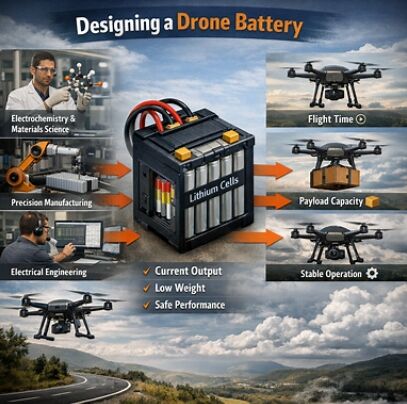
Creating a battery for a drone is not as simple as wiring together a few lithium cells. The power source must deliver strong bursts of current, remain lightweight, and operate safely under rapidly changing loads. Because a drone’s battery directly affects flight duration, payload capacity, and stability, its design requires a blend of scientific understanding and engineering precision. Every decision—from chemistry to structure—shapes how the battery performs once airborne.
Performance Demands That Shape Battery Chemistry Choices
Before any manufacturing begins, engineers must understand what the battery needs to accomplish. Drone motors consume large amounts of current, so the battery must release energy quickly without overheating or causing voltage drops. At the same time, weight must be minimized to preserve flight efficiency. These requirements explain why lithiumpolymer cells dominate the drone industry: their pouchstyle construction keeps mass low, and their chemistry supports high discharge rates. Although cylindrical lithiumion or LiFePO₄ cells appear in certain applications, their limitations in weight, voltage, or discharge capability make them less suitable for most aerial platforms.
Defining Voltage, Capacity, and Discharge Requirements
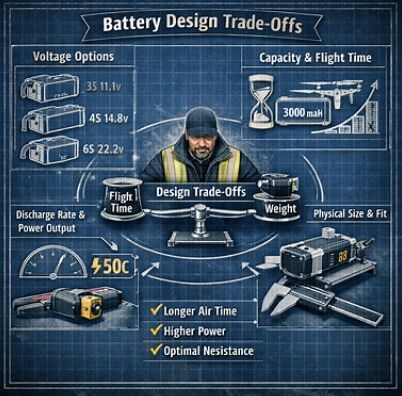
The design process begins with determining the electrical characteristics of the battery. Voltage is set by the number of cells connected in series, with common configurations such as 3S, 4S, or 6S. Capacity, measured in milliamphours, influences how long the drone can remain in the air, while the discharge rating indicates how quickly the stored energy can be delivered to the motors. These specifications must align with the drone’s physical constraints, since the battery must fit securely within the frame and avoid adding unnecessary mass. Engineers often balance endurance, weight, and power output to achieve the desired performance.
Industrial Processes Behind LithiumPolymer Cell Production
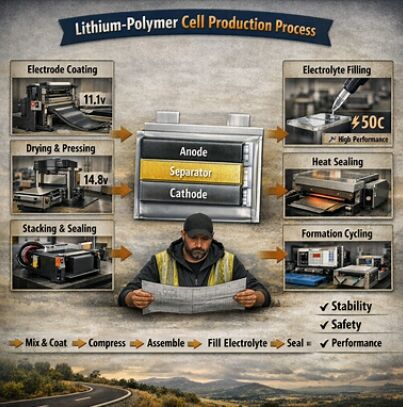
Producing lithiumpolymer cells involves a sequence of tightly controlled steps. Active materials for the anode and cathode are blended with binders and conductive additives, then coated onto thin metal foils. After drying and compression, the coated layers are stacked with a separator film that prevents internal short circuits. This layered structure is placed inside a flexible pouch, filled with electrolyte under vacuum, and sealed. The cells then undergo formation cycling, a process in which they are charged and discharged under monitored conditions. This step stabilizes the internal chemistry and forms the protective layer that ensures longterm safety and performance.
Assembling Cells Into a Functional Drone Battery Pack
Once individual cells are prepared, they are combined into a complete battery pack. Cells must be matched so that their capacity and internal resistance are nearly identical; otherwise, the pack may become unbalanced during use. Depending on the required voltage and capacity, cells are connected in series, parallel, or a combination of both. Interconnections are typically made using ultrasonic or spot welding to ensure low resistance and strong mechanical bonds. At this stage, a battery management system may be added to monitor voltage, temperature, and current, providing protection against overcharging, overdischarging, and short circuits. Professional drone batteries often include advanced BMS features, while racing drones may use simpler balance leads to reduce weight.
Mechanical Protection and Connector Integration
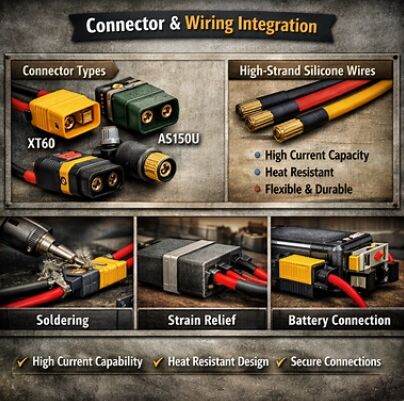
Beyond electrical assembly, the battery must be physically protected. The pack is wrapped with insulating materials such as Kapton or fiberglass tape, and foam padding may be added to absorb vibration and impact. Heatshrink tubing or a molded housing forms the outer shell. Connectors such as XT60, XT90, or AS150U are attached using highstrand silicone wires capable of handling the expected current. Proper strain relief and insulation are essential to prevent failures during flight, especially in highvibration environments.
Testing, Verification, and Safety Certification
Before a battery is approved for use, it undergoes a series of qualitycontrol evaluations. These include verifying actual capacity, checking internal resistance, assessing discharge behavior, and ensuring that the cells remain balanced. Environmental tests may expose the pack to temperature extremes, humidity, vibration, or drop impacts to confirm that it can withstand realworld conditions. Many regions also require safety certifications for transportation and consumer use, such as UN38.3 or CE compliance, ensuring that the battery meets international safety standards.
Labeling, Smart Features, and Future Technology Trends
After testing, the battery is labeled with its specifications, safety warnings, and manufacturing information. Some advanced packs include smart features such as communication ports or healthmonitoring indicators. As drone technology evolves, battery development continues to advance as well. Research into solidstate electrolytes, siliconbased anodes, and lithiumsulfur chemistry promises higher energy density and improved safety. Hybrid systems that combine batteries with fuel cells or supercapacitors may also become more common as the industry seeks longer flight times and greater efficiency.
Conclusion: The Interplay of Chemistry, Engineering, and Safety
In summary, building a drone battery is a complex process that integrates materials science, electrical engineering, and precision manufacturing. From selecting the right chemistry to assembling cells, integrating protection circuits, and performing rigorous testing, each step ensures that the final product delivers reliable power while maintaining safety. Understanding how these batteries are created offers insight into their performance and highlights the innovations that may shape the future of drone power systems.
Summary
Voltage affects motor power; higher cell count boosts thrust but adds weight. Capacity determines flight time but increases size. Discharge rate impacts performance—higher C-ratings deliver more current. Physical dimensions must match drone frame. Designers balance endurance, weight, output, and fit to optimize battery performance for specific drone applications.
Table of Contents
- Why Drone Battery Design Requires More Than Basic Assembly
- Performance Demands That Shape Battery Chemistry Choices
- Defining Voltage, Capacity, and Discharge Requirements
- Industrial Processes Behind LithiumPolymer Cell Production
- Assembling Cells Into a Functional Drone Battery Pack
- Mechanical Protection and Connector Integration
- Testing, Verification, and Safety Certification
- Labeling, Smart Features, and Future Technology Trends
- Conclusion: The Interplay of Chemistry, Engineering, and Safety
- Summary