
 EN
EN
Here is the English translation of your comprehensive guide on FPV drone battery life, formatted exactly as requested.
How Long Do FPV Drone Batteries Last? — The Complete Guide to Flight Time and Lifespan
For FPV (First-Person View) drone pilots, batteries are essentially the "lifeline" of every flight. Whether you are a racing pilot chasing speed or a Cinewhoop flyer enjoying smooth aerial filming, understanding actual battery performance and proper maintenance methods will help improve flight safety and extend the lifespan of your batteries and related components.
This guide covers the core knowledge of FPV drone batteries and helps you estimate actual flight times more accurately.
1. What Is an FPV Drone Battery?
FPV drones primarily use Li-Po (Lithium Polymer) batteries. For FPV applications, Li-Po batteries offer three main advantages:
High Energy Density: Capable of storing a large amount of power in a relatively light and compact size.
Lightweight Design: Crucial for multirotor drones where every gram counts.
High Discharge Capability (C Rating): Can instantly output large currents to meet the demands of rapid acceleration, flips, rolls, and sharp climbs.
Key Battery Specifications
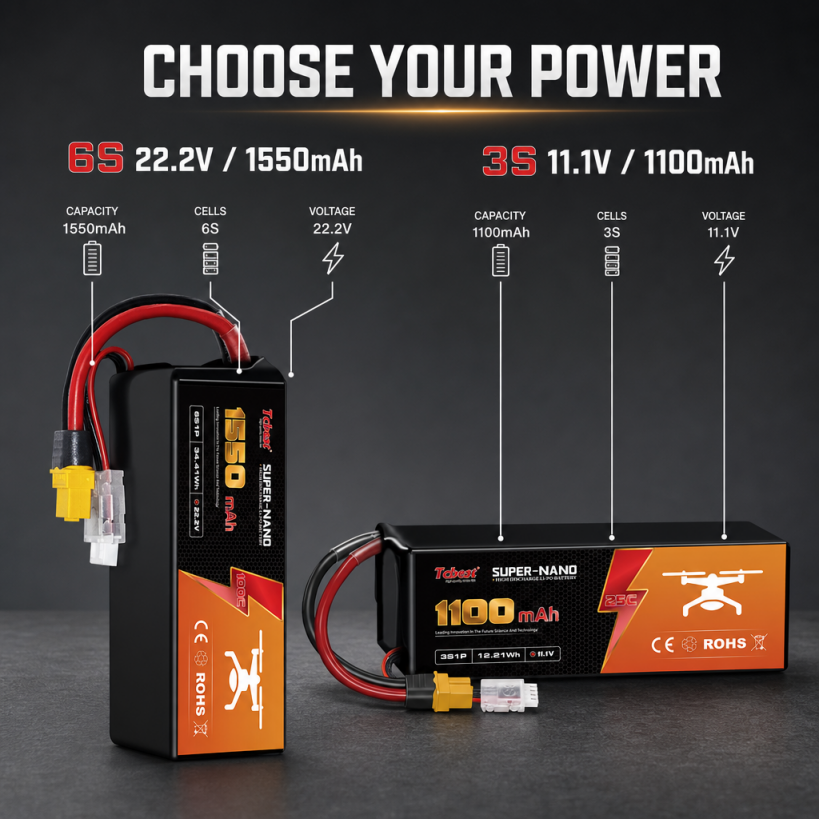
Voltage: Affects motor power output and drone thrust performance.
Capacity (mAh): Represents how much electrical charge the battery can store.
Discharge Rate (C Rating): Indicates the maximum current the battery can safely discharge.
Cell Configuration: Common setups like 3S, 4S, and 6S represent the number of cells connected in series inside the battery.
2. How Long Do FPV Drones Actually Fly?
An FPV drone's flight time is affected by various factors, including frame size, battery specifications, flying style, and payload weight. Below are typical flight times for common FPV setups.
2.1 Typical FPV Flight Time Reference
Racing / Freestyle FPV (1300–1500mAh, 4S / 6S): Around 3–5 minutes. Frequent high-throttle usage drains the battery rapidly.
Tiny Whoop / Micro FPV (300–600mAh): Around 3–5 minutes. Due to the small battery capacity, flight time is usually limited.
Cinewhoop FPV: Around 5–8 minutes. Smoother and gentler flying styles generally yield longer flight times.
Long-Range FPV: Utilizing high-efficiency motors and Lithium-ion (Li-ion) batteries can achieve flight times of 15–20 minutes or more.
2.2 Formula to Calculate Theoretical Flight Time
You can estimate the theoretical flight time using the following formula:
Flight Time (minutes) = Battery Capacity (Ah) ÷ Average Current Draw (A) × 60
Example:
For a 1500mAh (1.5Ah) battery, if the drone's average flight current is 30A:
1.5 ÷ 30 × 60 = 3 minutes
Please note that actual flight times are usually shorter than theoretical calculations.
It is highly recommended to reserve at least 20% of safe battery capacity for return-to-home (RTH) and landing. Furthermore, voltage sag, air resistance, wind, and extra payloads will further shorten the actual flight duration.
3. Major Factors Affecting FPV Battery Flight Time
1. Drone Weight
Every gram of added weight requires the motors to output more thrust to maintain flight. Therefore, heavier frames generally drain batteries faster.
2. Flying Style
Aggressive throttle punches, rapid climbs, and intense acrobatic maneuvers consume significantly more power than stable cruising.
3. Payloads and Accessories
Mounting action cameras, heavy protective guards, or other additional modules can noticeably reduce flight time.
4. Battery Choice
Higher mAh or mWh ratings usually mean more available energy, but larger capacity often translates to heavier weight. Thus, a larger capacity is not always better; you must find the right balance between battery capacity and weight.
5. Environmental Conditions
Headwinds force the motors to work harder to maintain speed, while cold temperatures decrease the discharge performance of Li-Po batteries, thereby reducing actual flight times.
4. How to Extend Li-Po Battery Lifespan?
4.1 Avoid Over-discharging (Deep Discharging)
Deep discharging can cause irreversible damage to Li-Po cells.
Recommended Landing Voltage: Prepare to land when the single-cell voltage drops to around 3.5V.
Critical Limit: Try to never let the single-cell voltage drop below 3.2V.
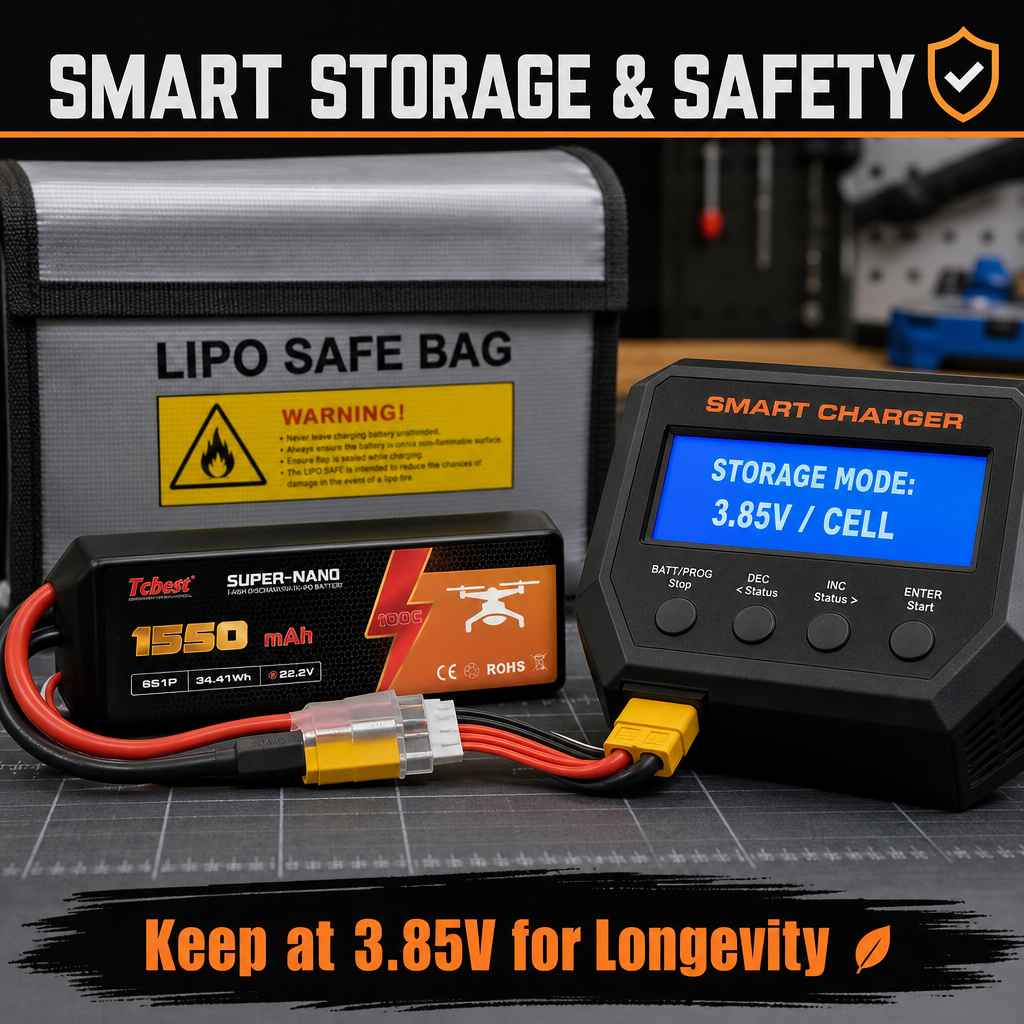
4.2 Use the Correct Storage Voltage
If fully charged batteries are not going to be used within 24 hours, it is highly recommended to discharge/charge them to their storage voltage:
3.8V–3.85V per cell.
Storing Li-Po batteries fully charged for long periods increases the risk of cell swelling (puffing) and high internal resistance.
4.3 Charge Correctly
Always use a reliable, high-quality balance charger designed for Li-Po batteries.
The recommended charging rate is 1C.
For example, a 1500mAh battery should be charged at approximately 1.5A.
Never leave charging Li-Po batteries unattended.
Keep batteries away from flammable materials during charging.
5. Safe Storage and Daily Maintenance
Storage Temperature: Store batteries in a dry, well-ventilated environment at around 10°C–25°C, away from direct sunlight.
Safety Containers: It is strongly advised to store Li-Po batteries in fireproof Li-Po safety bags or metal ammo/safety boxes.
Temperature Management: Cold temperatures degrade battery performance. In cold weather, warm up your batteries before flying. After a flight, let the batteries cool down completely before recharging them.
Regular Inspections: Periodically check your batteries for physical signs of swelling (puffing), leaks, external damage, or severe cell voltage imbalance. If you find severe damage or swelling, stop using the battery immediately and dispose of it safely.
6. When to Replace FPV Batteries?
Even with proper care, Li-Po batteries are consumables.
Cycle Life: Under normal use and proper maintenance, high-quality Li-Po batteries typically last about 300–500 charge cycles.
Signs It's Time to Replace: High internal resistance, significantly reduced flight times, weak throttle response (sagging), or persistent swelling.
If you experience these symptoms, it is time to replace them with new battery packs.
7. FAQ (Frequently Asked Questions)
How long does a 1500mAh FPV battery last?
It depends on your drone setup and flying style, but it generally lasts about **3–8 minutes**.
Is a higher-capacity battery always better?
Not necessarily.
Higher capacity means more weight. If the battery is too heavy, the motors have to work harder, which degrades flight handling and may not yield any meaningful increase in flight time.
At what voltage should I land my FPV drone?
When the OSD shows the average single-cell voltage dropping to around **3.5V**, you should prepare to land.
Is it safe to charge Li-Po batteries overnight?
No, it is not recommended.
You should always monitor Li-Po batteries during charging to minimize the safety risks associated with potential charging anomalies.
What is Voltage Sag?
Voltage sag is the temporary drop in voltage that occurs when a battery is subjected to a heavy current draw.
This is especially noticeable when executing sudden punch-outs (full-throttle maneuvers) on FPV drones. Batteries with higher discharge rates (C ratings) are better at handling high current demands and will experience less voltage sag.
8. Conclusion
An FPV drone's battery performance is the collective result of battery specs, drone configuration, flying habits, and daily maintenance practices.
By selecting the right battery, avoiding deep discharges, utilizing proper charging techniques, and storing them at the correct voltage and temperature, you can maximize your flight time and significantly extend the overall lifespan of your FPV batteries.
Tip: Flight safety should always be your top priority. Never push your batteries to their absolute limit just to squeeze out a few more seconds of flight. Always leave a safe margin of battery capacity to return and land.
Tcbest has been deeply engaged in the FPV battery industry for many years, specializing in the research, development, manufacturing, and sales of professional lithium batteries. The company adheres to quality as its core principle, strictly controlling every step of the process—from cell selection to final product delivery. We are committed to providing FPV pilots worldwide with high-burst, long-endurance, and safer flight batteries. Our mission is: to ensure every takeoff is powered with vigorous and reliable energy.
This guide covers FPV drone battery flight time and lifespan. It explains key specs, typical flight durations for different setups, calculation formulas, and factors like weight and flying style. It also provides essential maintenance tips—avoid over-discharging, store at 3.8V–3.85V per cell, charge at 1C, and replace batteries showing swelling or reduced performance.