
 EN
EN
Drone pilots often run into the same frustrating problem: the flight time shown on the product page and the flight time they actually get can be very different. A drone may be advertised with a 30-minute flight time, yet in everyday use, the low-battery warning may appear after only 20 to 25 minutes.
That does not necessarily mean there is something wrong with the drone or the battery. Manufacturer flight-time figures are usually measured under highly controlled conditions. Real-world flying is much more demanding. Wind, temperature, payload weight, flight speed, repeated acceleration and braking, hovering, battery age, and even the way the pilot moves the sticks can all affect how quickly the battery drains.
Among all these factors, three are especially common: aggressive flying, cold weather, and battery aging. Understanding how each one affects your drone can help you stay in the air longer, reduce unexpected low-battery situations, and get more useful life from your batteries.
How Much Does Flying Style Affect Drone Battery Life?
Flying style is one of the biggest factors a pilot can control. Two people can fly the same drone with the same battery and still get noticeably different flight times simply because they fly differently.
A drone that cruises smoothly and steadily will usually consume less power than one that is constantly accelerating, braking, climbing hard, making sharp turns, and changing direction.
Every time the motors need to produce more thrust, current draw increases. If this happens throughout most of the flight, the battery will drain much faster.
Rapid acceleration is especially demanding because the motors need to increase speed almost instantly. High-speed flight also consumes more energy because the drone has to overcome greater aerodynamic drag. Fast climbs, sudden stops, aggressive turns, and repeated direction changes all increase the load on the propulsion system.
For aerial photography, mapping, inspections, or casual flying, smooth stick inputs can make a noticeable difference. Gentle acceleration and controlled movements keep power demand more stable instead of repeatedly forcing the battery to deliver high current.
Flying in Sport Mode
Sport mode is designed for speed and responsiveness, not efficiency.
In this mode, the drone usually allows higher forward speed, faster acceleration, sharper turns, and stronger motor output. All of these increase current consumption.
A battery that gives you around 25 minutes of relaxed cruising may provide noticeably less flight time if most of the flight is spent at high speed. The exact difference depends on the drone, battery capacity, wind conditions, and how aggressively you fly.
When maximum speed is not necessary, Normal mode or Cine mode is usually a better choice.
Cine mode can be especially useful for aerial photography because slower, smoother movements not only reduce power consumption but also produce more stable-looking footage.
Sport mode is best saved for situations where the extra speed is actually needed rather than used throughout every flight.
Flying Into a Headwind
Wind can reduce flight time more than many pilots expect.
When a drone flies into a headwind, the motors have to work harder to maintain the desired ground speed and position. Even hovering becomes more demanding because the flight controller must constantly make small corrections to keep the aircraft from drifting.
The return trip can become particularly risky.
If you fly a long distance with a tailwind and then have to return against the wind, the drone may use much more power on the way back than it did on the way out.
A safer approach is to check wind direction before takeoff and plan the route accordingly. When possible, fly into the wind during the outbound leg and return with the wind behind you. This gives you more battery reserve for the journey home.
It is also a good idea not to rely too heavily on the estimated remaining flight time shown in the app. Wind conditions can change quickly, and a strong headwind can make the return flight far more demanding than expected.
Hovering for Too Long
Hovering looks effortless, but the drone is still working continuously.
To remain stationary, the motors must produce enough thrust to support the full weight of the aircraft. At the same time, the flight controller keeps making tiny adjustments to compensate for wind, drift, and attitude changes.
That means hovering still consumes a significant amount of energy.
During aerial photography, unnecessary hovering often happens while the pilot is deciding on the next shot, waiting for a subject to move into position, or reviewing footage.
A few minutes of hovering during a mission can take away a meaningful amount of usable flight time.
Planning your shots before takeoff helps. If you already know the route, shooting positions, and sequence of movements, you can spend less time waiting in the air and more time actually completing the mission.
Carrying Too Much Weight
Extra weight directly increases power consumption.
When you attach additional equipment such as lights, guards, landing-gear extensions, sensors, cameras, or other payloads, the motors must generate more lift. That increases current draw and shortens flight time.
Even relatively small accessories can make a noticeable difference on compact drones because their batteries and propulsion systems are designed around a limited weight range.
Before takeoff, remove anything that is not needed for the mission.
Professional operators should also include payload weight when estimating endurance instead of assuming the manufacturer's advertised flight time will remain unchanged.
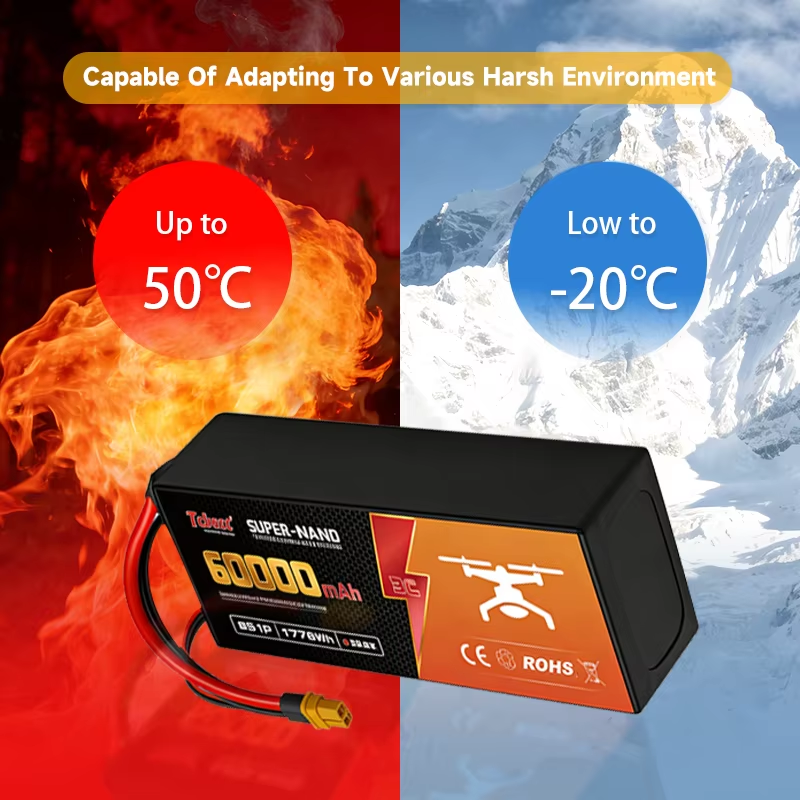
Why Is Cold Weather So Hard on Drone Batteries?
Cold weather can have one of the most obvious effects on drone battery performance.
Most modern drones use lithium-based rechargeable batteries, including lithium-ion and lithium-polymer batteries. These batteries rely on chemical reactions that allow ions to move during charging and discharging.
As temperature drops, those reactions slow down.
A cold battery also develops higher internal resistance. This makes it more difficult for the battery to deliver high current efficiently.
The result is often voltage sag.
Voltage sag is a temporary drop in battery voltage when the battery is placed under heavy load. During takeoff, climbing, or rapid acceleration, the motors may demand a large amount of current. If a cold battery cannot supply that current efficiently, its voltage can fall quickly.
The battery percentage shown in the app may also drop faster than expected. In some cases, the drone may trigger a low-battery warning or even start an automatic return-to-home procedure even though some energy remains in the battery.
The energy has not disappeared. The problem is that a cold battery cannot deliver it as effectively under heavy load.
That is why a drone that performs normally in warm weather may suddenly have much shorter flight times during winter.
Keep Batteries Warm Before Takeoff
One of the most effective cold-weather habits is also one of the simplest: keep the battery reasonably warm before flying.
Do not leave drone batteries sitting in freezing temperatures for long periods.
If you are traveling to a cold location, keep batteries in an insulated bag, inside the vehicle cabin, or in a protected pocket when appropriate and safe.
The goal is not to make the battery hot. You simply want to prevent it from becoming deeply chilled before the flight begins.
Install the battery shortly before takeoff instead of leaving the drone sitting outside with the battery already installed.
Pilots who regularly operate in winter conditions may use suitable battery warming equipment, but the battery manufacturer's recommended temperature limits should always be followed.
Warm the Battery Gently After Installation
Once the battery is installed, it can help to begin the flight gently.
Avoid immediately climbing at full power or switching straight into a high-performance mode.
If conditions and the manufacturer's instructions allow it, hovering one or two meters above the ground for around 60 to 90 seconds can help the battery warm slightly.
As current flows through the battery, it naturally produces some heat.
During this period, watch the battery temperature and voltage information in the flight app. Once the battery reaches a healthier operating temperature, its ability to deliver current will usually improve.
Avoid aggressive acceleration immediately after taking off with a cold battery. Sudden high-current demand is one of the easiest ways to trigger severe voltage sag.
Watch Voltage, Not Just Battery Percentage
Battery percentage is useful, but it should not be the only thing you watch in cold weather.
The percentage displayed in the app is an estimate based on battery voltage, load, battery condition, and software calculations. In cold conditions, voltage behavior can become less predictable.
Individual cell voltage can provide more useful information about the actual condition of the battery.
If one cell drops sharply under load, it may indicate that the battery is struggling to supply enough current.
Always follow the minimum voltage recommendations provided by the drone or battery manufacturer. Do not continue flying simply because the percentage indicator still appears acceptable.
If voltage drops unusually low during acceleration, climbing, or strong wind, landing earlier is usually the safer choice.
Is the Battery Simply Getting Old?
Sometimes the weather is fine and the pilot is flying normally. The battery is simply aging.
Rechargeable drone batteries do not stay in factory-new condition forever.
Every charge and discharge cycle causes gradual changes inside the cells. Over time, maximum capacity decreases and internal resistance increases.
That means the battery stores less energy and becomes less capable of delivering high current efficiently.
A new battery may provide flight time close to the advertised figure, while the same battery may perform noticeably worse after hundreds of cycles.
Many drone batteries can provide several hundred charge cycles under suitable conditions. A commonly mentioned range is around 300 to 500 cycles, although actual battery life can vary widely.
Cell chemistry, operating temperature, depth of discharge, storage habits, charging methods, and flight conditions all play a role.
A battery that is used gently and stored correctly may last considerably longer than one that is frequently overheated, deeply discharged, or stored at full charge.
Battery aging can also become a safety issue.
Older batteries may begin to swell, become unusually hot, show increasing differences between cell voltages, or suddenly lose a large amount of indicated capacity.
These warning signs should not be ignored.
How Can You Check Battery Health and Extend Battery Life?
Good battery care cannot stop aging completely, but it can slow unnecessary degradation and make battery performance more predictable.
Check the Cycle Count
Many intelligent drone batteries record the number of charge cycles they have completed.
This information can often be found in the manufacturer's flight app or battery management software.
Cycle count is useful because it gives you a general idea of how heavily the battery has been used, but it should not be treated as the only reason to replace a battery.
A battery with 250 cycles that has regularly been overheated or over-discharged may be in worse condition than another battery with more cycles that has been carefully maintained.
Pay attention to real-world performance.
If a battery that once gave you around 25 minutes of flight time now provides only 15 to 18 minutes under similar conditions, there has clearly been meaningful degradation.
Once a battery has passed roughly 300 cycles and is also showing reduced capacity, unusual voltage behavior, or noticeably worse flight performance, it deserves closer inspection and may need to be replaced.
Store Batteries Properly
Storage habits have a major effect on the aging of lithium batteries.
Keeping a lithium battery fully charged for long periods places additional chemical stress on the cells. High temperatures make the problem even worse.
At the other extreme, storing a battery completely discharged is also risky.
Batteries naturally lose some charge while sitting unused. If cell voltage falls too low, the battery may be permanently damaged or may no longer accept a charge normally.
For longer periods of storage, lithium batteries are generally better kept at a partial state of charge.
They should also be stored in a cool, dry place away from direct sunlight, excessive heat, combustible materials, and environments outside the manufacturer's recommended storage conditions.
Use a Suitable Storage Charge
If you are not going to use a drone battery for more than about a week, storing it at roughly 40% to 60% charge is a common practice for many lithium battery systems.
This range reduces the stress associated with long-term full-charge storage while leaving enough energy to help prevent the cells from becoming over-discharged during normal storage.
Many modern intelligent drone batteries automatically discharge themselves to a safer storage level after a set number of days.
If your battery supports this feature, check the settings in the app.
Pilots using conventional LiPo batteries with balance chargers can usually select a dedicated storage mode that charges or discharges each cell to an appropriate storage voltage.
After a flight, allow the battery to cool before charging it again. Charging a battery while it is still hot can accelerate degradation.
Other Factors That Can Reduce Flight Time
Flying style, temperature, and battery age are three of the biggest reasons for short flight time, but they are not the only ones.
Propeller condition matters as well.
Damaged, bent, dirty, or incorrectly installed propellers reduce aerodynamic efficiency and force the motors to work harder.
Altitude can also affect performance because thinner air changes how much work the propulsion system must do to generate sufficient lift.
Frequent climbing consumes more energy than steady level flight. Repeated rapid descents followed by aggressive climbs can also increase total energy consumption.
The camera, onboard processors, obstacle-avoidance sensors, video transmission system, and other electronics all use power too, although the motors normally account for the largest share of consumption.
There can also be small differences between batteries of the same model and age. Two batteries that look identical may not deliver exactly the same flight time.
For professional operations, keeping flight records can make these differences easier to spot.
Recording the battery number, cycle count, battery temperature, flight duration, remaining charge at landing, payload, and weather conditions can help you identify batteries whose performance is beginning to decline.
Why Is the Advertised Flight Time Usually Longer?
It helps to understand how maximum flight-time figures are usually measured.
These numbers are often produced under highly controlled conditions designed to maximize efficiency.
The drone may be flying without unnecessary accessories, with a new and healthy battery, at a moderate temperature, in little or no wind, and along a carefully planned flight profile.
Real-world flying is rarely that perfect.
A pilot may take off in moderate wind, climb to altitude, record video, hover repeatedly, accelerate between locations, return against the wind, and still need to land with a safe battery reserve.
Under those conditions, reaching the laboratory maximum is unlikely.
The advertised flight time is better treated as a useful reference point rather than a guarantee of what you will get on every flight.
For mission planning, your own flight history is usually much more valuable.
If your drone normally gives you around 22 minutes before reaching your preferred landing reserve, plan around 22 minutes instead of the maximum figure printed on the specification sheet.
Conclusion
When a drone battery seems to drain unusually fast, it is often responding to normal operating conditions rather than suffering from one specific fault.
Aggressive flying increases current demand. Hard acceleration, Sport mode, sharp turns, heavy payloads, extended hovering, and headwinds all make the motors work harder.
Cold weather creates another major challenge. Low temperatures increase internal resistance, making voltage sag, sudden percentage drops, and early low-battery warnings more likely. Keeping batteries warm before takeoff and avoiding immediate high-power maneuvers can improve cold-weather performance.
Battery aging is the third major factor. As cycle count increases, usable capacity gradually falls and internal resistance rises. Monitoring cycle count, cell voltage, flight time, temperature, and physical battery condition can help you recognize when a battery is nearing the end of its useful life.
A few simple habits can make a real difference. Fly smoothly when maximum speed is unnecessary, remove unused payloads, plan routes around wind direction, keep batteries warm in cold weather, avoid storing them completely full or empty, and use an appropriate storage charge.
Good battery management is not only about squeezing a few extra minutes out of each flight. It also makes flight time more predictable, reduces the risk of unexpected low-battery situations, and helps protect both the battery and the drone.
Once pilots understand how flying style, temperature, and battery health work together, they can make better decisions before and during every flight—and get more consistent performance from every battery.
Learn why your drone battery drains faster than expected. This guide explains how aggressive flying, cold weather, heavy payloads, wind, and battery aging affect flight time. Discover practical tips for improving battery performance, extending battery lifespan, reducing voltage drop, and getting safer, more reliable drone flights.