
 EN
EN
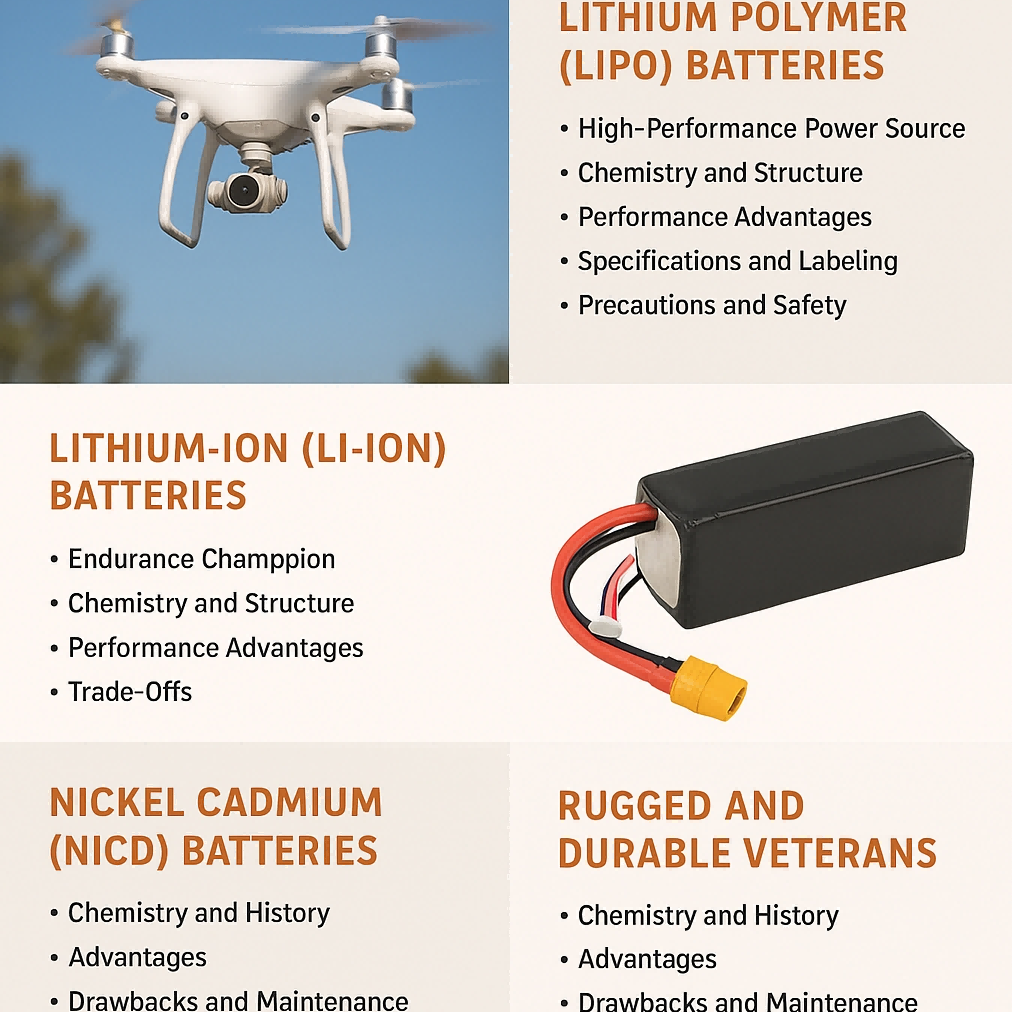
The development of drone technology is closely tied to advancements in battery chemistry. The power supply is the core of unmanned aerial vehicles (UAVs), determining flight time, performance range, and overall capabilities. For pilots ranging from enthusiasts to professionals, understanding the characteristics, advantages, and limitations of the main battery types is essential for selecting the right tools and operating them safely and efficiently. This article explores three main types of drone batteries: lithium polymer (LiPo), lithium-ion (Li-ion), and nickel cadmium (NiCd).
Lithium Polymer (LiPo) Batteries: High-Performance Power Source
LiPo batteries have become the standard for many consumer-grade and performance-oriented drones, especially in racing, stunt flying, and high-end film photography. Their popularity stems from features that meet the demanding requirements of modern drones.
● Chemistry and Structure: Unlike lithium-ion batteries that use liquid electrolytes, LiPo batteries use semi-solid or gel-like polymer electrolytes. They are typically packaged in soft aluminum-plastic film bags rather than rigid metal cylinders. This flexible design allows manufacturers to produce lightweight batteries in various shapes, accommodating compact and aerodynamic drone bodies.
● Performance Advantages: LiPo batteries offer high energy density (typically 150–250 Wh/kg) and high discharge rates. This translates into longer flight times and the ability to deliver rapid bursts of power for acceleration, maneuverability, and high-thrust motors. Their low self-discharge rate also helps maintain stored energy when not in use.
● Specifications and Labeling: Capacity is measured in milliampere hours (mAh) or ampere hours (Ah). Voltage depends on the number of cells in series (S), with each cell providing 3.7V. For example, a 3S pack delivers 11.1V, while a 6S pack provides 22.2V. The C-rate indicates safe continuous discharge capability; a 30C, 5000mAh battery can supply 150A continuously.
● Precautions and Safety: LiPo batteries are sensitive to misuse. Overcharging beyond 4.2V per cell or discharging below 3.2V can cause permanent damage, swelling, or even fire. They require dedicated chargers with balancing functions and careful monitoring. Their cycle life is typically 150–300 cycles, shorter than lithium-ion batteries. To extend lifespan, they should be stored at about 50% charge in a cool, dry environment.
Lithium-Ion (Li-ion) Batteries: Endurance Champion
Li-ion batteries are another mainstream lithium-based chemistry, chosen for applications requiring extended flight time and longer operational lifespan rather than maximum power output.
● Chemistry and Structure: Li-ion batteries use liquid electrolytes and are usually found in rigid cylindrical (e.g., 18650 cells) or prismatic packs, making them sturdy and durable.
● Performance Advantages: They offer high energy density, often comparable to or exceeding LiPo batteries. This makes them ideal for drones used in surveying, inspection, surveillance, and photography, where endurance is critical. Li-ion batteries typically last 300–500 cycles, with advanced formulations reaching 500–1000 cycles. They are more stable, less prone to swelling, and safer under normal use.
● Trade-Offs: Li-ion batteries generally have lower maximum discharge rates than LiPo packs, making them less suitable for racing or stunt drones. They may also be slightly heavier for the same capacity. However, innovations such as high-energy-density lithium batteries (up to 400 Wh/kg) are pushing the boundaries, enabling longer flight times and stable operation across wide temperature ranges (-40°C to 60°C).
Nickel Cadmium (NiCd) Batteries: Rugged and Durable Veterans
NiCd batteries represent older technology, largely replaced by lithium-based chemistries in consumer drones, but they remain useful in specific applications due to their durability.
● Chemistry and History: NiCd batteries use cadmium and nickel hydroxide electrodes with alkaline electrolytes. Their energy density is much lower (40–60 Wh/kg), making them heavier and bulkier compared to lithium batteries.
● Advantages: NiCd batteries excel in extreme conditions, operating reliably between -20°C and 60°C (sometimes -30°C to 50°C). They tolerate physical shock, vibration, overcharging, and deep discharge better than lithium batteries. They also provide high discharge rates and are generally cheaper.
● Drawbacks and Maintenance: NiCd batteries suffer from the “memory effect,” where repeated partial charge/discharge cycles reduce capacity. Regular full discharges are required to maintain performance. They also have high self-discharge rates and contain toxic cadmium, raising environmental concerns. Charging is slower (10–16 hours with trickle charging), though fast charging at 1C is possible in about an hour.
Conclusion: Choosing the Right Power Source
● LiPo batteries are best for high-performance drones used in racing, stunts, or custom builds, offering explosive power and lightweight design but requiring careful handling.
● Li-ion batteries are ideal for commercial, photography, and endurance-focused drones, balancing energy density, safety, and long cycle life.
● NiCd batteries are suitable only for specific industrial, military, or legacy applications where extreme durability and temperature tolerance outweigh their drawbacks.
As battery technology continues to evolve, higher energy densities, improved safety, and better temperature adaptability are emerging. The trade-off between power, endurance, and robustness will remain central to drone aviation. By understanding these core battery types, pilots and operators can make informed decisions, ensuring their drones have the right “heart” for the mission.