
 EN
EN
Why Solar Charging Matters for Outdoor Drone Operations
Solar charging has become an increasingly valuable solution for drone pilots who frequently operate in remote environments where access to traditional electricity is limited or nonexistent. Whether conducting field research, filming natural landscapes, or traveling through wilderness areas, drone operators often face the challenge of keeping batteries powered throughout the day. Solar energy offers a sustainable and portable alternative, allowing pilots to convert sunlight into usable electricity without relying on wall outlets or fuel-powered generators. This makes solar charging not only practical but also environmentally friendly and cost-effective for long-term outdoor use.
Understanding Drone Battery Requirements Before Charging
Modern drones typically use lithium-ion or lithium-polymer batteries, both of which require stable and regulated power to charge safely. These batteries vary in voltage, capacity, and charging wattage depending on the drone’s size and performance level. Smaller consumer drones often require around 25–35 watts of charging power, while mid-range camera drones may need 50–70 watts. Professional-grade drones can demand 80 watts or more. Because solar panels naturally produce fluctuating voltage depending on sunlight intensity, they cannot be connected directly to a drone battery. Instead, the power must be stabilized through a portable power station, a charge controller, or a USB-C Power Delivery (PD) interface to ensure safe and efficient charging.
Method 1: Solar Panel to Portable Power Station
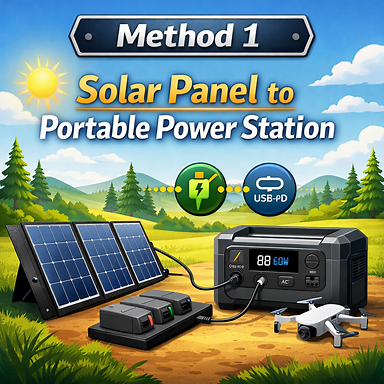
One of the most reliable and user-friendly methods for charging drone batteries outdoors is to connect a solar panel to a portable power station. In this setup, the solar panel collects sunlight and transfers the energy to the power station, which stores it and outputs clean, regulated AC or USB-C PD power. This allows the drone’s official charging hub or USB-C charger to operate exactly as it would when plugged into a household outlet. Portable power stations are particularly useful because they provide stable voltage, support multiple devices, and store energy for nighttime charging. For extended outdoor operations, a power station with a capacity between 500 and 1000 watt-hours paired with a 200-watt solar panel is often sufficient to support several drone batteries throughout the day.
Method 2: Solar Panel with Charge Controller
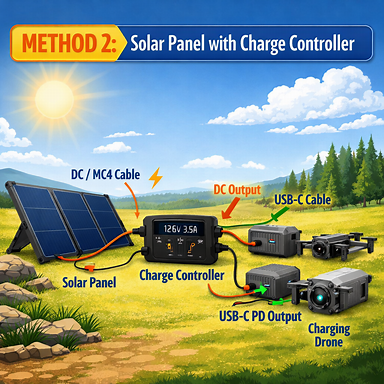
Another effective approach is to connect the solar panel to a charge controller—either PWM or MPPT—which regulates the voltage before delivering power to a DC output or USB-C PD adapter. MPPT controllers are especially efficient because they optimize energy harvest even when sunlight conditions fluctuate. This method is lighter and more compact than carrying a power station, making it ideal for backpackers or travelers who need a minimalist setup. However, it requires careful attention to voltage compatibility, and without an additional battery pack, it does not store energy for later use. Despite these limitations, it remains a practical option for lightweight outdoor charging.
Method 3: Solar Panels with Built-In USB-C PD Output
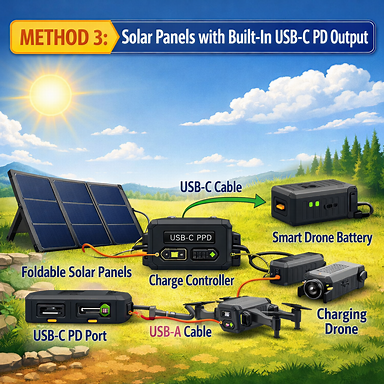
Some modern foldable solar panels include high-power USB-C PD ports capable of delivering 60 to 100 watts. These panels can charge smaller drones directly through USB-C PD without additional equipment. This is the simplest and most portable method, suitable for lightweight travel or quick charging sessions. However, it depends heavily on strong sunlight and is not suitable for larger drones that require higher wattage. Additionally, because there is no energy storage, charging stops immediately when sunlight weakens.
Choosing the Right Solar Equipment
Selecting appropriate solar equipment is essential for efficient outdoor charging. Foldable monocrystalline solar panels between 60 and 200 watts offer a good balance of portability and performance. MPPT charge controllers provide superior efficiency in variable weather, while portable power stations with pure sine wave AC output and USB-C PD ports offer maximum compatibility with different drone models. Cables and adapters—such as MC4 connectors, XT60 adapters, and USB-C PD hubs—ensure proper connections between components. Choosing high-quality equipment not only improves charging efficiency but also enhances safety and reliability in outdoor environments.
Expected Charging Times in Real Conditions
Charging time varies depending on panel wattage, sunlight intensity, and battery size. Under strong midday sunlight, a 100-watt panel can typically charge a small drone battery in about 1.5 to 2 hours. Larger batteries may require 3 to 4 hours with the same panel. Cloudy conditions can reduce output to 30–60 percent of the panel’s rated wattage, while cold temperatures slow chemical reactions inside the battery. Hot weather can also affect charging efficiency, making temperature management an important part of outdoor charging.
Safety Guidelines for Solar Charging Drone Batteries
Because lithium batteries are sensitive to heat and voltage fluctuations, safety must be a priority when charging outdoors. Batteries should never be charged in direct sunlight; instead, they should be placed in the shade or under a protective cover to prevent overheating. Always use regulated power sources and avoid connecting a battery directly to a solar panel. Monitor the battery during charging and stop immediately if you notice swelling, unusual heat, or odor. When storing batteries for extended periods, keep them at 30–60 percent charge to prolong their lifespan and maintain optimal performance.
Recommended Outdoor Solar Charging Setups
Different outdoor scenarios call for different charging configurations. Lightweight travelers may prefer a 60–100 watt foldable panel with USB-C PD output for compact drones. Professional filmmakers working in remote areas often rely on a 200-watt panel paired with a 500–1000 watt-hour power station to support multiple batteries. Surveying teams or mapping crews may deploy 400-watt solar arrays and large power stations to maintain continuous operations for high-demand drones. Choosing the right setup depends on the drone type, mission duration, and environmental conditions.
Step-by-Step Solar Charging Workflow
A typical workflow begins by positioning the solar panel toward the sun at an optimal angle, usually between 30 and 45 degrees. After connecting the panel to a power station or charge controller, verify that the system is producing stable wattage. Once the output is confirmed, plug in the drone charger and monitor the battery temperature throughout the process. Before sunset, store excess energy in a power station or charge additional batteries to prepare for the next day’s flights. This routine ensures consistent power availability during extended outdoor operations.
Charging in Cloudy, Cold, or Hot Conditions
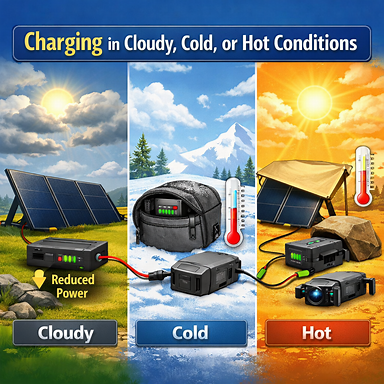
Solar charging remains functional even in less-than-ideal weather, though efficiency decreases. Cloudy skies reduce output but can still provide usable power, especially with MPPT controllers. Cold temperatures slow charging, so keeping batteries warm—such as inside a jacket pocket—helps maintain performance. In hot climates, shading the battery is essential to prevent overheating and maintain safe charging conditions. Understanding how weather affects solar performance allows pilots to plan charging sessions more effectively.
Real-World Applications of Solar Charging
Solar charging is widely used across various fields. Wildlife filmmakers rely on solar setups to stay off-grid for days while documenting remote ecosystems. Search-and-rescue teams use solar power to maintain drone readiness during extended missions. Surveyors and engineers benefit from solar charging on construction sites without grid access. Even casual travelers and backpackers use compact solar panels to keep lightweight drones powered during long expeditions. These real-world applications demonstrate the versatility and practicality of solar charging in diverse environments.
Troubleshooting Common Solar Charging Issues
If your solar panel produces insufficient power, adjusting its angle or cleaning dust from the surface often improves performance. If a power station fails to charge, check cable connections and verify voltage compatibility. Slow drone charging is often caused by weak sunlight or high battery temperature, both of which can be managed with proper positioning and shading. Understanding these common issues helps ensure reliable charging in the field.
Conclusion
Solar charging provides a practical, efficient, and environmentally friendly solution for powering drone batteries outdoors. With the right combination of solar panels, charge controllers, and portable power stations, drone pilots can operate confidently in remote environments without relying on traditional electricity. Understanding your drone’s power requirements, selecting appropriate equipment, and following safe charging practices ensures reliable performance and extends your drone’s operational capabilities in the field.
Summary
Solar charging enables drones to operate off-grid using sunlight converted through panels and controllers. It ensures safe, efficient power for batteries in diverse conditions—cloudy, cold, or hot—by regulating voltage and temperature. Proper equipment selection, workflow, and safety practices extend battery life and support sustainable outdoor operations.
Table of Contents
- Why Solar Charging Matters for Outdoor Drone Operations
- Understanding Drone Battery Requirements Before Charging
- Choosing the Right Solar Equipment
- Expected Charging Times in Real Conditions
- Safety Guidelines for Solar Charging Drone Batteries
- Recommended Outdoor Solar Charging Setups
- Step-by-Step Solar Charging Workflow
- Real-World Applications of Solar Charging
- Troubleshooting Common Solar Charging Issues
- Conclusion
- Summary