
 EN
EN
1. Introduction
Knowing precisely when a drone battery has completed its charging cycle is fundamental to safe flight operations, battery longevity, and mission reliability. Although modern UAV power systems incorporate advanced protection circuits, misinterpreting charge status can still lead to premature takeoff, mid-air power loss, or accelerated battery degradation. As drone platforms diversify—from consumer quadcopters to enterprise-grade UAVs—the indicators of a fully charged battery also vary. This article provides a comprehensive, technically grounded explanation of how to determine when a drone battery is fully charged, integrating electrical principles, brand-specific behaviors, and best-practice recommendations for both recreational and professional operators.
2. Understanding How Drone Batteries Charge
Drone batteries—primarily Lithium-Polymer (LiPo), Lithium-ion (Li-ion), and High-Voltage Lithium-Polymer (LiHV)—follow a standardized charging profile known as Constant Current / Constant Voltage (CC-CV). During the constant-current phase, the charger supplies a fixed current while the battery voltage gradually rises. Once the battery reaches its maximum allowable voltage, the charger transitions into the constant-voltage phase, holding voltage steady while the current gradually tapers. Charging terminates when the current falls below a predefined threshold, signaling that the battery has reached its full state of charge.
Charge Current (A)=(Battery Capacity (Ah)/Charge Current (A) )
This electrochemical behavior explains why indicators change gradually rather than instantaneously. LED patterns slow down, charger lights shift color, and smart-battery apps display the final percentage only when the tapering current reaches the cutoff point. Understanding this profile helps operators interpret the signals correctly and avoid misjudging the battery’s readiness.
3. Primary Indicators That a Drone Battery Is Fully Charged
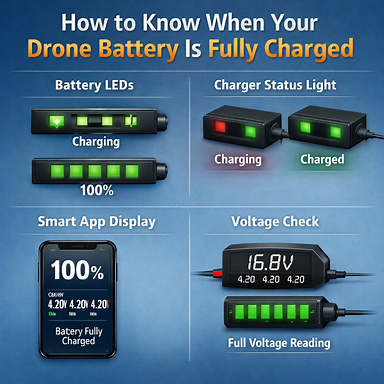
3.1 Battery-Integrated LED Indicators
Most consumer and professional drone batteries incorporate multi-LED indicators that communicate charge progress. During charging, LEDs typically blink in sequence, representing incremental increases in state of charge. When the battery reaches full capacity, the LEDs stop blinking and remain solid. Although the exact pattern varies by manufacturer, the underlying logic is consistent: blinking means charging; solid means complete. This method is simple and requires no additional equipment, making it the most universal indicator across UAV platforms.
3.2 Charger Status Lights
Chargers often provide their own visual cues, usually through color-coded LEDs. A red or amber light generally indicates active charging, while a green or blue light signifies completion. Some chargers also incorporate flashing patterns to indicate errors such as cell imbalance or temperature issues. Because charger-side indicators are independent of the battery’s internal electronics, they offer a secondary confirmation that the charging cycle has terminated.
3.3 Smart-Battery Applications and Telemetry
Modern UAV ecosystems—such as those from DJI, Autel, and Skydio—use smart batteries equipped with a Battery Management System (BMS). These systems monitor voltage, current, temperature, cell balance, and state of charge in real time. When connected to the drone or charging hub, the companion app displays precise numerical values, including 100% SoC, individual cell voltages, and thermal conditions. This method provides the most accurate assessment of charge completion and is especially valuable for enterprise operations where reliability is critical.
3.4 Voltage Measurement for FPV and Custom Builds
FPV pilots and operators of custom UAV platforms often rely on direct voltage measurement. A fully charged LiPo cell reaches 4.20 V, while LiHV cells reach 4.35 V. For multi-cell packs, the total voltage is the sum of individual cell voltages. For example, a 4-cell LiPo pack is fully charged at:
4×4.20 = 16.8V
Voltage measurement is the most precise method but requires experience and appropriate tools such as a LiPo checker or multimeter.
3.5 Audible or Digital Notifications
Some chargers emit an audible tone when charging is complete, while smart-battery ecosystems may send push notifications to a mobile device. These alerts are particularly useful when charging multiple batteries simultaneously or when the operator is not physically near the charging station.
4. How Major Drone Brands Indicate Full Charge
Different manufacturers implement unique signaling conventions, though the underlying principles remain consistent. DJI batteries typically display solid LEDs on the battery itself and a green indicator on the charging hub, while the DJI Fly or Pilot app shows 100% SoC. Autel Robotics uses a similar system, with the charger LED turning green upon completion. Parrot batteries rely primarily on LED behavior, with blinking patterns ceasing once the battery is full. FPV LiPo packs, lacking smart circuitry, depend entirely on voltage measurement. Skydio batteries integrate tightly with the Skydio app, providing detailed telemetry and explicit “Battery Fully Charged” messages.
These variations highlight the importance of understanding brand-specific behavior, especially when operating multiple UAV platforms within the same workflow.
5. Typical Charging Durations and What They Indicate
Charging time varies according to battery capacity, charger wattage, and battery chemistry. Consumer drones such as the DJI Mini series typically require 60–90 minutes, while professional systems like the Mavic 3 or Autel EVO II may require 90–120 minutes. Enterprise platforms with highcapacity batteries, such as the DJI Matrice series, often charge faster due to high-power charging hubs capable of delivering elevated current levels safely. FPV LiPo packs generally charge within 30–50 minutes at a 1C rate.
If a battery charges significantly faster or slower than expected, it may indicate aging cells, imbalance, or thermal constraints. Thus, charging duration itself becomes an indirect indicator of battery health and charge completion accuracy.
6. Indicators That a Battery Is Not Fully Charged
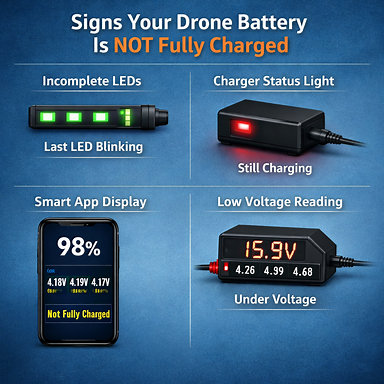
Recognizing incomplete charging is equally important. If only some LEDs remain solid while the final LED continues blinking, the battery has not yet reached full capacity. Similarly, if the charger light remains red or amber, the cycle is still in progress. In smart-battery systems, an SoC reading below 100%—even 97–99%—may indicate that the BMS has paused charging due to temperature or cell-balance constraints. Voltage readings below the full-cell threshold also confirm incomplete charging, especially in FPV systems.
In some cases, a battery may refuse to reach 100% due to aging, internal resistance, or imbalance. These conditions require further inspection and may signal the need for replacement.
7. How Smart Batteries Determine Charge Completion
Smart batteries rely on a BMS that continuously evaluates multiple parameters. The system monitors state of charge, state of health, cell voltages, temperature, and charge cycles. Charging terminates automatically when the current falls below a predefined cutoff, ensuring that the battery is neither overcharged nor subjected to unnecessary thermal stress. This automated termination is why modern drone batteries are generally safe to leave connected to the charger, although unattended charging is still discouraged for safety reasons.
8. Verifying Full Charge After Disconnecting the Charger
Operators may need to confirm charge status after removing the battery from the charger. This can be done by pressing the battery’s LED button, inserting the battery into the drone and checking the app, or measuring voltage directly. FPV pilots often use portable LiPo checkers to verify cell balance and total voltage. These methods provide reliable confirmation even when the charger is unavailable.
9. Best Practices for Accurate Charge Assessment
Accurate charge readings depend on proper charging conditions. Batteries should be charged at room temperature—ideally between 20°C and 25°C—because extreme temperatures distort voltage and SoC calculations. Using the manufacturer’s charger ensures compatibility with the battery’s chemistry and BMS logic. Battery contacts should be kept clean to prevent false readings or incomplete charging. Allowing the battery to rest for 10–15 minutes after charging stabilizes voltage and improves accuracy. Finally, avoiding mid-cycle interruptions prevents the BMS from miscalculating the state of charge.
10. Common Misconceptions About Drone Battery Charging
Several myths persist among drone operators. One common misconception is that leaving a battery on the charger will overcharge it; in reality, modern chargers terminate automatically. Another myth is that batteries must always reach 100%, but charging to 80–90% can significantly extend lifespan, especially for storage. A third misconception is that voltage alone determines charge status; while voltage is important, cell balance and temperature are equally critical.
11. Troubleshooting When a Battery Never Reaches 100%
If a battery consistently fails to reach full charge, several issues may be responsible. Cell imbalance is a common cause, particularly in older batteries. A balance charger can sometimes correct this, but severely imbalanced packs should be retired. Battery aging also reduces capacity and increases internal resistance, making full charge difficult to achieve. Temperature issues—either too hot or too cold—can cause the BMS to halt charging prematurely. Faulty chargers or dirty contacts may also interfere with the charging process. In smart-battery systems, outdated firmware can cause inaccurate SoC readings, making updates essential.
12. Safety Considerations During Charging
Safety remains paramount. Batteries should never be charged unattended, especially LiPo packs used in FPV systems. Fire-resistant bags or charging boxes provide additional protection. Damaged or swollen batteries must be retired immediately, as they pose significant fire risks. Long-term storage should be at 30–60% state of charge, never at full capacity, to minimize chemical stress and prolong lifespan.
13. Conclusion
A drone battery is fully charged when its indicators—whether LEDs, charger lights, app telemetry, or voltage measurements—confirm that it has reached its maximum safe state of charge. Although different drone platforms use different signaling conventions, the underlying principles remain consistent across UAV systems. Understanding these indicators, along with the electrochemical behavior of lithium-based batteries, enables operators to charge safely, extend battery lifespan, and ensure reliable flight performance.
Summary
A fully charged drone battery shows solid LEDs, green charger light, 100% app reading, and voltage near 4.20 V per cell. Smart batteries stop automatically when current drops below threshold, ensuring safe termination and balanced cells for optimal flight performance and battery longevity.
Table of Contents
- 1. Introduction
- 2. Understanding How Drone Batteries Charge
- 3. Primary Indicators That a Drone Battery Is Fully Charged
- 4. How Major Drone Brands Indicate Full Charge
- 5. Typical Charging Durations and What They Indicate
- 6. Indicators That a Battery Is Not Fully Charged
- 7. How Smart Batteries Determine Charge Completion
- 8. Verifying Full Charge After Disconnecting the Charger
- 9. Best Practices for Accurate Charge Assessment
- 10. Common Misconceptions About Drone Battery Charging
- 11. Troubleshooting When a Battery Never Reaches 100%
- 12. Safety Considerations During Charging
- 13. Conclusion
- Summary