
 EN
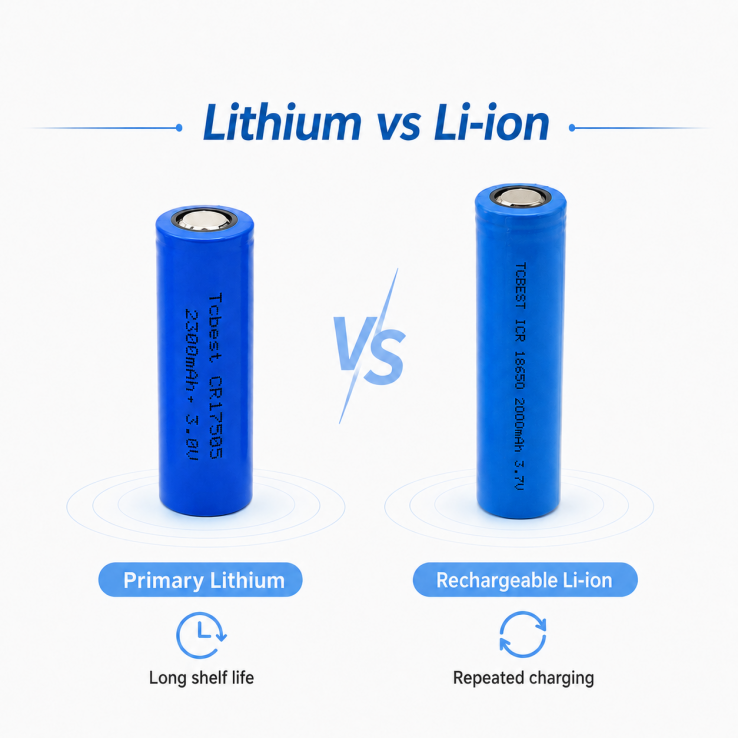
Lithium batteries and lithium-ion batteries are often confused because their names sound very similar. But they are not the same.
In simple terms, a lithium battery usually refers to a primary, non-rechargeable battery, while a lithium-ion battery is rechargeable and designed for repeated charge and discharge cycles.
That difference affects how the battery works, how long it lasts, where it is used, and how it should be handled.
For example, a CR2032 battery in a car key is normally a disposable lithium battery. The battery inside a smartphone, laptop, drone, or power tool is usually a rechargeable lithium-ion battery.
So which one should you choose? It depends on how the device will be used.
This guide explains the main differences between lithium and lithium-ion batteries, including chemistry, rechargeability, energy density, service life, applications, safety, and environmental impact.
What Is a Lithium Battery?
The term “lithium battery” commonly refers to a primary lithium battery.
These batteries are designed to provide power until their stored energy is used up. After that, they are replaced rather than recharged.
One of their biggest advantages is long storage life. Many primary lithium batteries have low self-discharge, which means they can sit unused for a long time and still provide reliable power when needed.
Common types include:
- Lithium manganese dioxide batteries, such as CR2032
- Lithium iron disulfide batteries
- Lithium thionyl chloride batteries
- Other specialty lithium primary cells
A typical lithium coin cell provides around 3V, making it suitable for compact devices such as car keys, calculators, electronic scales, watches, meters, and sensors.
Tcbest supplies different types of primary lithium batteries for consumer electronics, smart devices, meters, security products, and industrial applications.
What Is a Lithium-ion Battery?
Lithium-ion batteries work differently because they are designed to be rechargeable.
During charging and discharging, lithium ions move between the positive and negative electrodes. This reversible process allows the battery to be used again and again.
A typical lithium-ion cell includes:
- A positive electrode
- A negative electrode, often graphite
- Electrolyte
- Separator
- Current collectors
- Protective components
Many lithium-ion battery packs also include a battery management system, or BMS, to monitor voltage, current, temperature, and other operating conditions.
Li-ion batteries are commonly used in:
- Smartphones
- Laptops
- Bluetooth devices
- Power tools
- Drones
- Electric bicycles
- Portable power stations
- Energy storage systems
- Electric vehicles
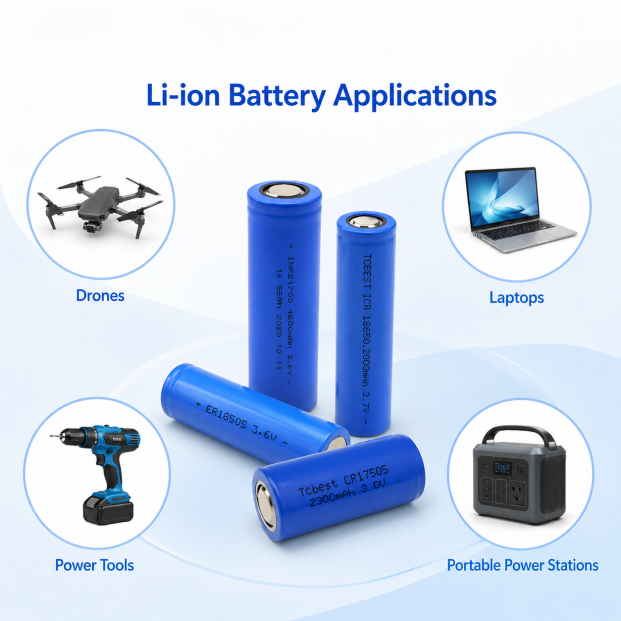
Tcbest also provides lithium-ion cells and customized battery packs for applications that require rechargeable power and flexible battery configurations.
Lithium Battery vs. Lithium-ion Battery: Main Difference
The simplest way to understand the difference is:
Lithium battery: normally non-rechargeable
Lithium-ion battery: rechargeable
A primary lithium battery is designed to provide its stored energy once.
A lithium-ion battery is designed to go through repeated charging and discharging.
For example, the CR2032 battery in a car key may last several years before replacement. A smartphone battery, however, may be charged almost every day.
Both battery types are useful, but they are designed for very different applications.
How Does a Lithium Battery Work?
When a primary lithium battery powers a device, a chemical reaction takes place inside the cell.
Electrons flow through the external circuit and provide electrical energy, while ions move through the electrolyte inside the battery.
As the battery continues to discharge, the active materials are gradually consumed.
Once the stored energy is used up, the battery cannot safely return to its original state.
This is why primary lithium batteries should not be recharged.
Trying to recharge a non-rechargeable lithium battery can cause leakage, overheating, internal pressure buildup, or even fire.
Always check the battery label before charging.
How Does a Lithium-ion Battery Work?
Lithium-ion batteries use a reversible process.
When the battery is charged, lithium ions move from the positive electrode to the negative electrode.
When the battery powers a device, they move back toward the positive electrode.
This movement can be repeated many times.
However, lithium-ion batteries do not last forever.
With every charge and discharge cycle, small physical and chemical changes occur inside the cell. Over time, internal resistance may increase and available capacity may decrease.
You may notice this with an older phone battery. When the phone was new, one charge may have lasted all day. After several years, it may need to be charged more frequently.
The battery still works, but it stores less energy than before.
Which One Has Higher Energy Density?
Both primary lithium and lithium-ion batteries can offer high energy density, but their strengths are different.
Primary lithium batteries are known for:
- Long shelf life
- Low self-discharge
- High stored energy for one-time use
This makes them suitable for devices that need to work for long periods without regular battery replacement.
Lithium-ion batteries are known for combining high energy density with rechargeability.
That makes them ideal for portable electronics and high-use equipment.
It is therefore not always useful to ask which type has “higher energy density.”
A better question is whether the device needs long-term standby power or repeated charging.
Battery Life and Cycle Life
For primary lithium batteries, users usually care about operating life and shelf life.
A lithium battery in a low-power sensor may work for several years depending on the device and operating conditions.
For lithium-ion batteries, cycle life is more important.
A battery cycle generally represents the equivalent of using 100% of the battery’s capacity.
For example, using 50% of the battery today and another 50% tomorrow is roughly equal to one full cycle.
The actual cycle life depends on:
- Battery chemistry
- Temperature
- Charging voltage
- Charging current
- Discharge current
- Depth of discharge
- Storage conditions
- Battery quality
High temperatures are one of the main causes of faster battery aging.
Frequent deep discharge, excessive charging voltage, and heavy loads can also reduce battery life.
For customized battery packs, cell quality, protection design, and proper cell matching are also important.
Tcbest can customize lithium battery packs according to voltage, capacity, size, current, connector, and protection requirements.
Where Are Lithium Batteries Used?
Primary lithium batteries are suitable for devices that need long standby time and do not require regular charging.
Common applications include:
- Car keys
- Watches
- Electronic scales
- Calculators
- Smart meters
- Security sensors
- Remote monitoring devices
- Cameras
- Medical equipment
- Backup memory systems
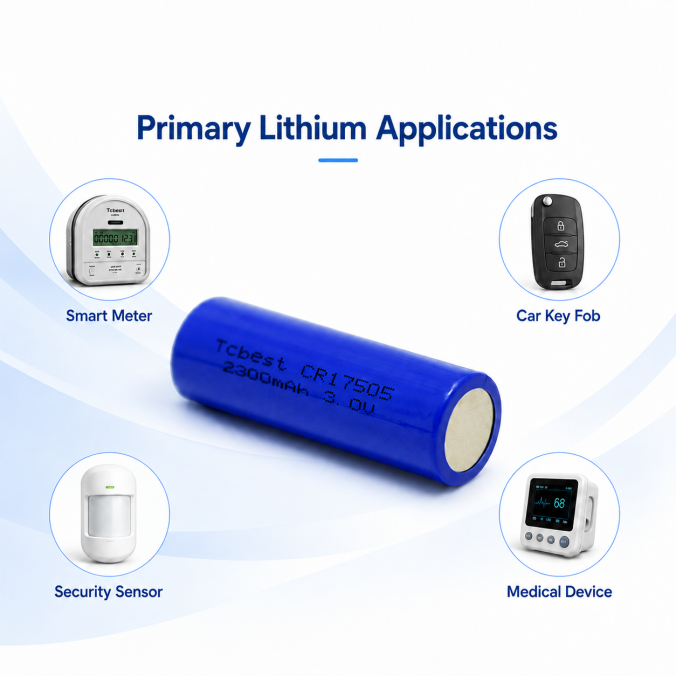
A car key is a good example.
It uses very little power, so adding a charging port would make the design more complicated than necessary.
A small lithium coin battery is a much simpler solution.
The same applies to remote sensors that may operate for years without regular maintenance.
Where Are Lithium-ion Batteries Used?
Lithium-ion batteries are better suited to products that are used frequently.
Common examples include:
- Smartphones
- Laptops
- Wireless electronics
- Electric bicycles
- Power tools
- Drones
- Portable energy storage
- Industrial equipment
A smartphone is a good example.
Replacing a disposable battery every time the phone runs out of power would be inconvenient and expensive.
A rechargeable lithium-ion battery is much more practical.
Drones are another common application.
Drone batteries must be relatively lightweight while still delivering high current. Depending on the design, drones may use lithium-ion or lithium polymer batteries.
Tcbest can provide customized rechargeable battery solutions based on voltage, capacity, discharge current, dimensions, connector type, and battery pack structure.
Advantages of Lithium Batteries
Primary lithium batteries offer several useful advantages.
Long Shelf Life
They can retain energy for a long time when stored correctly.
Low Self-discharge
They lose relatively little charge when not in use.
Compact Size
Lithium batteries can provide useful energy in a small package.
Good for Low-drain Devices
They are especially suitable for devices that only need small amounts of power over long periods.
The main disadvantage is that they cannot normally be recharged.
Once depleted, they must be replaced.
Advantages of Lithium-ion Batteries
Lithium-ion batteries are popular mainly because they are rechargeable.
Rechargeable
They can be used repeatedly rather than discarded after one discharge.
High Energy Density
They store a useful amount of energy without becoming too heavy or bulky.
Strong Power Output
Many lithium-ion batteries can provide enough current for demanding equipment.
Flexible Designs
They can be made as cylindrical cells, pouch cells, prismatic cells, or customized battery packs.
This makes lithium-ion batteries useful for OEM products with different shapes and power requirements.
Tcbest can also integrate cells with wires, connectors, protection boards, and housings according to project requirements.
What Are the Disadvantages?
Both battery types also have limitations.
Primary lithium batteries are single-use products. For devices that consume batteries frequently, replacement costs can become relatively high.
Lithium-ion batteries can be reused, but they gradually lose capacity over time.
They are also more sensitive to:
- High temperatures
- Overcharging
- Deep discharge
- Short circuits
- Physical damage
- Incorrect chargers
Larger lithium-ion battery packs may also require more advanced protection systems.
This means battery pack design is just as important as choosing the right cell.
Are Lithium Batteries Safe?
Primary lithium batteries are generally safe when used correctly.
The most important rule is not to recharge batteries that are marked as non-rechargeable.
Charging a primary lithium battery may cause:
- Leakage
- Overheating
- Internal pressure
- Rupture
- Fire
Coin batteries also require extra care because of their small size.
Keep them away from children and make sure battery compartments are properly secured.
Loose batteries should also be kept away from metal objects such as keys, coins, screws, or tools because these can cause a short circuit.
Are Lithium-ion Batteries Safe?
Lithium-ion batteries are also generally safe when used properly.
However, serious damage or misuse can lead to thermal runaway.
Thermal runaway is a rapid self-heating reaction that may produce gas, smoke, or fire.
Risk factors include:
- Overheating
- Overcharging
- Short circuit
- Crushing
- Puncturing
- Incorrect charging
- Serious cell defects
To reduce risk:
- Use the correct charger
- Do not charge swollen or damaged batteries
- Avoid high temperatures
- Do not puncture or crush the battery
- Stop using batteries that become unusually hot
- Protect spare battery terminals
- Follow manufacturer instructions
For battery packs, a suitable BMS or protection circuit can help monitor overcharge, over-discharge, overcurrent, and other abnormal conditions.
Which Battery Is Better for the Environment?
Both battery types have an environmental impact.
Raw material extraction, manufacturing, transportation, use, and disposal all consume resources.
Primary lithium batteries may last a long time in low-power applications, but they are still disposable.
Lithium-ion batteries can be charged many times, which can reduce the number of batteries consumed in frequently used products.
However, rechargeable batteries still need proper recycling when they reach the end of their service life.
The better choice depends on the application.
A sensor that needs to work for years may be better suited to a primary lithium battery.
A device used every day is usually better suited to lithium-ion.
In both cases, used batteries should be sent to appropriate collection or recycling facilities rather than simply thrown away.
Lithium or Lithium-ion: Which Should You Choose?
Start by looking at how your device will be used.
Choose a primary lithium battery when you need:
- Long standby time
- Low self-discharge
- Compact size
- Little or no maintenance
- No regular charging
Choose lithium-ion when you need:
- Rechargeability
- Frequent use
- Higher power output
- Lightweight energy storage
- Customized battery pack options
Before selecting a battery, consider voltage, capacity, discharge current, size, operating temperature, charging method, and expected service life.
For OEM products, battery selection involves more than choosing a capacity value.
The battery also needs to fit the product, provide sufficient power, match the charger, use the right connector, and include suitable protection.
Tcbest provides standard battery products as well as customized lithium-ion battery packs for consumer electronics, drones, smart devices, industrial equipment, and energy storage applications.
Conclusion
Lithium batteries and lithium-ion batteries may sound similar, but they are designed for different purposes.
Primary lithium batteries are normally non-rechargeable. They are a good choice for low-power devices that need long shelf life and low self-discharge.
Lithium-ion batteries are rechargeable and are more suitable for devices that are used frequently, such as smartphones, laptops, drones, power tools, and energy storage equipment.
The best battery is not simply the one with the highest capacity or energy density.
It is the one that fits the actual application.
When choosing a battery, consider voltage, capacity, current, dimensions, charging method, operating environment, and expected service life.
For standard batteries or customized rechargeable battery solutions, Tcbest can provide battery selection and battery pack customization based on different application requirements.
Always follow the manufacturer’s instructions, never recharge a battery that is marked non-rechargeable, and recycle used batteries responsibly.
Lithium and lithium-ion batteries have similar names but key differences. Lithium batteries are single-use and non-rechargeable, ideal for low-power devices. Lithium-ion batteries are rechargeable and suited for frequent-use applications like smartphones and electric vehicles. Choose based on usage needs and power demand
Table of Contents
- What Is a Lithium Battery?
- What Is a Lithium-ion Battery?
- Lithium Battery vs. Lithium-ion Battery: Main Difference
- How Does a Lithium Battery Work?
- How Does a Lithium-ion Battery Work?
- Which One Has Higher Energy Density?
- Battery Life and Cycle Life
- Where Are Lithium Batteries Used?
- Where Are Lithium-ion Batteries Used?
- Advantages of Lithium Batteries
- Advantages of Lithium-ion Batteries
- What Are the Disadvantages?
- Are Lithium Batteries Safe?
- Are Lithium-ion Batteries Safe?
- Which Battery Is Better for the Environment?
- Lithium or Lithium-ion: Which Should You Choose?
- Conclusion