
 EN
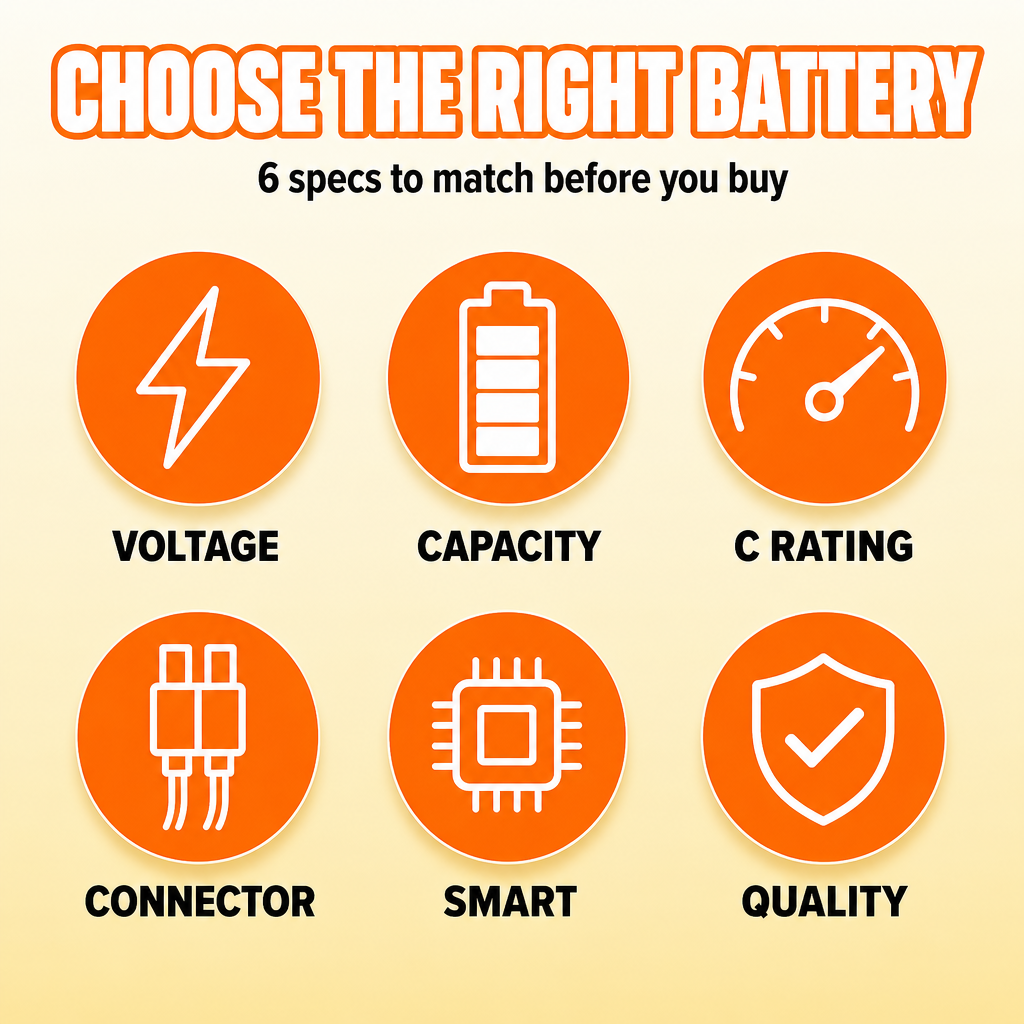
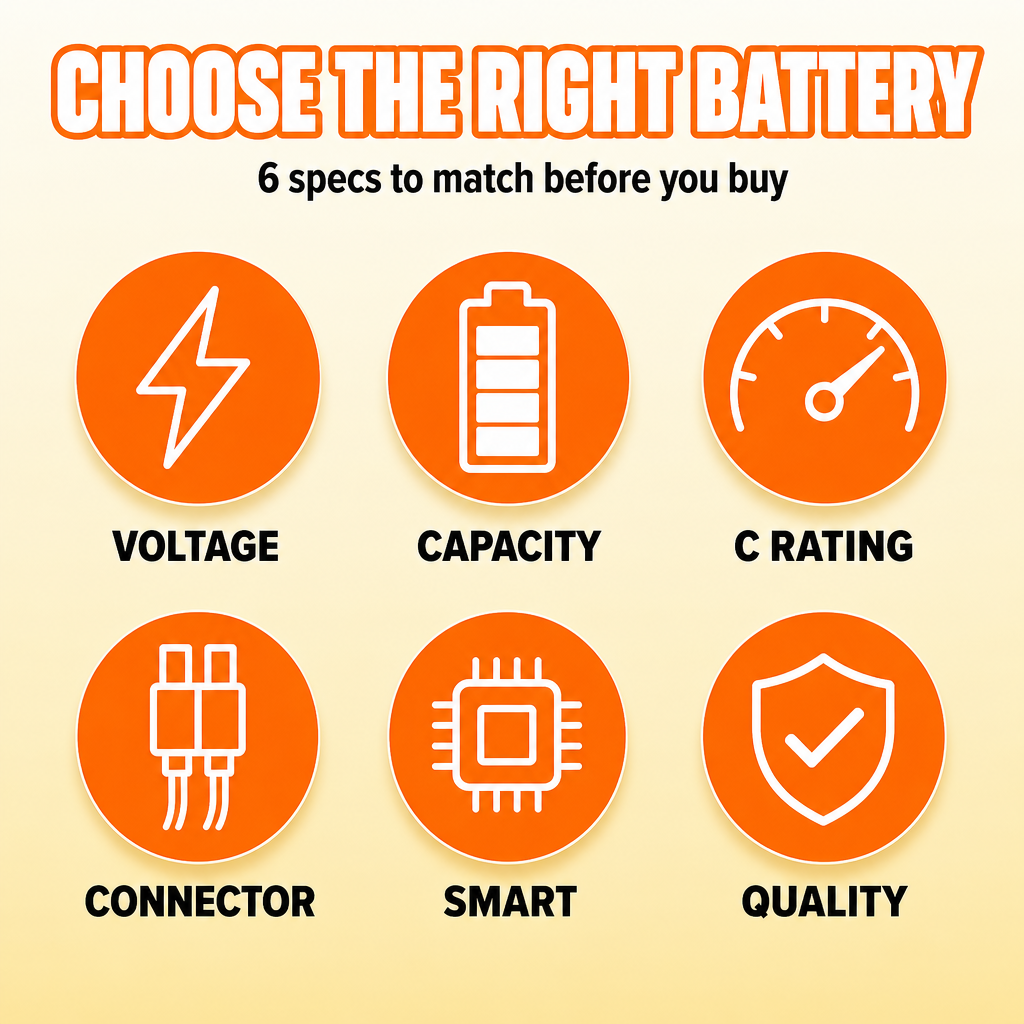
Buying a new drone battery sounds easy — find the pack your drone came with and order another one. In practice it rarely stays that simple. Maybe you need spares, want longer flights, or the original battery is no longer stocked. That's when the spec sheet starts to look like alphabet soup: 4S, 5200mAh, 45C, XT60. Get it wrong and the price is more than money — a mismatched pack sags under load, runs hot, stresses the electronics, and can turn a routine flight into an early landing.
The good news is that you only need to make sense of a handful of numbers to choose well. Here's what matters, roughly in the order you should think about it.
1. Start With the Voltage and Cell Count
This is the one number you can't get wrong. The pack's voltage has to sit inside the range your drone was designed for — the same cell count, not one more, not one less.
Batteries are described by their cells in series (the "S" number):
- 3S: 11.1V nominal, about 12.6V fully charged
- 4S: 14.8V nominal, about 16.8V fully charged
- 6S: 22.2V nominal, about 25.2V fully charged
Plug a 6S pack into a drone built for 4S and you're asking the speed controllers and motors to handle voltage they were never rated for. Go the other way and the drone flies flat and sluggish, drawing extra current to make up for the missing power. If you're not sure what your drone takes, check the manual — or simply read the label on the battery that came with it. The cell count is printed on every decent pack.
2. Pick a Capacity That Fits How You Fly
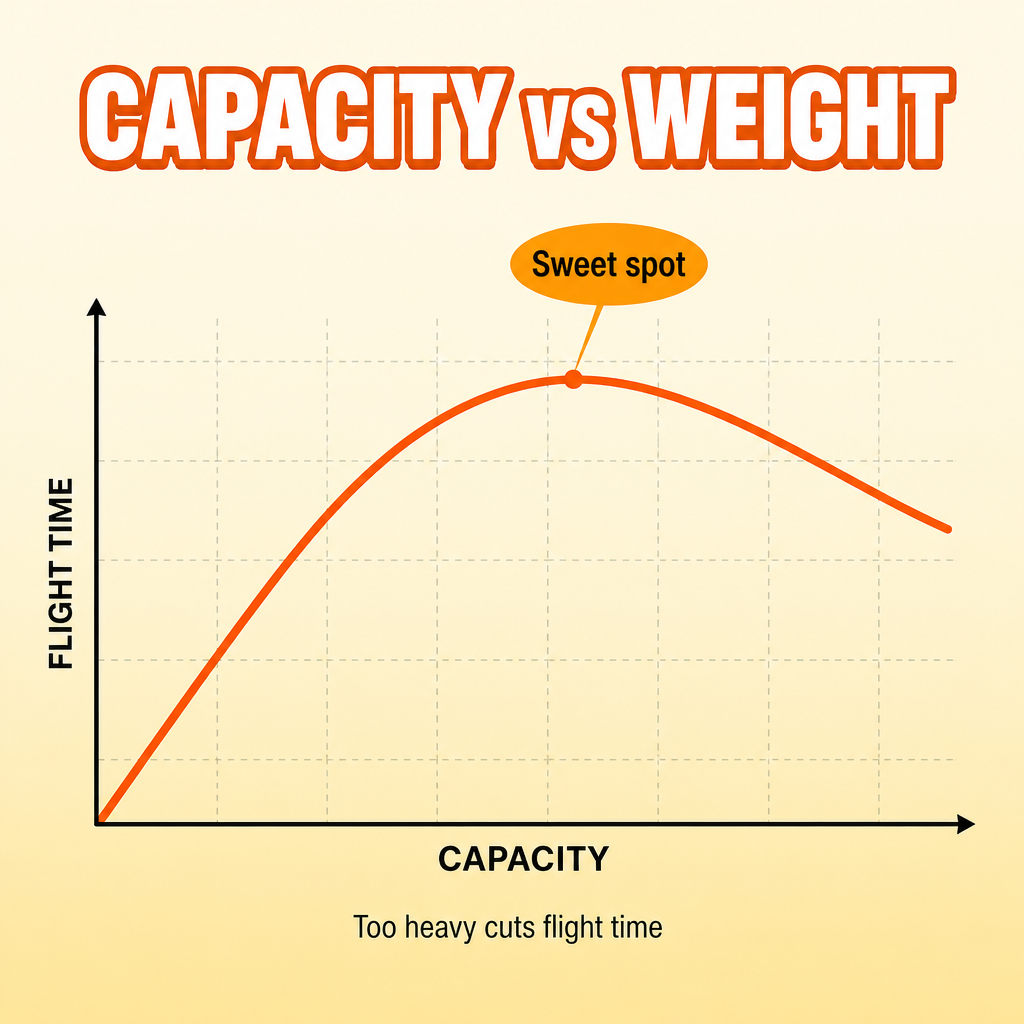
Capacity, in mAh, is the number that decides flight time. More mAh means more endurance — up to a point.
The limit is weight. A bigger pack makes the aircraft heavier, and a heavier aircraft needs more current just to stay level — current that quietly eats the flight time you paid for. Go past a certain size and you end up flying shorter, not longer, on a drone that also handles worse.
So think about what you actually do with the drone before you buy:
- Long, steady flights — photography, mapping, gentle cruising — reward big capacity.
- Racing and freestyle reward the opposite: the lightest pack that still delivers the current, so the quad stays responsive.
- For general flying, choose the capacity your drone carries comfortably, not the largest number that fits the bay.
3. Don’t Underrate the Discharge Rating
The C rating tells you how much current the battery can keep delivering under load. Multiply the C number by the capacity in amp-hours and you get the sustained current: a 3000mAh pack rated 20C can hold about 60A continuous.
That number matters because your motors pull current according to props, weight, and throttle. When the pack can't keep up, voltage sags mid-flight, the battery heats up, and low-voltage warnings tend to show up at exactly the wrong moments. Push it like that flight after flight and the pack ages fast.
More C isn't automatically better either. A rating you never use just adds weight and cost. Pick something comfortably above what your setup actually draws — for many hobby drones that lands in the 30–60A range — and call it done.
4. Make Sure the Pack Actually Fits
A battery that checks every spec box is useless if it doesn’t fit your drone. Three things to verify before you order:
- Size — measure the battery bay. A pack that has to be forced in can pinch wires or flex the frame in flight.
- Weight and balance — a much heavier pack shifts the center of gravity, and an off-balance drone behaves like a different aircraft.
- Connector — XT60, XT90, EC3, EC5, and T-plug are all common, and they don’t mix. Matching the connector your drone and charger already use saves you adapters and awkward soldering later.
5. Smart Battery or Standard?
If you've shopped for drone batteries recently, you've seen two very different kinds of pack.
Smart packs carry their own management system. They watch each cell, log charge cycles, warn you before a problem turns serious, and many discharge themselves to a safe storage voltage when you forget. You trade a higher price — and, on some brands, a closed ecosystem — for that convenience. A smart pack from one manufacturer usually won’t talk to another brand’s drone.
Standard packs are cheaper, widely interchangeable, and completely fine. They just put the responsibility on you: you set the storage charge, you check cell balance, you retire the pack when it misbehaves.
If you want the least possible fuss, smart is worth the premium. If you’re comfortable with basic battery care, or you fly several different drones, standard packs often make more sense.
6. Quality Beats Specs on Paper
Here’s the uncomfortable truth about cheap batteries: the numbers on the label are the last thing you should trust. Budget packs are where overstated capacity, weak cells, and premature swelling come from — and a failing LiPo isn’t just an inconvenience, it’s a fire risk.
Things worth checking before you buy:
- An actual brand with a history, not a random listing
- Recognized marks like CE and RoHS, plus UN38.3 certification for air transport
- A warranty, and someone to contact if the pack arrives dead on arrival
- Reviews from pilots flying similar gear, not just the store’s own photos
You can't judge cell quality from a product photo, and that's exactly why brand reputation and feedback from real pilots count for more here than in almost any other purchase.
7. Buy for the Flying You Do
Run through the list above and the right pack usually stands out:
- Aerial photography and survey work: endurance first — high capacity with a moderate C rating.
- Racing and freestyle: light weight and headroom in the C rating over raw capacity.
- Heavy lifting and industrial jobs: capacity, rugged build, dependable connectors — plus spares.
- New pilots: skip the biggest, cheapest pack. A quality battery that matches your drone teaches you more than a bargain that doesn’t.
How Many Batteries Should You Own?
At least two. One pack can’t fly all afternoon — it needs to cool down before recharging, and batteries wear out with use. Owning two or three lets you keep flying while one charges, and spreading your flights across packs keeps every battery younger for longer. Beyond three or four, you’re mostly buying convenience.
Where It’s Okay to Save Money
You can economize on capacity you rarely use, on smart features you don’t need, and on brand markup if you only fly occasionally. Don’t economize on the essentials: correct voltage, real cell quality, and a battery that fits properly. Those three aren’t negotiable, and the few dollars saved on a no-name pack rarely look worth it from the ground.
Final Thoughts
You don't need to be a spec-sheet expert to buy a good battery. Match the voltage, size the capacity to the flying you actually do, make sure the discharge rating can feed the motors, and buy from a brand you'd trust with your aircraft. Get those four right and you've already dodged most of the mistakes that end flights early. The right pack doesn't just fly longer — it flies safer, and that's worth more than any label.
Learn how to choose drone batteries for your drone. Match voltage and cell count, size capacity to your flying style, pick the right discharge rating, check size and connectors, and weigh smart batteries, cell quality, and price before you buy.
Table of Contents
- 1. Start With the Voltage and Cell Count
- 2. Pick a Capacity That Fits How You Fly
- 3. Don’t Underrate the Discharge Rating
- 4. Make Sure the Pack Actually Fits
- 5. Smart Battery or Standard?
- 6. Quality Beats Specs on Paper
- 7. Buy for the Flying You Do
- How Many Batteries Should You Own?
- Where It’s Okay to Save Money
- Final Thoughts