
 EN
Drone batteries directly affect flight time, power output, payload capacity, flight stability, and operational safety. Most modern drones use rechargeable lithium-based batteries, but the most suitable battery chemistry and specifications depend on the aircraft’s size, motors, payload, and intended application.
This guide explains what batteries drones use, how different battery types compare, how to calculate flight time, and how to safely select, charge, store, and maintain a drone battery.
What Types of Batteries Do Drones Use?
Most consumer, FPV, aerial photography, and professional drones use one of the following battery types:
-Lithium polymer batteries (LiPo)
-Lithium-ion batteries (Li-ion)
-High-voltage lithium polymer batteries (LiHV)
-Lithium iron phosphate batteries (LiFePO4)
-Smart battery packs with an integrated battery management system (BMS)
-Older nickel-based batteries are now uncommon because they are heavier and -store less energy.
1. Lithium Polymer Batteries (LiPo)
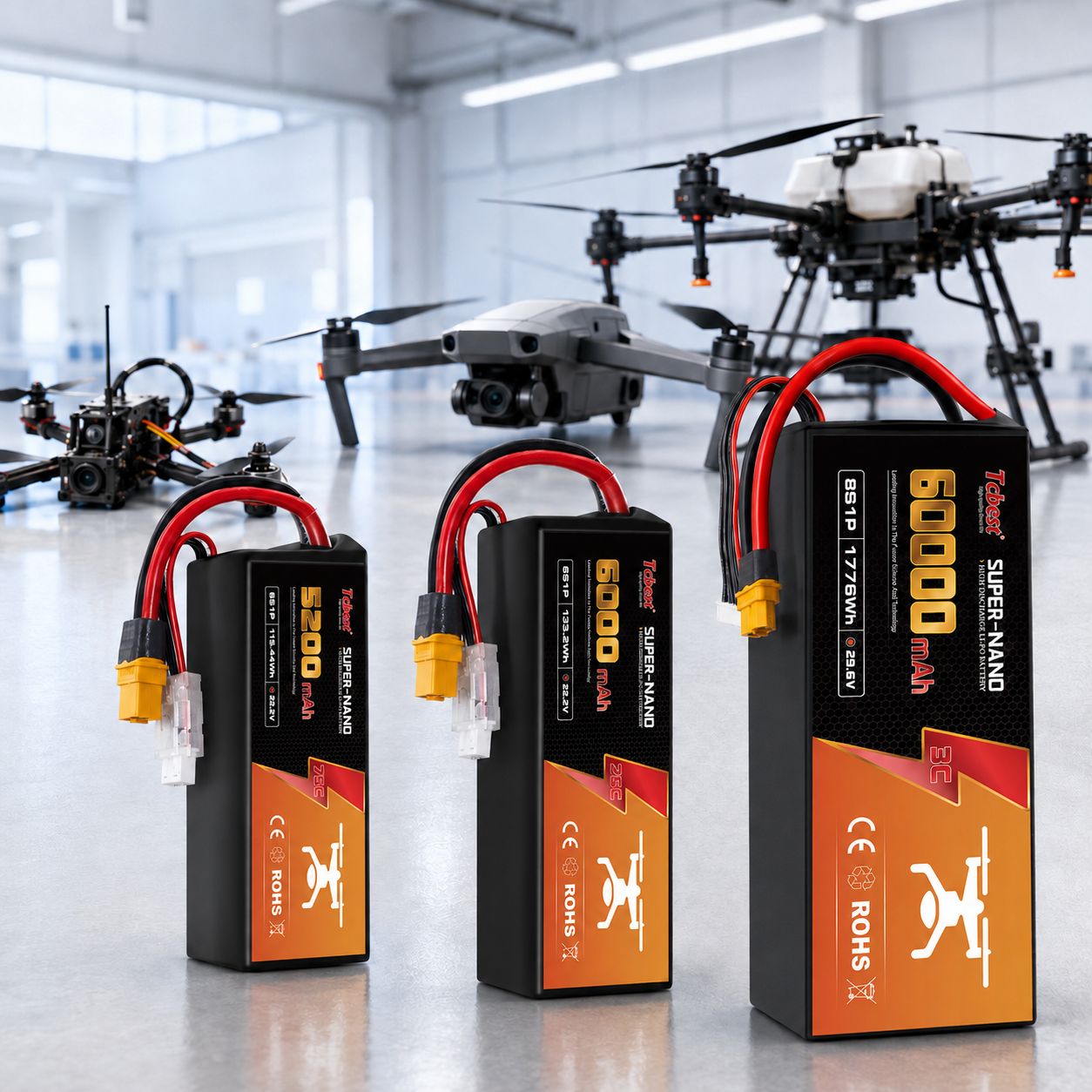
Lithium polymer batteries, commonly known as LiPo batteries, are the most widely used power source for FPV drones, racing drones, aerial photography drones, and many professional aircraft.
LiPo cells use lightweight pouch packaging, allowing manufacturers to produce batteries in various shapes and sizes. They can also deliver the high current required for rapid acceleration, climbing, and aggressive maneuvers.
Advantages of LiPo Drone Batteries
discharge rates
High Lightweight construction
Flexible shapes and dimensions
Strong power output
Suitable for high-performance motors
Disadvantages of LiPo Drone Batteries
-Sensitive to overcharging and deep discharge
-More vulnerable to swelling and physical damage
-Require a compatible balance charger
-Present a higher fire risk when damaged or charged incorrectly
-LiPo batteries are generally the best choice for FPV racing, freestyle flying, aerial photography, and other applications requiring rapid power delivery.
2. Lithium-Ion Batteries (Li-ion)
Lithium-ion batteries commonly use cylindrical cells such as 18650 or 21700 cells. They usually offer higher usable energy density and longer endurance than high-discharge LiPo battery packs, although their maximum current output may be lower.
Advantages of Lithium-Ion Drone Batteries
-Long flight endurance
-Low self-discharge
-Good cycle life
-High energy storage relative to weight
-Suitable for long-distance cruising
Disadvantages of Lithium-Ion Drone Batteries
-Lower discharge capability than many FPV LiPo batteries
-Less suitable for aggressive acceleration
-Cylindrical cells limit battery-pack shapes
-Require precise cell matching and pack design
Lithium-ion batteries are commonly used in long-endurance drones, mapping aircraft, inspection drones, and other applications that prioritize flight time over maximum burst power.
3. High-Voltage Lithium Polymer Batteries (LiHV)
High-voltage lithium polymer batteries, commonly known as LiHV batteries, are designed for a higher maximum charging voltage than standard LiPo batteries.
A standard LiPo cell is usually charged to 4.20V, while a LiHV cell may be charged to approximately 4.35V. This provides slightly more stored energy, but only when the drone and charger are specifically designed for LiHV batteries.
Never charge a standard LiPo battery using a LiHV voltage setting. Doing so may cause swelling, overheating, permanent damage, or fire.
4. Lithium Iron Phosphate Batteries (LiFePO4)
Lithium iron phosphate batteries, or LiFePO4 batteries, are valued for their thermal stability, long cycle life, and reliable performance.
They are less common in small drones because they generally provide less energy per kilogram than LiPo or conventional lithium-ion batteries. However, their safety and durability may make them suitable for certain industrial, research, and safety-critical platforms.
5. Nickel-Based Drone Batteries
Nickel-cadmium (NiCad) and nickel-metal hydride (NiMH) batteries were once used in older radio-controlled aircraft, but they are rarely selected for modern drones.
These batteries are heavier and have lower energy density than lithium batteries. Nickel-cadmium batteries also contain toxic cadmium and may suffer from memory-effect problems.
They may still appear in older equipment, educational aircraft, or specialized systems, but they are generally unsuitable for modern high-performance drones.
Understanding Drone Battery Voltage
Drone battery voltage mainly depends on the number of cells connected in series. The letter “S” indicates the series cell count.
Cell Count |
Nominal Voltage |
Fully Charged Voltage |
1S |
3.7V |
4.2V |
2S |
7.4V |
8.4V |
3S |
11.1V |
12.6V |
4S |
14.8V |
16.8V |
6S |
22.2V |
25.2V |
Higher voltage allows a motor system to produce the same power using less current. However, the drone’s motors, electronic speed controllers, flight controller, and other components must support the selected voltage.
Never replace a battery with a higher-voltage model unless the aircraft manufacturer confirms compatibility.
What Does Battery Capacity Mean?
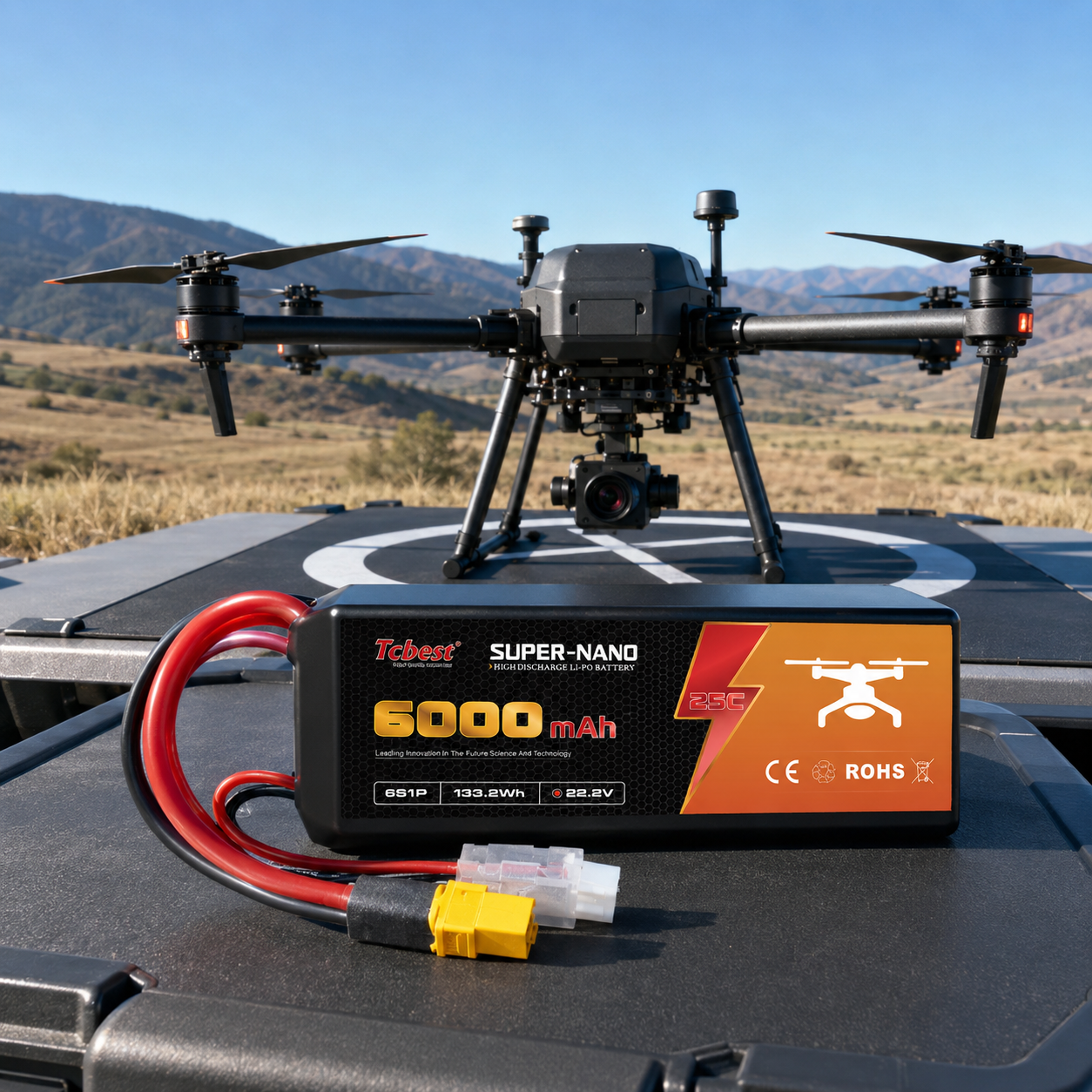
Battery capacity is measured in milliamp-hours (mAh) or amp-hours (Ah). It indicates how much electrical charge the battery can store.
A higher-capacity battery may provide a longer flight time, but it will also be larger and heavier. If the additional weight is excessive, the motors must consume more power to keep the drone airborne, reducing the expected endurance benefit.
Therefore, the best drone battery is not always the one with the highest capacity. It is the battery that provides the best balance among capacity, weight, power output, and aircraft compatibility.
What Is the C Rating of a Drone Battery?
The C rating indicates how quickly a battery can safely discharge.
Maximum continuous current (A) = Battery capacity (Ah) × C rating
For example, a 4000mAh battery has a capacity of 4Ah. If its rated continuous discharge rate is 50C:
4Ah × 50C = 200A
In practice, advertised C ratings are not always measured using the same testing standards. Buyers should also consider voltage sag, internal resistance, operating temperature, connector limitations, and manufacturer test data.
Exceeding the battery’s safe discharge current may cause overheating, sudden voltage drops, swelling, reduced cycle life, or permanent damage.
Which Batteries Are Suitable for Different Types of Drones?
FPV Racing and Freestyle Drones
FPV drones normally use high-discharge LiPo batteries. Racing pilots require lightweight battery packs that can provide high current during sudden acceleration and rapid directional changes.
Common configurations include 4S and 6S packs, although the correct voltage depends on the motor and electronic speed controller specifications.
Aerial Photography and Consumer Drones
Aerial photography drones usually use proprietary smart lithium battery packs. These batteries may contain electronics that monitor temperature, voltage, cycle count, cell balance, and remaining capacity.
Some smart batteries also provide an automatic discharge function for storage.
Long-Endurance Drones
Long-endurance drones often use lithium-ion battery packs because flight time is more important than maximum burst power. The motors and propellers must operate efficiently within the battery’s current limits.
Agricultural and Industrial Drones
Agricultural spraying, mapping, delivery, and inspection drones require larger battery packs to support heavier payloads.
-These batteries may include:
-High-current cells
-Reinforced enclosures
-Temperature sensors
-Communication interfaces
-Battery management systems
-Customized connectors
-Impact and vibration protection
Specialized Drones
Specialized drones may require customized batteries for extreme temperatures, vibration, impact, extended endurance, or high-altitude operation.
How to Calculate Drone Flight Time
A simplified flight-time estimate can be calculated using battery energy and average power consumption:
Flight time (hours) = Battery capacity (Ah) × Nominal voltage (V) × System efficiency ÷ Average power consumption (W)
For example, a 5Ah, 14.8V battery stores approximately:
5Ah × 14.8V = 74Wh
If the drone consumes an average of 500W and the system efficiency is estimated at 80%:
74Wh × 0.8 ÷ 500W = 0.118 hours
This is approximately seven minutes.
Actual flight time may be affected by:
-Aircraft weight
-Payload
-Wind speed
-Propeller efficiency
-Flight speed
-Aggressive acceleration
-Ambient temperature
-Battery age
-Internal resistance
-Required landing reserve
Pilots should normally land before the battery is completely depleted. Maintaining a reasonable reserve reduces the risk of sudden voltage drops and helps protect the cells.
How to Charge a Drone Battery Safely
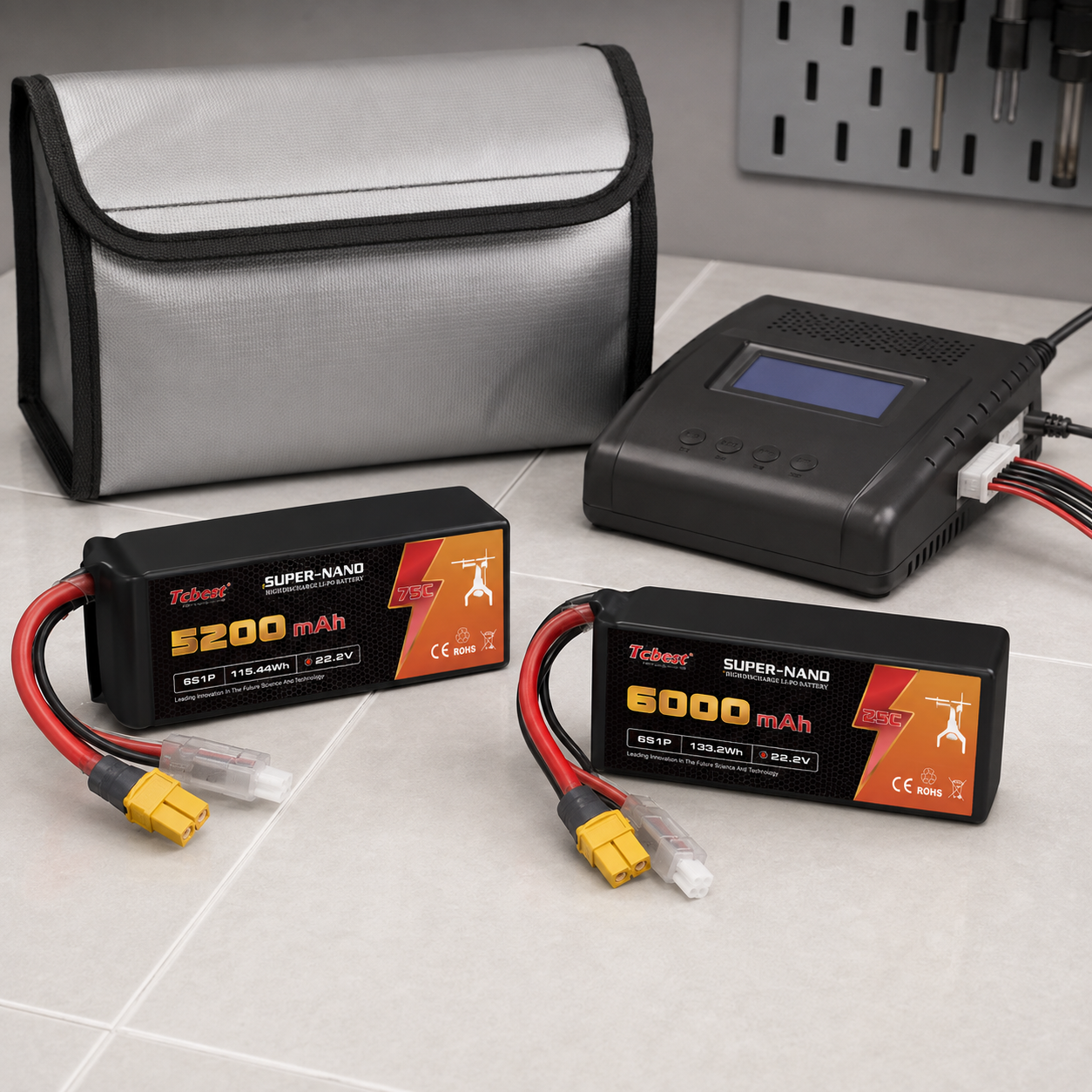
Always use a charger designed for the battery’s chemistry, voltage, and cell count.
For a standard FPV LiPo battery:
1.Inspect the battery for swelling, punctures, damaged wires, or loose connectors.
2.Confirm the correct battery chemistry and series cell count on the charger.
3.Connect both the main power lead and balance connector when balance charging is required.
4.Select a suitable charging current. A 1C rate is commonly used unless the manufacturer specifies otherwise.
5.Charge the battery on a nonflammable surface in a well-ventilated area.
6.Remain nearby throughout the charging process.
7.Disconnect the battery when charging is complete.
Charging at 1C does not always mean the battery will be fully charged in exactly one hour. The final balancing and constant-voltage stages may increase the total charging time.
How Should Drone Batteries Be Stored?
Lithium batteries should not remain fully charged or deeply discharged for long periods.
For many LiPo batteries, a storage voltage of approximately 3.7–3.85V per cell is suitable. Always follow the battery manufacturer’s instructions, as smart batteries may manage storage discharge automatically.
For safer storage:
1.Remove the battery from the drone after it has cooled.
2.Store it in a cool, dry, and ventilated location.
3.Avoid direct sunlight and heat sources.
4.Protect the terminals against accidental short circuits.
5.Keep the battery away from flammable materials.
6.Periodically inspect stored batteries for swelling or abnormal voltage loss.
When Should a Drone Battery Be Replaced?
-Stop using a battery if you notice:
-Swelling or bubbling
-Cracks, punctures, or crushed areas
-Electrolyte leakage
-Damaged connectors or wires
-Unusual heat during charging or use
-Severe cell-voltage imbalance
-Rapidly decreasing flight time
-Excessive voltage sag
-Significantly increased internal resistance
Do not puncture, crush, burn, or test a visibly damaged lithium battery. Isolate it safely and take it to an authorized battery recycling or hazardous-waste facility according to local regulations.
Can Drone Batteries Be Taken on an Airplane?
Airlines apply strict rules to lithium batteries. Spare drone batteries are generally required to be carried in cabin baggage rather than checked baggage. Their terminals must also be protected against short circuits.
Battery restrictions are usually based on watt-hours:
Watt-hours (Wh) = Nominal voltage (V) × Capacity (Ah)
Rules may vary depending on the airline, country, battery size, and route. Check the current requirements of the airline and relevant aviation authority before traveling. Never carry a damaged or swollen battery.
How to Choose a Drone Battery Manufacturer
For commercial and customized drone projects, a battery manufacturer should not be evaluated on price alone.
Important factors include:
-Experience with LiPo and lithium-ion battery packs
-Cell sourcing and traceability
-Voltage, capacity, and internal-resistance consistency
-Battery management system development
-Custom shape and connector options
-Protection-circuit design
-Prototyping and testing capabilities
-Production capacity and delivery control
-Quality-management procedures
-Technical support and warranty service
Depending on the product and target market, relevant documentation may include UN38.3, MSDS, IEC 62133, CE, RoHS, or other application-specific certifications and test reports.
A professional customization process normally includes requirement confirmation, electrical design, structural design, sample production, performance testing, safety verification, optimization, and mass production.
Future Drone Battery Technologies
Lithium-ion and LiPo batteries will continue to be widely used, but several emerging technologies may improve drone endurance and safety.
Solid-State Batteries
Solid-state batteries replace conventional liquid or gel electrolytes with solid materials. Their potential advantages include improved safety and higher energy density, although manufacturing costs and large-scale commercialization remain challenging.
Lithium-Sulfur Batteries
Lithium-sulfur technology may provide higher specific energy than conventional lithium-ion batteries. It is being explored for long-endurance aviation applications, but cycle life, stability, and commercial scalability still require improvement.
Lithium-Metal Batteries
Lithium-metal cells may significantly increase stored energy without proportionally increasing battery weight. However, safety, cycle life, dendrite formation, and manufacturing consistency remain important development challenges.
Hydrogen Fuel Cells
Hydrogen fuel-cell systems can provide longer endurance for certain industrial drones. They are more complex than rechargeable battery packs and require hydrogen storage, supporting equipment, and specialized operating procedures.
Intelligent Battery Management
Future drone batteries will increasingly use intelligent monitoring to estimate remaining flight time, detect cell imbalance, predict battery aging, and prevent unsafe operation.
Frequently Asked Questions
What Batteries Do Most Drones Use?
Most modern drones use lithium polymer or lithium-ion batteries. FPV drones commonly use high-discharge LiPo packs, while long-endurance aircraft may use lithium-ion packs.
Can I Use a Higher-Capacity Battery in My Drone?
Only if its voltage, dimensions, weight, connector, discharge capability, and effect on the aircraft’s center of gravity are compatible with the drone.
Can I Replace a 4S Battery With a 6S Battery?
No, unless the motors, electronic speed controllers, and other electronic components are specifically rated for 6S voltage.
How Long Does a Drone Battery Last?
Flight time may range from only a few minutes for racing drones to more than 30 minutes for efficient aerial photography or long-endurance drones.
Battery service life depends on operating temperature, discharge depth, charging habits, storage conditions, and operating load.
Why Does My Drone Battery Drain Quickly?
Possible causes include cold weather, a heavy payload, strong winds, aggressive flying, inefficient propellers, aging cells, increased internal resistance, or unsuitable battery specifications.
Conclusion
So, what batteries do drones use? Most drones rely on LiPo batteries for high power and flexible packaging or lithium-ion batteries for longer endurance. LiHV and LiFePO4 batteries serve more specialized requirements, while emerging technologies may support future long-endurance aircraft.
Choosing the right drone battery requires more than matching voltage and capacity. You must also consider cell count, discharge rate, weight, dimensions, connector type, operating temperature, aircraft power demand, charging method, and safety protection.
Three rules are especially important:
1.Never leave a lithium battery charging unattended.
2.Never continue using a swollen, leaking, or physically damaged battery.
3.Store the battery at the manufacturer-recommended voltage in a cool, dry, and protected location.
This complete guide covers drone battery types, performance metrics, safety, and maintenance. It explains LiPo, Li-ion, LiHV, and LiFePO4 batteries, voltage, capacity, C-rating, flight time calculation, charging, storage, and replacement signs. It also explores future technologies including solid-state, lithium-sulfur, and lithium-metal batteries for longer endurance
Table of Contents
- What Types of Batteries Do Drones Use?
- 1. Lithium Polymer Batteries (LiPo)
- 2. Lithium-Ion Batteries (Li-ion)
- 3. High-Voltage Lithium Polymer Batteries (LiHV)
- 4. Lithium Iron Phosphate Batteries (LiFePO4)
- 5. Nickel-Based Drone Batteries
- Understanding Drone Battery Voltage
- What Does Battery Capacity Mean?
- What Is the C Rating of a Drone Battery?
- Which Batteries Are Suitable for Different Types of Drones?
- How to Calculate Drone Flight Time
- How to Charge a Drone Battery Safely
- How Should Drone Batteries Be Stored?
- When Should a Drone Battery Be Replaced?
- Can Drone Batteries Be Taken on an Airplane?
- How to Choose a Drone Battery Manufacturer
- Future Drone Battery Technologies
- Frequently Asked Questions
- Conclusion