
 EN
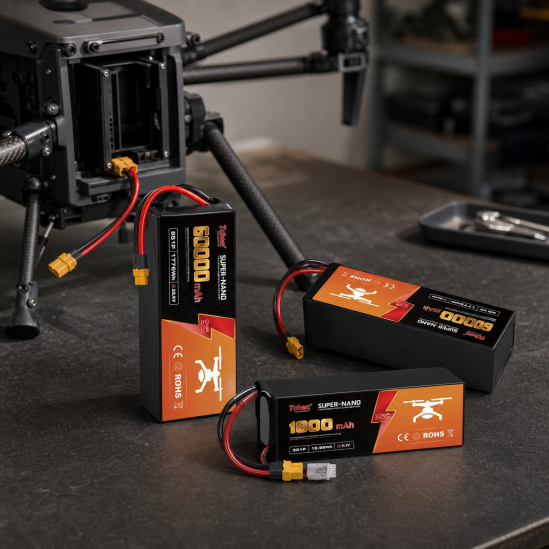
Anyone who flies drones has probably experienced this moment: you are in the middle of capturing a great shot when the battery icon on the screen suddenly starts flashing. The anxiety kicks in immediately. You start calculating the fastest route back while wondering why you did not bring an extra battery.
Drone batteries may not seem like the most exciting part of a drone. They do not attract as much attention as flight controllers, cameras, or video transmission systems. But without a battery, even the most expensive drone is nothing more than a carefully designed collection of plastic and metal.
In fact, many beginners focus almost entirely on camera resolution, flight time, and obstacle avoidance when buying their first drone. Very few people seriously study the black battery pack hidden inside the aircraft. It is usually only after flying for a while, when they start thinking about longer flight time or upgrading their drone, that they realize there is much more to drone batteries than expected.
Battery Size: Bigger Is Not Always Better
Battery size is probably one of the first specifications people notice. Common sense tells us that a larger battery should hold more energy and therefore provide longer flight time. In general, that is true. Under similar technical conditions, physical size is closely related to battery capacity. A 5000mAh battery will naturally be larger than a 1500mAh battery.
The problem, however, is the extra weight.
A drone is very different from a car. A car carrying more weight may simply consume more fuel, but every extra gram on a drone has to be lifted continuously by the motors. If you install an oversized battery, you may gain more capacity, but the motors also need to produce more power just to keep the heavier aircraft in the air.
Sometimes, a larger-capacity battery can even result in shorter flight time because much of the additional energy is used simply to carry the battery's own weight.
That is why one of the first things you should check when selecting a battery is your drone's maximum takeoff weight. This information can usually be found in the user manual or on the manufacturer's website.
For example, if your drone has a maximum takeoff weight of 250 grams and the larger battery pushes the total weight very close to that limit, you should not expect ideal flight performance. Leaving some weight allowance for the camera, gimbal, or other accessories can make the drone much easier and more efficient to fly.
There is also another very practical issue: whether the battery physically fits inside the battery compartment.
Some batteries may look attractive because of their higher capacity, but just two extra millimeters in width or thickness can make installation difficult. In some cases, people force the battery into the compartment and then struggle to remove it afterward.
Before buying, it is always a good idea to measure the internal dimensions of the battery compartment rather than choosing a battery based only on its capacity.
Voltage and Cell Count: Key Factors in Power Output
Anyone familiar with FPV drones has probably seen terms such as 2S, 4S, and 6S.
The “S” refers to the number of battery cells connected in series. A typical lithium battery cell has a nominal voltage of 3.7V. Two cells in series provide 7.4V, three cells provide 11.1V, and so on.
Higher voltage allows the motors to receive more power, which usually translates into stronger acceleration, faster throttle response, and higher overall performance.
But higher voltage does not automatically mean better.
Higher-voltage battery packs are generally heavier and may discharge faster under aggressive flying conditions. Take FPV drones as an example. A 6S setup can provide much more aggressive acceleration and high-speed performance than a 4S setup, especially during rapid climbs or dives.
The trade-off is that 6S batteries are generally larger, heavier, and more expensive. In some cases, the price of one 6S battery can be similar to that of two or even three lower-voltage batteries.
For beginners, casual FPV pilots, or people mainly flying aerial photography missions and slow cruising flights, a 3S or 4S battery may already provide enough performance. There is often no need to use a higher-voltage battery unless your drone is designed for it.
So how do you determine the most suitable voltage?
The most reliable method is to check the specifications of your motors and ESCs.
Motor manufacturers usually provide thrust data showing how much thrust and current a motor produces at different voltages, propeller sizes, and throttle levels. By comparing these figures with the weight of your drone, you can estimate how much thrust is required for hovering and identify the setup that delivers adequate performance with reasonable current consumption.
Another important point is voltage compatibility.
ESCs and flight controllers usually have a defined voltage range. If an ESC only supports up to 4S and you connect a 6S battery, you may damage the ESC or even the flight controller.
Before purchasing a battery, always confirm the maximum voltage supported by your electronic components. This information is usually printed on the ESC or listed in the product specifications.
Connectors: Small Components That Matter a Lot
Battery connectors may look insignificant, but when something goes wrong with them, they can become a major source of trouble.
Common drone battery connectors include XT30, XT60, EC3, EC5, and T-style connectors. Different connector types have different physical sizes and current-handling capabilities.
XT60 connectors are especially common in RC models and drones because they can handle relatively high current while providing a secure connection that does not easily come loose during flight.
The basic rule when choosing a connector is simple: it must match your drone and charger.
If your drone uses an XT60 connector, then ideally your battery should also use the matching XT60 connector.
If the connectors do not match, you may need to replace the connector or use an adapter cable. However, adapter cables should be avoided whenever possible.
Every additional connection point introduces extra electrical resistance. Under high current, these points may heat up, and in severe cases, the plastic connector housing can even soften or melt.
Another detail that is often overlooked is soldering quality.
Some low-cost battery packs use poorly soldered connectors, with uneven joints or insufficient solder penetration into the wire strands. The battery may appear to work normally at first, but after repeated high-current flights, the solder joint can heat up and its resistance can increase.
Eventually, that small soldering point can become the bottleneck that limits the performance of the entire battery.
When choosing a battery, pay attention to details such as clean solder joints, properly insulated wiring, and well-fitted heat-shrink tubing. Small details like these can often reveal a lot about a manufacturer's quality control.
Discharge Rate: Understanding the Meaning of C Rating
What exactly do labels such as 25C, 50C, or 100C mean?
Simply put, the C rating indicates how quickly a battery can safely discharge relative to its capacity.
To estimate the maximum continuous discharge current, multiply the battery capacity by the C rating.
For example, a 2000mAh 30C battery can theoretically provide:
2000mAh × 30 = 60,000mA
That equals 60A of continuous discharge current.
This number matters because it determines whether the battery can provide enough current for your motors.
Suppose your drone requires 40A at full throttle, but the battery can only reliably provide 30A. In that situation, the battery may struggle to supply enough current, resulting in voltage sag, reduced motor speed, and weaker thrust.
On the other hand, if the battery's discharge capability is much higher than what your motors actually require, there is generally no major disadvantage apart from paying extra for performance you may never use.
So is a higher C rating always better?
Not necessarily.
Higher-C batteries often use designs with lower internal resistance and materials optimized for high-current discharge. These packs may be slightly heavier, larger, and more expensive.
For casual aerial photography drones, a battery with a moderate discharge rate may be sufficient. FPV and racing drones, however, can require much higher discharge capability because their motors may draw very large bursts of current during aggressive throttle inputs.
The best way to choose the correct C rating is to look at motor test data.
Motor manufacturers often provide current consumption at different voltages and throttle levels. Add together the maximum current draw of all motors, then leave an additional safety margin of around 20% to 30%.
For example, if four motors together can draw 80A at full throttle, choosing a battery capable of safely delivering more than 100A would provide a reasonable margin.
Drone Battery Brands
When comparing batteries on paper, many brands appear very similar. They may all advertise several thousand milliamp-hours of capacity and high C ratings.
In real-world use, however, the difference can be significant.
One of the biggest factors is the quality and consistency of the battery cells.
High-quality cells usually have lower internal resistance, lower self-discharge, and better consistency between cells. They can often maintain relatively good capacity even after many charge and discharge cycles.
Lower-quality cells may begin swelling after relatively few cycles, lose capacity quickly, or generate excessive heat during charging and discharging.
There are many drone battery brands on the market today, with prices ranging from very inexpensive to quite costly. Some low-priced batteries advertise the same capacity and C rating as premium products, but their actual performance may fall far below the specification.
Experienced users often check battery internal resistance or compare the actual capacity measured by a charger. These tests can quickly reveal whether a battery's advertised specifications are realistic.
For beginners, however, the easiest approach is usually to choose a brand with stable product quality and a good reputation.
For example, Tcbest offers drone battery solutions with extensive manufacturing experience, stable quality control, strong safety performance, and competitive value for different drone applications.
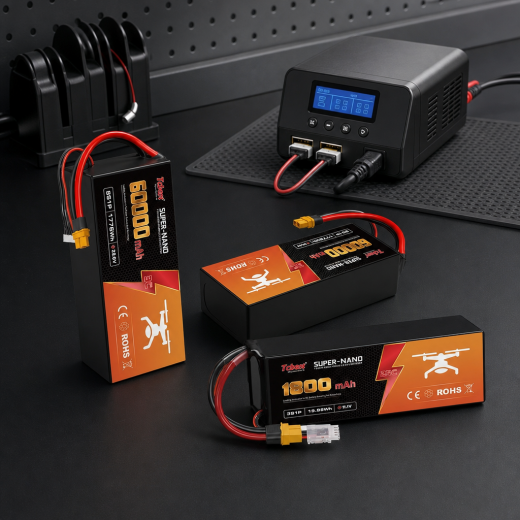
Daily Drone Battery Maintenance
Many people spend a lot of time choosing a good battery, only to shorten its lifespan because of poor charging, discharging, or storage habits.
Lithium batteries are particularly sensitive to two things: over-discharging and overcharging.
Over-discharging means allowing the battery voltage to fall too low. If a lithium cell drops below around 3.0V, or even down to 2.8V, permanent damage may occur.
Once the voltage reaches extremely low levels, the internal chemistry of the battery can begin to degrade, resulting in permanent capacity loss.
That is why it is important to set a low-voltage alarm when flying. For many drone batteries, once the voltage approaches around 3.5V per cell under light load, it is time to start preparing to land.
Do not risk damaging the battery just to gain an extra few seconds of flight time.
Storage voltage is also very important.
Lithium batteries are generally best stored at around 3.8V per cell, often referred to as storage voltage.
If you finish flying with the battery nearly full or nearly empty and then leave it in a drawer for one or two weeks, the battery may age faster or even begin to swell.
A good habit is to use the storage mode on your charger whenever you know the battery will not be used for several days. This mode brings the pack to a more suitable storage voltage.
Temperature is another important factor.
In summer, the inside of a parked car can easily reach 50°C or 60°C. Leaving batteries in such an environment is both unsafe and harmful to battery lifespan.
Cold weather creates a different problem. At low temperatures, lithium batteries become less chemically active and their discharge performance decreases.
Before flying in winter, it is better to keep the battery warm and, when practical, bring it to around 20°C before installation. This can help improve discharge efficiency and reduce excessive voltage sag.
Conclusion
Choosing the right drone battery is not as simple as buying the most expensive battery or the one with the highest capacity.
You need to understand your actual flying requirements as well as the basic specifications of your drone's power system.
Battery size, voltage, connector type, discharge rating, and brand quality all work together to determine whether a battery is suitable for your drone.
If you mainly fly on weekends to capture scenery, there is probably no need to buy racing-grade, high-voltage, ultra-high-C batteries. In that situation, capacity, weight, reliability, and flight time may be more important.
If you enjoy high-speed FPV flying, then voltage and discharge capability become much more important, and investing in higher-performance batteries makes more sense.
More importantly, remember that batteries are consumable components. Even the best battery will eventually reach the end of its useful life.
Instead of focusing too much on finding one “perfect” battery, it is often more practical to keep several suitable battery packs ready so you can fly with greater confidence.
Hopefully, this guide helps you find the drone battery that best matches your aircraft and your flying style.
Enjoy your flights, and always put safety first.
Choosing the right drone battery involves balancing size, voltage, connector type, discharge rate, and brand. Larger batteries offer more capacity but add weight, reducing flight time. Higher voltage boosts power but increases weight. Match connectors, calculate C-rating for current needs, and choose reputable brands for reliability and safety.