
 EN
Introduction
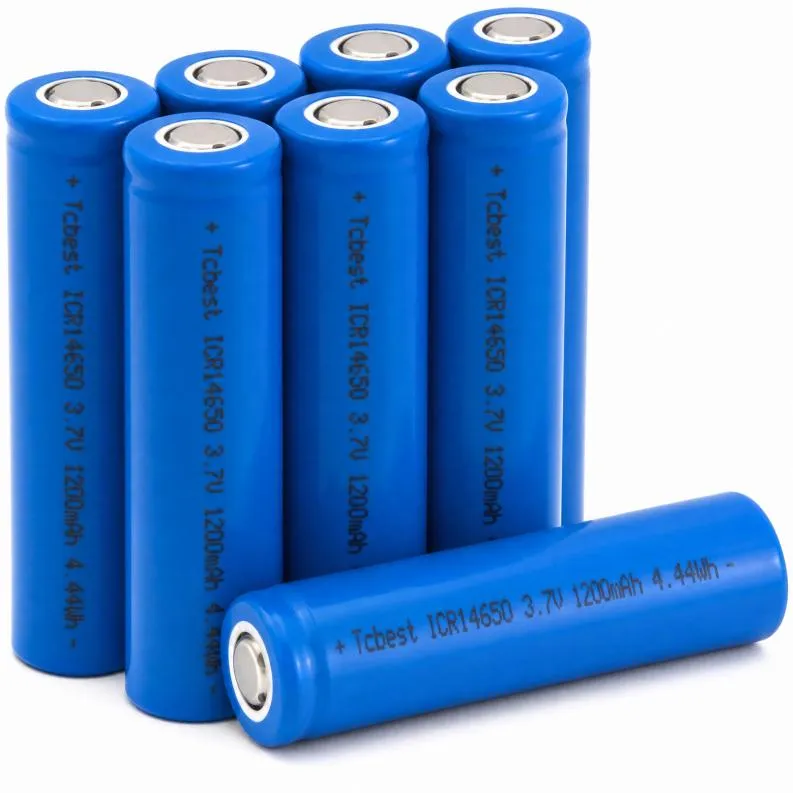
Lithium batteries have become one of the most important energy technologies in modern life. From smartphones and laptops to electric vehicles, medical equipment, smart devices, and renewable energy systems, lithium battery technology powers many products that people use every day.
Compared with traditional battery technologies, lithium batteries offer higher energy density, lighter weight, lower self-discharge, and longer service life. These advantages have made them a preferred power solution for portable electronics, industrial equipment, transportation, and energy storage applications.
However, the term “lithium battery” does not refer to only one type of battery. It includes different battery technologies with different structures, charging methods, performance characteristics, and applications. Understanding the differences between lithium batteries and lithium-ion batteries is important when selecting the right battery solution.
A lithium battery generally refers to electrochemical energy storage devices that use lithium metal or lithium-containing compounds to store and release electrical energy. They can be divided into two main categories: primary lithium batteries and rechargeable lithium-ion batteries.
This guide explains how lithium batteries work, the main types available, their advantages and disadvantages, common applications, and practical tips for improving battery life.
How Does a Lithium Battery Work?
A battery converts stored chemical energy into electrical energy through electrochemical reactions. Every battery contains three basic components:
Negative electrode (Anode) – The electrode where electrons are released during discharge.
Positive electrode (Cathode) – The electrode that receives lithium ions during discharge.
Electrolyte – A medium that allows lithium ions to move between electrodes while preventing direct electron flow inside the battery.
In a rechargeable lithium-ion battery, lithium ions move between the two electrodes during charging and discharging.
When the battery powers a device:
- Lithium ions move internally from the negative electrode to the positive electrode.
- Electrons travel through the external circuit.
- The connected device receives electrical power.
- During charging:
- The charger pushes lithium ions back toward the negative electrode.
- Energy is stored inside the battery.
- The battery becomes ready for another discharge cycle.
This reversible movement of lithium ions is known as intercalation. Unlike disposable batteries, lithium-ion batteries do not consume their active materials during normal operation, which allows them to be charged and reused many times.
Lithium is especially valuable for battery technology because it is extremely lightweight and highly electrochemically active. These properties allow lithium batteries to store significant energy while maintaining a compact size and low weight.
Lithium Battery vs Lithium-Ion Battery: What Is the Difference?
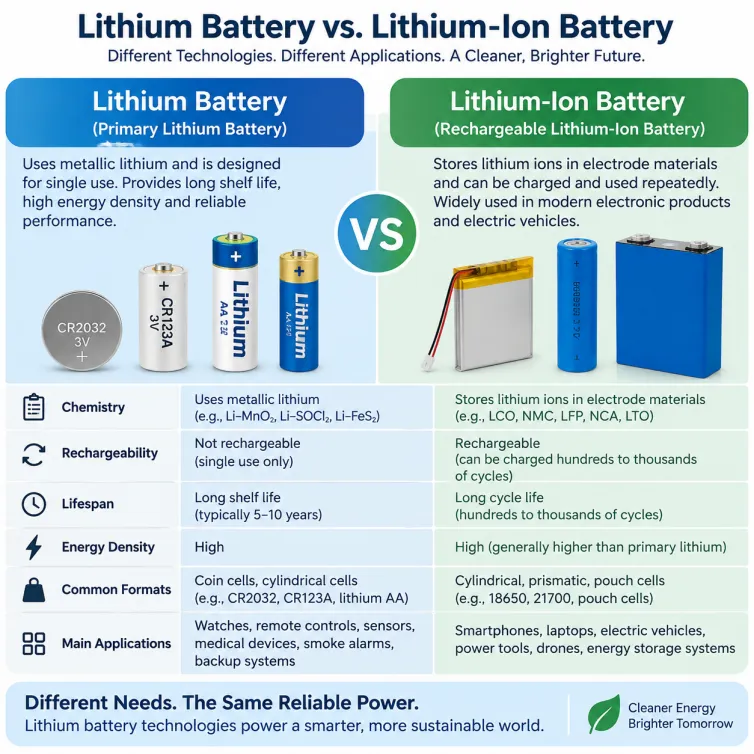
Although people often use the terms interchangeably, lithium batteries and lithium-ion batteries are not exactly the same.
Lithium Primary Battery
A lithium primary battery:
Uses metallic lithium as part of its chemistry
Is designed for single-use applications
Cannot normally be recharged
Provides long shelf life and stable standby performance
Common examples include:
CR2032 coin cells
CR123A batteries
Lithium AA batteries
Industrial lithium batteries
These batteries are commonly used in devices that require reliable power for long periods, such as:
Sensors
Watches
Remote controls
Medical devices
Security systems
Lithium-Ion Battery
A lithium-ion battery:
Uses lithium ions stored inside electrode materials
Can be charged and discharged repeatedly
Requires battery protection and management systems
Is widely used in modern electronic products
Common applications include:
Smartphones
Laptops
Power tools
Electric vehicles
Drones
Energy storage systems
The key difference is that primary lithium batteries store energy through a non-reversible chemical reaction, while lithium-ion batteries rely on reversible lithium-ion movement between electrodes.
Main Types of Lithium Batteries
Lithium battery technology has developed into many different chemistries. Each type offers different advantages in energy density, safety, cycle life, cost, and power output.
1. Primary Lithium Batteries
Primary lithium batteries are non-rechargeable batteries designed to provide power until their chemical materials are consumed.
They are popular because of:
High energy density
Extremely low self-discharge
Long storage life
Reliable performance in standby applications
These characteristics make them suitable for products that may remain unused for months or years but need immediate operation when required.
Typical applications include:
Smoke detectors
Cameras
Watches
Calculators
Sensors
Meters
Backup power devices
Common primary lithium chemistries include:
Chemistry |
Characteristics |
Applications |
Lithium Manganese Dioxide (Li-MnO₂) |
High energy density and compact design |
Coin cells, cameras, medical devices |
Lithium Thionyl Chloride (Li-SOCl₂) |
Extremely long shelf life and wide temperature range |
Industrial sensors, meters, monitoring systems |
Lithium Iron Disulfide (Li-FeS₂) |
Designed for AA-size batteries with strong performance |
Flashlights, cameras, handheld devices |
A very important safety point: primary lithium batteries should never be recharged unless specifically designed and approved as rechargeable batteries.
Attempting to recharge a disposable lithium battery may cause:
Overheating
Leakage
Battery damage
Fire risk
2. Rechargeable Lithium-Ion Batteries
Rechargeable lithium-ion batteries are currently the most widely used lithium battery technology.
They work by repeatedly moving lithium ions between electrodes during charging and discharging. Depending on battery chemistry, operating conditions, and usage habits, lithium-ion batteries can provide hundreds or even thousands of charge cycles before significant capacity loss occurs.
Lithium-ion batteries are available in several physical designs:
Cylindrical Cells
Cylindrical lithium cells are widely used because of their mechanical strength, stable production process, and cost efficiency.
Common models include:
18650 battery
21700 battery
Applications:
Power tools
E-bikes
Battery packs
Electric vehicles
Prismatic Cells
Prismatic cells use a rigid rectangular structure and are often used in larger battery systems.
Applications:
Electric vehicles
Energy storage systems
Industrial equipment
Pouch Cells
Pouch batteries use a flexible aluminum film package, allowing manufacturers to create lightweight and thin battery designs.
Applications:
Smartphones
Tablets
Drones
Wearable devices
Laptops
The battery cathode chemistry plays an important role in determining energy density, cycle life, cost, safety, and power performance.
Common Lithium-Ion Battery Chemistries
Lithium-ion batteries are not all the same. Different cathode materials create different battery characteristics, including energy density, cycle life, charging speed, safety performance, and cost.
Manufacturers select different lithium battery chemistries depending on the requirements of the application.
Lithium Cobalt Oxide (LCO)
Lithium cobalt oxide (LCO) batteries are one of the earliest lithium-ion technologies and have been widely used in compact electronic devices.
Advantages:
- High energy density
- Small size and lightweight design
- Good performance for portable electronics
Limitations:
- Shorter cycle life compared with some newer chemistries
- Lower thermal stability
- Requires advanced battery protection systems
Common applications:
- Smartphones
- Tablets
- Digital cameras
- Laptops
Lithium Iron Phosphate (LiFePO₄ / LFP)
Lithium iron phosphate batteries are known for their excellent safety performance, long cycle life, and thermal stability.
Compared with cobalt-based lithium batteries, LFP batteries usually have lower energy density but provide better durability and safety.
Advantages:
- Long cycle life
- Excellent thermal stability
- Lower risk of thermal runaway
- Good high-temperature performance
Common applications:
- Solar energy storage systems
- RV and marine batteries
- Backup power systems
- Electric vehicles
- Power tools
Because of their long lifespan and safety advantages, LFP batteries have become increasingly popular in stationary energy storage applications.
Nickel Manganese Cobalt (NMC)
Nickel manganese cobalt batteries provide a balance between energy density, power output, lifespan, and cost.
By adjusting the ratio of nickel, manganese, and cobalt, manufacturers can optimize battery performance for different applications.
Advantages:
- Balanced performance
- Good energy density
- Suitable for high-power applications
Common applications:
- Electric vehicles
- E-bikes
- Power tools
- Energy storage systems
NMC batteries are widely used because they provide a good compromise between capacity, performance, and manufacturing cost.
Nickel Cobalt Aluminum (NCA)
Nickel cobalt aluminum batteries offer high energy density and strong performance.
They are often used in applications where maximum driving range or high energy storage capacity is important.
Common applications:
- Electric vehicles
- High-performance battery packs
NCA batteries usually require advanced battery management systems to maintain safety and performance.
Lithium Manganese Oxide (LMO)
Lithium manganese oxide batteries provide good power output and thermal performance.
They are often combined with other lithium chemistries to improve overall battery performance.
Common applications:
- Medical equipment
- Power tools
- Hybrid vehicle battery systems
Lithium Titanate (LTO)
Lithium titanate batteries are designed for applications requiring extremely fast charging and long cycle life.
Advantages:
- Very fast charging capability
- Excellent cycle performance
- Strong low-temperature performance
Limitation:
- Lower energy density compared with other lithium-ion chemistries
Common applications:
- Industrial equipment
- Electric buses
- High-cycle energy systems
Battery Management System (BMS): Why Lithium Batteries Need Protection
A lithium battery pack is more than just individual battery cells.
Modern lithium battery systems usually include electronic protection components called a Battery Management System (BMS).
A BMS monitors important battery parameters, including:
- Voltage
- Current
- Temperature
- State of charge (SOC)
- Battery health (SOH)
The BMS helps prevent:
- Overcharging
- Over-discharging
- Excessive current
- Overheating
- Cell imbalance
For example, an electric vehicle battery pack may contain hundreds or thousands of individual cells. Without proper monitoring and control, differences between cells could reduce performance and create safety risks.
This is why battery design, protection circuits, and intelligent management systems are essential parts of modern lithium battery technology.
Advantages of Lithium Batteries
Lithium batteries have become the preferred energy solution for many industries because their performance matches the requirements of modern electronic products and electric transportation.
1. High Energy Density
One of the biggest advantages of lithium batteries is their high energy density.
Compared with traditional battery technologies, lithium batteries can store more energy in a smaller and lighter package.
This makes them ideal for:
- Smartphones with slim designs
- Lightweight laptops
- Long-range electric vehicles
- Portable power equipment
High energy density allows manufacturers to create smaller products while maintaining longer operating times.
2. Low Self-Discharge Rate
Lithium batteries lose stored energy much more slowly than many traditional rechargeable batteries.
This makes them suitable for products that are not used continuously but need reliable performance when required.
Examples include:
- Emergency equipment
- Backup power devices
- Sensors
- Medical devices
A properly stored lithium battery can maintain its charge for a long period compared with many older battery technologies.
3. Higher Cell Voltage
A typical lithium-ion battery cell has a nominal voltage of around 3.6V to 3.7V.
By comparison:
- Nickel-metal hydride (NiMH) batteries: about 1.2V
- Alkaline batteries: about 1.5V
The higher voltage means fewer cells may be required to achieve the desired operating voltage, helping reduce system size and weight.
4. Low Maintenance Requirements
Unlike older rechargeable batteries, lithium-ion batteries do not suffer from the traditional “memory effect.”
Users do not need to regularly perform complete discharge cycles to maintain battery performance.
Modern lithium batteries can be charged according to daily usage patterns without requiring complicated maintenance procedures.
5. Rechargeability and Long Service Life
Rechargeable lithium-ion batteries can be used repeatedly through hundreds or thousands of charging cycles depending on:
- Battery chemistry
- Charging method
- Operating temperature
- Usage conditions
A charging cycle does not always mean charging from 0% to 100% in one session.
For example:
- Using 50% of battery capacity today
- Charging it fully
- Using another 50% tomorrow
Together, these two uses equal approximately one complete cycle.
This flexibility makes lithium-ion batteries suitable for daily-use devices.
6. Flexible Battery Design
Lithium battery technology supports many different shapes and sizes.
Manufacturers can produce:
- Small coin cells
- Cylindrical cells
- Thin pouch batteries
- Large battery modules
This flexibility allows lithium batteries to be customized for different applications, from wearable electronics to industrial energy storage systems.
Limitations and Challenges of Lithium Batteries
Although lithium batteries provide many advantages, they also require proper design, usage, and management.
1. Require Protection Systems
Lithium-ion batteries must operate within safe limits for:
- Voltage
- Current
- Temperature
Problems such as:
- Overcharging
- Deep discharge
- Short circuits
- Physical damage
may reduce battery performance or create safety risks.
2. Battery Aging Over Time
Lithium batteries naturally lose capacity as they age.
Battery aging is affected by:
- Number of charge cycles
- Storage temperature
- Charging habits
- Operating conditions
High temperatures and long periods at full charge can accelerate chemical aging.
As the battery ages:
- Maximum capacity decreases
- Runtime becomes shorter
- Performance may decline
3. Thermal Runaway Risk
In rare cases, lithium batteries can experience thermal runaway.
Thermal runaway occurs when internal chemical reactions generate increasing heat, potentially causing:
- Smoke
- Gas release
- Fire
- Battery failure
Factors that may increase risk include:
- Physical damage
- Manufacturing defects
- Incorrect chargers
- Extreme temperatures
- Short circuits
Proper battery design, quality control, and safety protection are critical for reducing these risks.
4. Higher Initial Cost
Lithium batteries usually have a higher upfront cost compared with alkaline batteries or some traditional rechargeable batteries.
The higher price comes from:
- Advanced materials
- Manufacturing processes
- Protection electronics
- Battery management systems
However, for high-use applications, the longer service life and rechargeable capability can provide better long-term value.
5. Recycling Requirements
Lithium batteries should not be disposed of with normal household waste.
Improper disposal may create safety problems because damaged batteries can short circuit during collection or recycling.
Used lithium batteries should be sent to:
- Battery recycling facilities
- Electronics recycling programs
- Authorized collection points
Proper recycling helps recover valuable materials and reduces environmental impact.
Where Are Lithium Batteries Used?
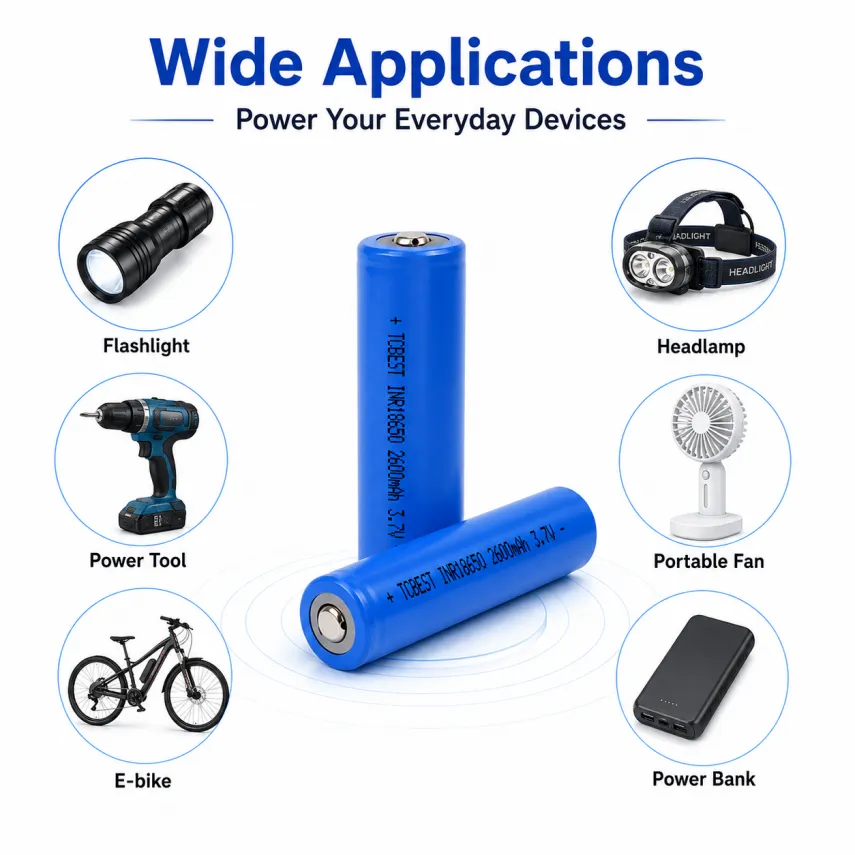
Lithium batteries are used across a wide range of industries because they can provide different combinations of compact size, high energy density, long service life, and reliable power output.
From small electronic devices to large energy storage systems, lithium battery technology has become an essential part of modern life.
1. Consumer Electronics
Consumer electronics are one of the most common applications for lithium-ion batteries.
Devices such as:
- Smartphones
- Laptops
- Tablets
- Smartwatches
- Wireless headphones
- Digital cameras
- Gaming devices
- Portable speakers
all rely on lithium battery technology.
The main reasons lithium batteries are widely used in consumer electronics include:
- Lightweight design
- High energy density
- Fast charging capability
- Long operating time
For example, smartphones require batteries that can provide enough power while maintaining a thin and lightweight design. Lithium-ion batteries meet these requirements better than many traditional battery technologies.
2. Electric Transportation
The rapid growth of electric transportation has significantly increased demand for lithium batteries.
Lithium-ion battery packs are used in:
- Electric vehicles (EVs)
- Electric buses
- Electric trucks
- E-bikes
- Electric scooters
- Motorcycles
- Industrial vehicles
Unlike small consumer batteries, electric vehicle battery packs contain many individual cells combined into a complete system.
A modern EV battery pack usually includes:
- Battery cells
- Cooling systems
- Sensors
- Protection circuits
- Battery Management System (BMS)
- Control software
Electric vehicle batteries must balance several important factors:
- Energy capacity
- Charging speed
- Safety
- Cycle life
- Temperature performance
- Manufacturing cost
Different vehicle manufacturers may choose different lithium chemistries, including NMC, NCA, and LFP, depending on their design goals.
3. Cordless Tools and Industrial Equipment
Lithium-ion batteries have transformed the cordless tool industry.
Products such as:
- Drills
- Impact drivers
- Electric saws
- Lawn equipment
- Vacuum cleaners
- Industrial tools
now commonly use rechargeable lithium battery packs.
Compared with older battery technologies, lithium-ion batteries provide:
- Higher power output
- Lower weight
- Longer runtime
- Faster charging
For professional users, these advantages improve efficiency and reduce downtime.
Many modern tool battery packs combine cylindrical lithium cells with electronic protection systems to ensure safe operation under high current conditions.
4. Medical and Safety Equipment
Reliable battery performance is especially important in medical and safety applications.
Lithium batteries are commonly used in:
- Portable medical monitors
- Infusion pumps
- Diagnostic equipment
- Hearing devices
- Emergency lighting
- Smoke detectors
- Alarm systems
- Wireless monitoring devices
Primary lithium batteries are particularly valuable in standby applications because they can maintain power for long periods with very low self-discharge.
For emergency equipment, battery reliability can be more important than rechargeability.
5. Renewable Energy Storage
As renewable energy continues to grow, lithium batteries have become an important solution for storing electricity generated from renewable sources.
Energy storage systems using lithium batteries can store electricity from:
- Solar panels
- Wind turbines
- Grid systems
Applications include:
- Home energy storage
- Commercial energy storage
- Industrial backup power
- Off-grid power systems
Lithium iron phosphate (LiFePO₄) batteries are frequently selected for stationary energy storage because they offer:
- Long cycle life
- Good thermal stability
- Strong safety performance
In these applications, long service life and reliability are often more important than achieving the highest possible energy density.
Lithium Batteries vs Traditional Batteries
The term “standard battery” usually refers to common alkaline batteries or nickel-metal hydride (NiMH) rechargeable batteries.
Lithium batteries differ significantly from traditional battery technologies in terms of voltage, energy density, weight, lifespan, and applications.
Feature |
Alkaline Battery |
NiMH Rechargeable Battery |
Lithium / Lithium-Ion Battery |
Typical applications |
Remote controls, clocks, low-power devices |
Rechargeable household electronics |
Electronics, EVs, tools, energy storage |
Nominal voltage |
About 1.5V |
About 1.2V |
About 3.6–3.7V for many Li-ion cells |
Energy density |
Moderate |
Moderate |
High |
Weight |
Moderate |
Relatively heavier |
Lightweight for stored energy |
Rechargeability |
No |
Yes |
Li-ion: Yes / Primary lithium: No |
Self-discharge |
Low |
Higher in many cases |
Generally low |
Protection requirements |
Limited |
Moderate |
Advanced protection required |
Initial cost |
Low |
Medium |
Higher |
Lithium batteries usually have a higher purchase price, but they often provide better long-term value in high-drain applications because they can store more energy and support repeated charging.
However, lithium batteries are not always the best choice for every product.
For example:
- A television remote control may work efficiently with alkaline batteries.
- A smartphone or electric vehicle requires the higher energy density and rechargeability of lithium-ion technology.
The best battery choice depends on the application requirements.
How to Extend Lithium Battery Life
Although lithium batteries naturally age over time, proper usage habits can reduce unnecessary stress and help maintain battery performance.
Here are practical ways to extend lithium battery lifespan.
1. Avoid Excessive Heat
Temperature is one of the most important factors affecting lithium battery aging.
Avoid:
- Leaving devices inside hot vehicles
- Exposing batteries to direct sunlight for long periods
- Charging batteries near heat sources
High temperatures accelerate chemical reactions inside the battery and can shorten service life.
2. Avoid Frequent Deep Discharge
Regularly draining a lithium battery completely to 0% can increase stress on the battery.
Whenever possible:
- Recharge before the battery is fully empty
- Avoid repeated deep discharge cycles
- Maintain moderate charging habits
3. Avoid Keeping the Battery at 100% for Long Periods
Keeping lithium-ion batteries fully charged for extended periods may accelerate aging.
For devices that remain connected to power continuously, battery optimization functions can help reduce unnecessary stress.
For daily use, maintaining a charge range around:
20%–80%
is often beneficial, although charging to 100% occasionally is normal when maximum runtime is needed.
4. Use the Correct Charger
Always use:
- Original chargers
- Approved charging equipment
- Compatible voltage and current specifications
Poor-quality or incompatible chargers may lack proper safety controls and increase battery risks.
5. Maintain Good Ventilation During Charging
Do not charge lithium battery devices:
- Under pillows
- Inside blankets
- In enclosed spaces with poor airflow
Charging generates heat, and trapped heat can accelerate battery aging.
6. Store Batteries Properly
For long-term storage:
- Keep batteries around 40%–60% charge
- Store in a cool and dry environment
- Avoid extreme temperatures
- Keep away from flammable materials
Proper storage can significantly reduce capacity loss during periods of inactivity.
7. Check Battery Condition Regularly
Stop using a battery if you notice:
- Swelling
- Leakage
- Cracks
- Unusual smell
- Excessive heat
- Sudden performance loss
Damaged batteries should be handled according to manufacturer recommendations.
8. Use Batteries Regularly
Rechargeable lithium batteries generally perform better when used moderately rather than being stored fully charged for long periods.
Balanced usage, proper charging, and suitable storage conditions help maximize battery lifespan.
Frequently Asked Questions About Lithium Batteries
How Can I Tell If a Battery Is Lithium?
Check the markings on the battery label.
Common lithium battery markings include:
- Lithium
- Li-ion
- Lithium-ion
- LiFePO₄
- Li-MnO₂
- Li-SOCl₂
A voltage rating of around 3.6V or 3.7V often indicates a lithium-ion battery, although voltage alone cannot always confirm battery chemistry.
It is important to remember that not every lithium battery is rechargeable. Some lithium primary batteries are designed for single use only.
Do iPhones Use Lithium-Ion Batteries?
Yes.
iPhones use rechargeable lithium-ion battery technology.
Lithium-ion batteries are widely used in smartphones because they provide:
- High energy density
- Lightweight design
- Fast charging capability
- Long operating time
What Is a Lithium Iron Phosphate Battery?
Lithium iron phosphate (LiFePO₄ or LFP) is a type of rechargeable lithium-ion battery chemistry.
Its main advantages include:
- Long cycle life
- Excellent thermal stability
- Strong safety performance
LFP batteries are commonly used in:
- Solar energy storage
- Backup power systems
- RV batteries
- Marine batteries
- Electric vehicles
What Is a Lithium-Metal Battery?
A lithium-metal battery traditionally refers to a primary battery that uses metallic lithium as an electrode.
These batteries can provide:
- High energy density
- Long shelf life
In addition, lithium-metal technology is also being researched as a future rechargeable battery technology.
Advanced lithium-metal batteries may potentially achieve higher energy density than current lithium-ion batteries, but challenges remain in areas such as:
- Safety
- Durability
- Manufacturing processes
Can Lithium Batteries Be Thrown Away?
No.
Lithium batteries should never be placed in normal household garbage.
Damaged batteries can create safety hazards during transportation and recycling.
Used lithium batteries should be sent to:
- Battery recycling facilities
- Authorized collection points
- Electronics recycling programs
Proper recycling helps recover valuable materials while reducing environmental risks.
Conclusion
Lithium batteries have become one of the most important technologies supporting modern energy needs.
Their combination of:
- High energy density
- Lightweight design
- Low self-discharge
- Rechargeability
- Flexible design options
has enabled the development of smartphones, electric vehicles, cordless tools, drones, medical devices, and renewable energy storage systems.
However, lithium batteries require proper handling and management. Using suitable chargers, avoiding extreme temperatures, preventing deep discharge, and storing batteries correctly can improve performance and extend service life.
As battery technology continues to advance, innovations such as solid-state batteries, lithium-metal batteries, intelligent Battery Management Systems, and next-generation energy storage solutions will continue to improve the future of energy.
For businesses looking for reliable lithium battery solutions, choosing an experienced battery manufacturer with strong design capability, quality control, and customization experience is essential for achieving safe and efficient power solutions.
Table of Contents
- Introduction
- How Does a Lithium Battery Work?
- Lithium Battery vs Lithium-Ion Battery: What Is the Difference?
- Lithium Primary Battery
- Lithium-Ion Battery
- Main Types of Lithium Batteries
- 1. Primary Lithium Batteries
- 2. Rechargeable Lithium-Ion Batteries
- Cylindrical Cells
- Prismatic Cells
- Pouch Cells
- Common Lithium-Ion Battery Chemistries
- Lithium Cobalt Oxide (LCO)
- Lithium Iron Phosphate (LiFePO₄ / LFP)
- Nickel Manganese Cobalt (NMC)
- Nickel Cobalt Aluminum (NCA)
- Lithium Manganese Oxide (LMO)
- Lithium Titanate (LTO)
- Battery Management System (BMS): Why Lithium Batteries Need Protection
- Advantages of Lithium Batteries
- 1. High Energy Density
- 2. Low Self-Discharge Rate
- 3. Higher Cell Voltage
- 4. Low Maintenance Requirements
- 5. Rechargeability and Long Service Life
- 6. Flexible Battery Design
- Limitations and Challenges of Lithium Batteries
- 1. Require Protection Systems
- 2. Battery Aging Over Time
- 3. Thermal Runaway Risk
- 4. Higher Initial Cost
- 5. Recycling Requirements
- Where Are Lithium Batteries Used?
- 1. Consumer Electronics
- 2. Electric Transportation
- 3. Cordless Tools and Industrial Equipment
- 4. Medical and Safety Equipment
- 5. Renewable Energy Storage
- Lithium Batteries vs Traditional Batteries
- How to Extend Lithium Battery Life
- 1. Avoid Excessive Heat
- 2. Avoid Frequent Deep Discharge
- 3. Avoid Keeping the Battery at 100% for Long Periods
- 4. Use the Correct Charger
- 5. Maintain Good Ventilation During Charging
- 6. Store Batteries Properly
- 7. Check Battery Condition Regularly
- 8. Use Batteries Regularly
- Frequently Asked Questions About Lithium Batteries
- How Can I Tell If a Battery Is Lithium?
- Do iPhones Use Lithium-Ion Batteries?
- What Is a Lithium Iron Phosphate Battery?
- What Is a Lithium-Metal Battery?
- Can Lithium Batteries Be Thrown Away?
- Conclusion