
 EN
Looking for a drone that can stay in the air longer? You’re in the right place.
Instead of getting lost in flashy specifications and marketing claims, this guide focuses on the practical questions that actually matter: how long drones really fly, why their batteries drain so quickly, and how to choose a drone with better endurance.
How Long Does a Drone Battery Really Last?
Here’s the first thing you should know: in real-world conditions, you probably won’t get the exact flight time advertised by the manufacturer.
For most consumer drones, around 20 to 40 minutes of actual flight time per charge is already pretty good.
When a manufacturer advertises “34 minutes” or “46 minutes,” that figure is usually measured under ideal conditions: little or no wind, steady flight speed, minimal aggressive maneuvering, and sometimes limited camera use.
Once you fly outdoors, things change. Wind, video recording, climbing, turning, and aggressive stick input all increase power consumption.
In practice, getting around 70% to 85% of the advertised flight time is completely normal.
So if a drone is rated for 31 minutes, planning around roughly 24 to 26 minutes of usable flight time is much more realistic.
Hover Time vs. Actual Flight Time: What’s the Difference?
Manufacturers usually test battery endurance under highly efficient flight conditions, such as hovering or steady forward flight.
But real flights are rarely that simple.
Taking off, climbing, turning, accelerating, braking, and changing direction all require additional energy.
Climbing is especially demanding because the motors must generate extra thrust to lift the drone against gravity.
For example, lifting a 1 kg drone by one meter requires roughly 10 joules of gravitational potential energy before motor and propeller efficiency losses are even considered.
During a normal flight, repeated climbs and aggressive movements gradually eat into your battery.
In simple terms, advertised hover or endurance figures represent something close to a best-case scenario. Real-world flight time is almost always shorter.
What Is the Average Drone Flight Time?
By 2026 standards, a typical multirotor drone generally offers around 25 to 45 minutes of flight time.
However, that is only a broad average. Flight endurance varies significantly depending on the type of drone.
Flight Time by Drone Category
Drone Type |
Typical Flight Time |
Description |
Toy drones |
5–10 minutes |
Lightweight and inexpensive, usually with small batteries |
Consumer camera drones |
30–47 minutes |
The typical range for mainstream photography drones |
Industrial / professional drones |
60+ minutes |
Longer endurance is often achieved with fixed-wing or VTOL designs |
The difference between consumer and industrial drones can be substantial.
Consumer multirotors are limited by battery weight, size, portability, and current battery technology. For most traditional quadcopters, flight times above 40 minutes are already impressive.
If you need more than an hour of continuous flight, you will usually need a different aircraft design rather than simply a larger battery.
How Long Does a Drone Battery Last in Real Flight?
A practical rule is to expect around 75% to 85% of the manufacturer’s advertised flight time under normal operating conditions.
Several factors explain the difference.
Weather and Temperature
Cold weather reduces lithium battery performance.
When temperatures drop, battery internal resistance increases and the battery may deliver less usable capacity, especially under high loads.
Strong wind also increases energy consumption because the motors must constantly adjust thrust to maintain position and direction.
In difficult winter conditions, your usable flight time may drop significantly compared with warm, calm weather.
Weight and Payload
Every extra gram matters.
Filters, propeller guards, additional sensors, lights, cameras, or other accessories increase the amount of thrust required to keep the drone airborne.
More weight means higher motor output and higher battery consumption.
Camera and Transmission Systems
The camera, gimbal motors, image processor, sensors, and video transmission system all consume power.
The amount is usually smaller than what the propulsion system uses, but it still contributes to total energy consumption.
Flight Style
Smooth cruising is generally more efficient than aggressive flying.
Frequent acceleration, rapid climbing, hard braking, sharp turns, and Sport Mode can noticeably reduce battery life.
Which Drones Have the Longest Flight Time?
The answer depends heavily on what type of drone you mean.
Among electric aircraft, some specialized VTOL and long-endurance platforms can stay airborne for several hours under specific operating conditions.
However, fixed-wing drones are generally much more efficient for long-duration missions.
Many commercial fixed-wing mapping and surveying drones can remain airborne for around 90 minutes to several hours.
The reason is simple: fixed-wing aircraft use aerodynamic lift from their wings. They do not need to generate all of their lift directly from the motors every second.
Multirotors, by comparison, must continuously use motor power just to stay in the air.
Military and special-purpose UAVs can remain airborne for much longer. Some platforms operate for more than 13 hours, while certain long-endurance systems can exceed 24 hours.
However, these aircraft are completely different from consumer drones in terms of size, propulsion, cost, and mission requirements.
Which Consumer Drones Offer Longer Flight Times?
If you mainly want a drone for photography, travel, or recreational flying, there are several categories worth considering.
Lightweight Camera Drones
Some lightweight camera drones offer around 35 to 40 minutes of advertised flight time with a standard battery.
Extended-capacity batteries may push certain models beyond 45 or even 50 minutes under ideal conditions.
Their low weight also makes them easy to carry and, in some regions, easier to operate under lightweight drone regulations.
Mid-Range Camera Drones
Mid-range drones often provide a good balance between flight endurance, camera quality, wind resistance, obstacle sensing, and overall performance.
For many buyers, this category offers a better real-world compromise than simply choosing the drone with the largest battery.
Budget-Friendly Drones
Some lower-cost camera drones now advertise flight times close to 35 to 40 minutes while still maintaining a relatively lightweight design.
They may not match premium models in camera performance, obstacle avoidance, transmission range, or software features, but they can offer strong value for casual users.
Mini Drones vs. Full-Size Drones
Mini drones are lighter, but they also use smaller batteries.
Larger drones can carry more battery capacity, but they also require more power to stay airborne.
Neither design is automatically better. The right choice depends on your intended use.
Which Professional and Commercial Drones Fly the Longest?
Professional drones operate in a completely different category.
Fixed-wing mapping drones may stay airborne for around 90 minutes or more while covering large areas during a single mission.
Some models can survey hundreds of hectares depending on altitude, speed, terrain, sensor payload, and regulatory limitations.
VTOL commercial drones combine vertical takeoff and landing with the efficient cruising characteristics of fixed-wing aircraft.
That makes them particularly useful for applications such as:
1.Mapping
2.Pipeline inspection
3.Power line inspection
4.Agriculture
5.Security
6.Infrastructure monitoring
7.Long-distance surveying
Long-endurance industrial drones are designed around mission time rather than portability. Their batteries, airframes, propulsion systems, and flight control software are optimized for continuous operation.
Naturally, their prices are also far higher than those of consumer drones.
Which Drones Can Fly for More Than Two Hours?
Drones capable of flying for more than two hours are generally not ordinary consumer quadcopters.
Fixed-wing drones are one of the most common options.
Their aerodynamic design allows the wings to generate lift efficiently, reducing the amount of continuous motor power required.
As a result, the same amount of stored energy can often keep a fixed-wing aircraft airborne much longer than a multirotor.
Solar-Powered Drones
Solar-powered drones are another area of development.
Research projects have demonstrated that solar energy can extend flight endurance substantially under suitable sunlight conditions.
However, solar-powered drone systems are still mainly used in research, specialized industrial applications, and long-endurance experimental platforms.
Hydrogen Fuel Cell Drones
Hydrogen fuel cells are another promising technology.
Hydrogen offers much higher specific energy than conventional lithium batteries at the fuel level, which makes it attractive for long-endurance UAV applications.
However, hydrogen storage, refueling infrastructure, system complexity, tank weight, and cost remain major challenges.
For now, most hydrogen-powered drones are still focused on industrial and professional markets rather than everyday consumers.
What Factors Have the Biggest Impact on Drone Flight Time?
Several factors directly affect how long a drone can remain airborne.
Battery Capacity
Battery capacity is one of the most obvious factors.
But there is a catch.
A larger battery stores more energy, but it also adds weight. That additional weight increases the power required to keep the drone in the air.
Eventually, adding more battery capacity produces diminishing returns.
Drone Weight and Payload
The heavier the drone, the more thrust it needs.
Additional cameras, sensors, propeller guards, lights, delivery payloads, or accessories all reduce flight endurance.
Wind and Temperature
Flying into strong wind requires significantly more power.
Cold temperatures can also reduce usable battery performance and increase voltage drop under load.
This is why winter flight times are often noticeably shorter than summer flight times.
Flight Speed and Maneuvering
Smooth, moderate-speed cruising is usually efficient.
Aggressive acceleration, high-speed flying, rapid climbing, sharp turns, and frequent braking consume considerably more energy.
Interestingly, for many multirotors, efficient forward flight can require less power than stationary hovering because the aircraft can benefit from improved aerodynamic conditions.
Sensors and Transmission Systems
Cameras, gimbals, obstacle sensors, onboard processors, communication modules, and video transmission systems all consume electricity.
The propulsion system still uses most of the battery, but onboard electronics contribute to overall consumption.
Why Is Drone Battery Life So Short?
The biggest reason is simple: multirotor flight requires a lot of energy.
A quadcopter must continuously produce enough thrust to counteract gravity.
Unlike a fixed-wing aircraft, it cannot rely primarily on wings to create lift while cruising.
That makes hovering inherently energy-intensive.
The Battery Weight Problem
Increasing battery capacity creates a difficult engineering trade-off.
More battery capacity means more stored energy.
But more battery also means more weight.
More weight requires additional thrust.
Additional thrust requires more power.
So part of the extra battery capacity is consumed simply carrying the larger battery itself.
This is one of the main reasons multirotor endurance improves relatively slowly.
Lithium Battery Safety Limits
Lithium batteries also have operating limits.
They should not normally be discharged to absolute zero, and storing them fully charged for long periods can accelerate aging.
Manufacturers also need to maintain voltage and capacity reserves for safety and battery protection.
As a result, not all of the battery's theoretical energy is available during normal flight.
Energy Conversion Losses
Energy is lost at every stage.
Battery energy passes through the electronic speed controllers, motors, propellers, and aerodynamic system before becoming useful thrust.
Some energy is inevitably lost as heat and electrical resistance.
Only part of the battery's stored energy ultimately contributes to keeping the drone airborne.
Which Battery Type Is Best for Long Flight Time?
LiPo and Li-ion batteries are currently the two most common choices for electric drones.
LiPo Batteries
Lithium polymer batteries are known for their high discharge capability.
They can deliver large amounts of current quickly, making them ideal for drones that need rapid acceleration, aggressive maneuvering, or high motor output.
Their main disadvantage is that their energy density is often lower than that of high-energy Li-ion cells.
For the same battery weight, a LiPo pack may store less total energy than an endurance-focused Li-ion pack.
Li-ion Batteries
Lithium-ion batteries generally offer higher energy density.
That makes them attractive for long-range cruising, fixed-wing aircraft, endurance drones, and other applications where sustained moderate power is more important than extreme current output.
Their disadvantage is lower peak discharge capability compared with high-performance LiPo batteries.
A poorly matched Li-ion pack may experience excessive voltage sag during aggressive acceleration or high-current operation.
Which One Should You Choose?
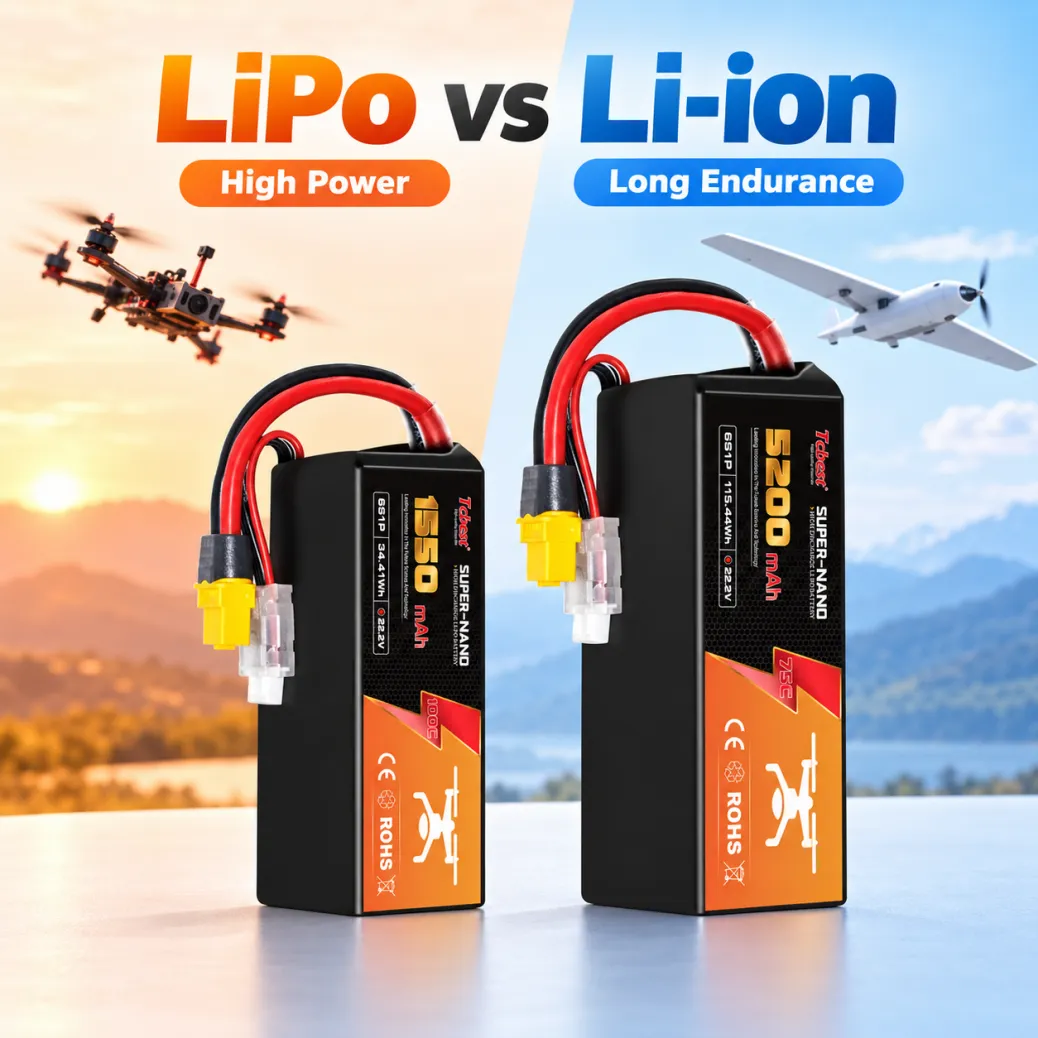
For FPV drones, high-performance multirotors, and aircraft requiring rapid acceleration, LiPo remains the standard choice.
For fixed-wing drones, long-range platforms, and endurance-focused aircraft, Li-ion can be a better option when the current requirements are compatible with the battery.
Battery management also matters.
A well-designed Battery Management System, or BMS, can help with:
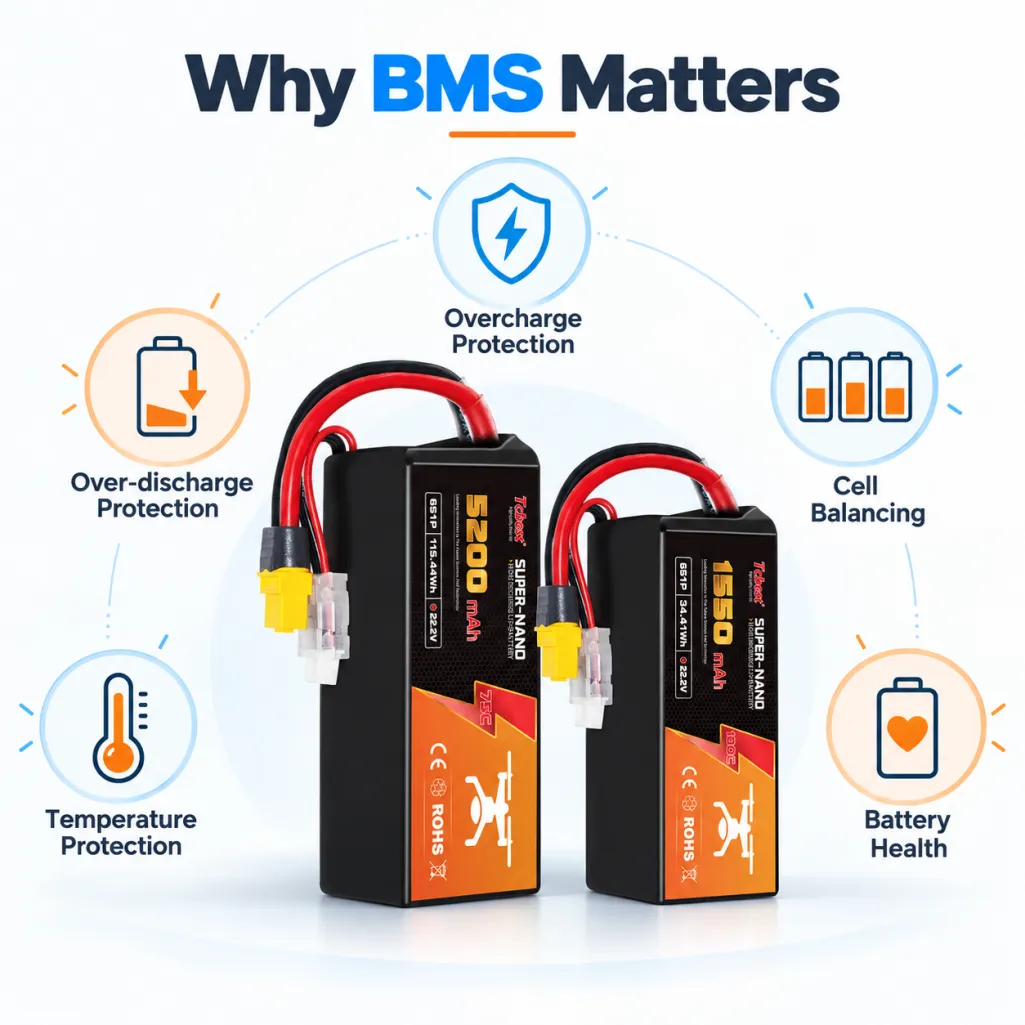
1.Overcharge protection
2.Over-discharge protection
3.Cell balancing
4.Temperature protection
5.Current monitoring
6.Battery health monitoring
A good battery management system can improve safety, service life, and usable battery performance.
How Can You Estimate Drone Flight Time?
A basic formula is:
Flight Time (minutes) = Battery Capacity (mAh) ÷ Average Current Consumption (mA) × 60
For example, if a drone uses a 5,000 mAh battery and consumes an average of 10,000 mA during flight:
5,000 ÷ 10,000 × 60 = 30 minutes
However, this is only a rough estimate.
The main problem is that most users do not know their drone's true average current consumption.
Power demand changes constantly depending on:
1.Throttle level
2.Wind
3.Payload
4.Flight speed
5.Climbing
6.Temperature
7.Battery condition
8.Propeller efficiency
For everyday users, a more practical method is to record several actual flights.
After three to five flights, you will usually have a much better idea of how long the battery lasts with your normal flying style.
You can then adjust your expectations depending on weather, payload, and mission conditions.
Flight logs and specialized software can also provide more accurate estimates.
How Can You Extend Drone Battery Life and Flight Time?
There are several simple ways to improve both battery longevity and usable flight time.
Avoid Over-Discharging the Battery
Do not routinely fly until the drone shuts itself down.
Many pilots plan to land with around 20% battery remaining, although the exact recommended reserve depends on the aircraft and manufacturer.
Repeated deep discharge can accelerate battery degradation and increase the risk of cell imbalance or swelling.
Store Batteries at Around 40% to 60%
If you are not going to use the battery for several days or weeks, avoid leaving it fully charged or completely empty.
For many lithium battery chemistries, storing the battery at around 40% to 60% state of charge is better for long-term battery health.
Keep Batteries Warm Before Cold-Weather Flights
Cold batteries cannot deliver power as efficiently.
Before flying in winter, keep the battery at a suitable temperature according to the manufacturer's recommendations.
Never use unsafe heating methods.
A properly warmed battery generally performs better than one that starts the flight extremely cold.
Remove Unnecessary Weight
If you do not need a filter, propeller guard, accessory, light, or external attachment, consider removing it.
Reducing unnecessary weight is one of the easiest ways to improve endurance.
Fly Smoothly
Avoid unnecessary full-throttle acceleration, aggressive climbing, and repeated sharp turns.
Smooth flight saves energy and often results in better video footage as well.
Keep Firmware Updated
Drone manufacturers sometimes improve power management, battery monitoring, or flight control efficiency through firmware updates.
Keeping the aircraft and battery system updated can help ensure that the battery management system operates as intended.
Frequently Asked Questions
How Long Does a Drone Battery Last?
This question can mean two different things.
If you mean flight time per charge, most consumer drones offer around 20 to 40 minutes of real-world flight time, depending on the model and conditions.
If you mean total battery lifespan, many drone batteries begin to show noticeable capacity loss after a few hundred charge cycles. Actual lifespan depends heavily on battery chemistry, operating temperature, storage conditions, charging habits, and discharge depth.
What Is the Average Drone Flight Time?
For consumer multirotor drones, around 25 to 45 minutes is a reasonable general range in 2026.
Toy drones may only fly for 5 to 10 minutes.
Professional fixed-wing and VTOL drones can often operate for one to three hours or longer.
Which Drone Has the Longest Flight Time?
There is no single answer because different drone categories use very different technologies.
Specialized electric multirotor and VTOL platforms can achieve very long endurance under certain conditions.
Commercial fixed-wing drones can stay airborne for several hours.
Military and special-purpose UAVs can operate for much longer, sometimes exceeding 24 hours.
Can a Drone Fly Continuously for Several Hours?
A typical consumer multirotor cannot.
The combination of battery energy density, aircraft weight, motor efficiency, and continuous lift requirements limits practical flight time.
To fly for several hours, you generally need a fixed-wing design, hybrid propulsion system, hydrogen fuel cell, solar assistance, or another specialized long-endurance power system.
Table of Contents
- How Long Does a Drone Battery Really Last?
- Hover Time vs. Actual Flight Time: What’s the Difference?
- What Is the Average Drone Flight Time?
- Flight Time by Drone Category
- How Long Does a Drone Battery Last in Real Flight?
- Which Drones Have the Longest Flight Time?
- Which Consumer Drones Offer Longer Flight Times?
- Which Professional and Commercial Drones Fly the Longest?
- Which Drones Can Fly for More Than Two Hours?
- What Factors Have the Biggest Impact on Drone Flight Time?
- Why Is Drone Battery Life So Short?
- Which Battery Type Is Best for Long Flight Time?
- How Can You Estimate Drone Flight Time?
- How Can You Extend Drone Battery Life and Flight Time?
- Frequently Asked Questions