Die Nickel-Metallhydrid-(NiMH-Akku-)Technologie stellt eine ausgereifte, aber wissenschaftlich bedeutende Klasse wiederaufladbarer elektrochemischer Systeme dar, deren Leistungsmerkmale nach wie vor Einfluss auf Unterhaltungselektronik, Hybridfahrzeuge und dezentrale Speicherung erneuerbarer Energien nehmen. Obwohl sie in einigen Märkten durch die rasche Expansion von Lithium-Ionen-Systemen in den Hintergrund gedrängt wurde, bleiben NiMH-Zellen aufgrund ihrer chemischen Stabilität, Umweltverträglichkeit und robusten Betriebscharakteristik bei Teil-Ladezustands-Zyklen eine wesentliche Technologie. Dieser Artikel bietet eine akademisch orientierte Untersuchung der NiMH-Chemie, ihres Wirkmechanismus, ihrer Materialzusammensetzung, ihrer Leistungsmerkmale sowie ihrer vergleichenden Stellung innerhalb der breiteren Batterielandschaft.
Eine NiMH-Batterie ist ein wiederaufladbares alkalisch arbeitendes System, bei dem elektrochemische Energie durch reversible Wasserstoffabsorptions- und -desorptionsprozesse gespeichert wird. Die Zellarchitektur besteht aus einer positiven Elektrode aus Nickeloxyhydroxid (NiOOH) und einer negativen Elektrode aus einer wasserstoffspeichernden Metalllegierung. Diese Elektroden arbeiten in einem konzentrierten Kalilauge-Elektrolyten, der den ionischen Transport ermöglicht, ohne direkt an den Redoxreaktionen teilzunehmen.
Aus funktioneller Sicht wandeln NiMH-Zellen elektrische Energie während des Ladens durch Wasserstoffinterkalation in das Metallhydridgitter in chemische potenzielle Energie um. Der umgekehrte Prozess setzt während der Entladung Elektronen an den externen Stromkreis frei. Dieser wasserstoffbasierte Mechanismus unterscheidet NiMH von früheren Ni-Cd-Systemen und trägt zu seinem verbesserten Umweltprofil bei.
NiMH-Akkus wurden aufgrund ihres ausgewogenen Verhältnisses von Energiedichte, Sicherheit und Kosten weit verbreitet in Hybridfahrzeugen, tragbaren Elektronikgeräten und Modulen für erneuerbare Energien eingesetzt.
Mehrere Merkmale bestimmen die technologische Relevanz von NiMH-Akkus:
· Sie sind wiederaufladbar und vergleichsweise umweltverträglich, da sie die Cadmium-Toxizität eliminieren.
· Ihre Energiedichte übertrifft die von Ni-Cd-Zellen und ermöglicht den Einsatz in Anwendungen mit mittlerer bis hoher Leistung.
· Die typische Zykluslebensdauer beträgt etwa 500 Zyklen, abhängig von der Entladetiefe und den thermischen Bedingungen.
· Die NiMH-Chemie weist einen nur geringen Memory-Effekt auf, was flexible Ladezyklen ermöglicht.
· Ihr Anwendungsbereich umfasst Unterhaltungselektronik, Hybridfahrzeuge sowie dezentrale Systeme für erneuerbare Energien.
3. Wichtige Merkmale von NiMH-Akkus
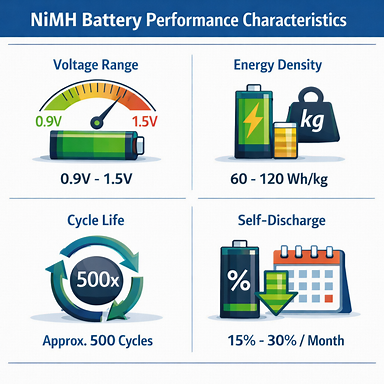
NiMH-Akkus sind so konstruiert, dass sie eine Kombination aus Energiedichte, Leistungsfähigkeit und Betriebssicherheit liefern. Ihr elektrochemisches Verhalten wird stark durch die Elektrodenzusammensetzung, die Struktur der Wasserstoffspeicherlegierung und die Elektrolytkonzentration beeinflusst.
· Spannungsbereich: 0,9–1,5 V
· Energiedichte: 60–120 Wh/kg
· Zyklenlebensdauer: ca. 500 Zyklen
· Kalenderlebensdauer: 3–5 Jahre
· Selbstentladung: Höher als bei Li-Ionen-Akkus, jedoch deutlich reduziert bei modernen Varianten mit geringer Selbstentladung
Technische Spezifikationstabelle
Spezifikation |
Typischer NiMH-Wert |
Nennspannung |
1,2 V |
Betriebstemperaturbereich |
0,9–1,5 V |
Energiedichte |
60–120 Wh/kg |
Leistungsfähigkeit |
Hoch |
Lebensdauer |
~500 Zyklen |
Selbstentladung |
15–30 % pro Monat |
Optimale Temperatur |
0–40°C |
4. Zusammensetzung und Wirkungsweise
NiMH-Zellen enthalten eine Reihe technisch optimierter Materialien, die auf Speicherung von Wasserstoff, Elektronentransfer und strukturelle Stabilität ausgelegt sind.
Komponente |
Funktion |
NiOOH-Kathode |
Nimmt während der Entladung wasserstoffbezogene Ladung auf |
Metallhydrid-Anode |
Speichert Wasserstoff reversibel |
Trenner |
Verhindert interne Kurzschlüsse |
KOH-Elektrolyt |
Bietet ionische Leitfähigkeit |
Stahltonne |
Gewährleistet die mechanische Integrität |
4.2 Elektrodengleichungen
Die elektrochemischen Prozesse lassen sich wie folgt zusammenfassen:
· Positive Elektrode: NiOOH + H₂O + e⁻ → Ni(OH)₂ + OH⁻
· Negative Elektrode: MH + OH⁻ → M + H₂O + e⁻
Diese Reaktionen laufen beim Laden umgekehrt ab, wodurch Wasserstoff wieder in das Legierungsgitter aufgenommen wird.
4.3 Lade- und Entladevorgang
Beim Laden werden Elektronen in die negative Elektrode getrieben, was die Aufnahme von Wasserstoff in die Metallhydrid-Matrix fördert. Gleichzeitig erfolgt an der positiven Elektrode eine Oxidation zur Bildung von NiOOH. Die Zellspannung steigt typischerweise auf 1,45–1,5 V.
Bei der Entladung wird Wasserstoff aus der Legierung freigesetzt und reagiert mit NiOOH, wobei Elektronen für den externen Stromkreis erzeugt werden. Die Spannung fällt unter Last allmählich auf etwa 1,0 V ab; 0,9 V gilt als praktische Abschaltspannung.
· Vollständig geladen: 1,45–1,5 V
· Vollständig entladen: 0,9–1,0 V
5. Vorteile und Einschränkungen
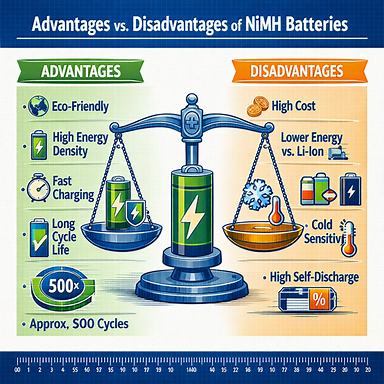
NiMH-Akkus bieten mehrere Leistungs- und Umweltvorteile:
· Umweltverträglichkeit, da sie Cadmium vermeiden und recycelbar sind.
· Höhere Energiedichte als Ni-Cd-Systeme.
· Schnelllade-Fähigkeit, unterstützt Laderaten bis zu 1C.
· Hohe Sicherheitsreserve, ohne Risiko einer thermischen Durchgehung.
· Lange Betriebsdauer mit etwa 500 Zyklen.
Vorteil |
Beschreibung |
Umweltfreundlich |
Kein Cadmium; recyclingfähig |
Hohe Energiedichte |
Überlegen gegenüber Ni-Cd |
Schnellladung |
Unterstützt 1C-Ladeströme |
Lange Lebensdauer |
~500 Zyklen |
HOHE SICHERHEIT |
Keine thermische Durchgehung |
5.2 Einschränkungen
Trotz ihrer Vorteile weisen NiMH-Akkus mehrere Einschränkungen auf:
· Höherer Selbstentladungsstrom im Vergleich zu Li-Ionen-Systemen.
· Geringere Energiedichte als fortschrittliche Lithium-Chemien.
· Thermische Empfindlichkeit, insbesondere bei niedrigen Temperaturen.
· Wärmeentwicklung beim schnellen Laden.
Einschränkung |
Auswirkungen |
Hohe Selbstentladung |
Verliert Ladung während der Lagerung |
Kälteempfindlichkeit |
Verringerte Kapazität |
Geringere Energiedichte im Vergleich zu Lithium-Ionen-Akkus |
Nicht ideal für kompakte Elektronikgeräte |
Wärmeerzeugung |
Erfordert Ladekontrolle |
5.3 Berücksichtigung des Memory-Effekts
NiMH-Akkus weisen einen vernachlässigbaren Memory-Effekt auf, was eine deutliche Verbesserung gegenüber Ni-Cd-Systemen darstellt. Diese Eigenschaft ermöglicht ein flexibles Laden ohne langfristige Kapazitätsminderung und macht NiMH daher für die zyklischen Lade- und Entladevorgänge in Hybridfahrzeugen geeignet.
6. Anwendungen von NiMH-Akkus
6.1 Unterhaltungselektronik
NiMH-Zellen werden weit verbreitet in Geräten mit moderatem bis hohem Strombedarf eingesetzt, darunter:
· Drahtlose Peripheriegeräte
Ihre Fähigkeit, hohe Entladeraten über längere Zeit aufrechtzuerhalten, macht sie bei anspruchsvollen Anwendungen den Alkalibatterien überlegen.
6.2 Systeme für erneuerbare Energien
Die NiMH-Technologie wird in kleineren Solarenergie- und Windenergiespeichersystemen eingesetzt, insbesondere in abgelegenen Regionen wie Australien und Chile. Ihre thermische Stabilität und ihr Sicherheitsprofil machen sie für netzunabhängige Installationen geeignet.
Funktion |
Relevanz |
Lange Lebensdauer |
Geeignet für tägliche Ladezyklen |
Temperaturstabilität |
Funktioniert unter extremen Klimabedingungen |
Sicherheit |
Kein Brandrisiko |
6.3 Industrielle und Transportanwendungen
NiMH-Batterien sind integraler Bestandteil von:
· Hybrid-Elektrofahrzeugen
· Notstromversorgungssystemen in der Luftfahrt
· Medizinischen Messgeräten
Hybridfahrzeuge profitieren insbesondere von der Fähigkeit von NiMH-Akkus, Tausende flacher Ladezyklen ohne signifikanten Leistungsabfall zu überstehen.
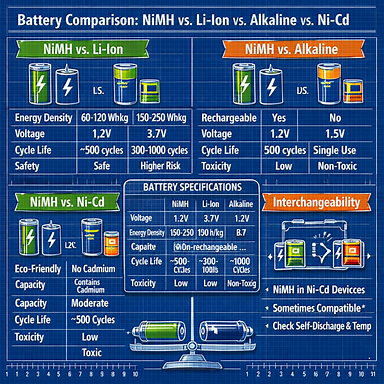
7. Vergleich mit anderen Batterietechnologien
7.1 NiMH vs. Lithium-Ion
Parameter |
NiMH |
Li-Ion |
Energiedichte |
Mittel |
Hoch |
Sicherheit |
Sehr hoch |
Mittel |
Kosten |
Niedriger |
Höher |
Lebensdauer |
~500 |
500–1500 |
Selbstentladung |
Hoch |
Niedrig |
Anwendungen |
Hybride, Werkzeuge |
Telefone, Laptops |
7.2 NiMH vs. Alkaline
Funktion |
NiMH |
Alkalin |
Aufladbare |
Ja |
No |
Spannung |
1,2 V |
1,5 V |
Leistungsverhalten bei hohem Strombedarf |
Ausgezeichnet |
Schlecht |
Kosten im Laufe der Zeit |
Niedrig |
Hoch |
7.3 NiMH vs. Ni-Cd
Funktion |
NiMH |
Ni-Cd |
Toxizität |
Kein Cadmium |
Enthält Cadmium |
Energiedichte |
Höher |
Niedriger |
Speichereffekts |
Mindestwert |
Bedeutend |
Lebensdauer |
Mittel |
Sehr hoch |
7.4 Austauschbarkeit mit Ni-Cd
NiMH-Zellen können Ni-Cd-Zellen in vielen Anwendungen ersetzen, doch Unterschiede hinsichtlich der Selbstentladung, der Ladeprofile und des Temperaturverhaltens müssen berücksichtigt werden.
NiMH-Batterien bleiben ein wissenschaftlich und technologisch relevantes Energiespeichersystem. Ihre Kombination aus Sicherheit, Umweltverträglichkeit und robuster Zyklusfestigkeit gewährleistet ihren weiterhin breiten Einsatz in Hybridfahrzeugen, Modulen für erneuerbare Energien sowie Unterhaltungselektronik. Obwohl Lithium-Ionen-Technologien viele Hochenergieanwendungen dominieren, behält die NiMH-Chemie eine entscheidende Rolle dort bei, wo Langlebigkeit, Sicherheit und Kostenwirksamkeit im Vordergrund stehen.
NiMH-Akkus verwenden Nickeloxyhydroxid und Metallhydrid-Legierungen, um Wasserstoff reversibel zu speichern und so einen sicheren und stabilen wiederaufladbaren Betrieb zu ermöglichen. Sie bieten eine moderate Energiedichte, eine hohe Leistungsabgabe und ökologische Vorteile. Aufgrund ihrer ausgewogenen Eigenschaften hinsichtlich Haltbarkeit, Sicherheit und Kosten werden sie häufig in Elektronikgeräten, Hybridfahrzeugen und erneuerbaren Energiesystemen eingesetzt, obwohl sie eine höhere Selbstentladung aufweisen und eine geringere Energiedichte als Lithium-Ionen-Zellen besitzen.

 EN
EN