Nickel–metal hydride (NiMH battery) technology represents a mature yet scientifically significant class of rechargeable electrochemical systems whose performance characteristics continue to influence consumer electronics, hybrid-electric transportation, and distributed renewable-energy storage. Although overshadowed in some markets by the rapid expansion of lithium-ion systems, NiMH cells remain an essential technology due to their chemical stability, environmental compatibility, and robust operational behavior under partial-state-of-charge cycling. This article provides an academically oriented examination of NiMH chemistry, its mechanistic operation, material composition, performance attributes, and comparative position within the broader battery landscape.
A NiMH battery is a rechargeable alkaline system in which electrochemical energy is stored through reversible hydrogen absorption and desorption processes. The cell architecture is defined by a nickel oxyhydroxide (NiOOH) positive electrode and a hydrogen-storage metal alloy negative electrode. These electrodes operate within a concentrated potassium hydroxide electrolyte that facilitates ionic transport without participating directly in the redox reactions.
From a functional perspective, NiMH cells convert electrical energy into chemical potential through hydrogen intercalation into the metal-hydride lattice during charging. The reverse process releases electrons to the external circuit during discharge. This hydrogen-based mechanism distinguishes NiMH from earlier Ni-Cd systems and contributes to its improved environmental profile.
NiMH batteries have been widely adopted in hybrid-electric vehicles, portable electronics, and renewable-energy modules due to their balance of energy density, safety, and cost.
Several characteristics define the technological relevance of NiMH batteries:
· They are rechargeable and comparatively environmentally benign, as they eliminate cadmium toxicity.
· Their energy density surpasses that of Ni-Cd cells and supports moderate-to-high power applications.
· Typical cycle life reaches approximately 500 cycles, depending on depth of discharge and thermal conditions.
· NiMH chemistry exhibits minimal memory effect, enabling flexible charging patterns.
· Their application domain spans consumer electronics, hybrid vehicles, and distributed renewable-energy systems.
3. Key Features of NiMH Batteries
NiMH batteries are engineered to deliver a combination of energy density, power capability, and operational safety. Their electrochemical behavior is strongly influenced by electrode composition, hydrogen-storage alloy structure, and electrolyte concentration.
Performance Characteristics
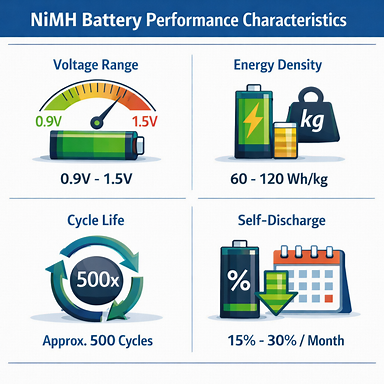
· Voltage range: 0.9–1.5 V
· Energy density: 60–120 Wh/kg
· Cycle life: ~500 cycles
· Calendar life: 3–5 years
· Self-discharge: Higher than Li-ion but significantly reduced in modern low-self-discharge variants
Technical Specification Table
Specification |
Typical NiMH Value |
Nominal Voltage |
1.2 V |
Operating Range |
0.9–1.5 V |
Energy Density |
60–120 Wh/kg |
Power Capability |
High |
Cycle Life |
~500 cycles |
Self-Discharge |
15–30% per month |
Optimal Temperature |
0–40°C |
4. Composition and Working Mechanism
NiMH cells incorporate a set of engineered materials designed to optimize hydrogen storage, electron transfer, and structural stability.
Component |
Function |
NiOOH Cathode |
Accepts hydrogen-related charge during discharge |
Metal-Hydride Alloy Anode |
Reversibly stores hydrogen |
Separator |
Prevents internal short circuits |
KOH Electrolyte |
Provides ionic conductivity |
Steel Can |
Ensures mechanical integrity |
The electrochemical processes can be summarized as follows:
· Positive electrode: NiOOH + H₂O + e⁻ → Ni(OH)₂ + OH⁻
· Negative electrode: MH + OH⁻ → M + H₂O + e⁻
These reactions reverse during charging, enabling hydrogen to be reabsorbed into the alloy lattice.
4.3 Charging and Discharging Mechanism
During charging, electrons are driven into the negative electrode, promoting hydrogen absorption into the metal-hydride matrix. Concurrently, the positive electrode undergoes oxidation to form NiOOH. The cell voltage typically rises to 1.45–1.5 V.
During discharge, hydrogen is released from the alloy and reacts with NiOOH, generating electrons for the external circuit. The voltage gradually declines to approximately 1.0 V under load, with 0.9 V considered the practical cutoff.
4.4 Voltage Characteristics
· Fully charged: 1.45–1.5 V
· Fully discharged: 0.9–1.0 V
5. Advantages and Limitations
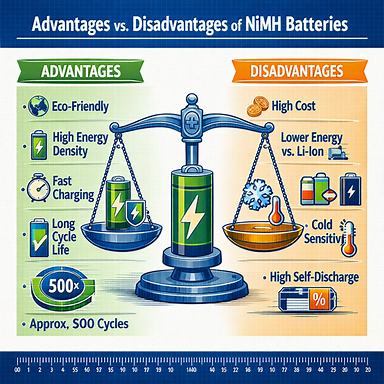
NiMH batteries offer several performance and environmental benefits:
· Environmental compatibility, as they avoid cadmium and are recyclable.
· Higher energy density than Ni-Cd systems.
· Fast-charge capability, supporting charge rates up to 1C.
· High safety margin, with no thermal-runaway risk.
· Long operational life, with approximately 500 cycles.
Benefit |
Description |
Eco-Friendly |
No cadmium; recyclable |
High Energy Density |
Superior to Ni-Cd |
Fast Charging |
Supports 1C rates |
Long Cycle Life |
~500 cycles |
High Safety |
No thermal runaway |
5.2 Limitations
Despite their advantages, NiMH batteries exhibit several constraints:
· Higher self-discharge compared with Li-ion systems.
· Lower energy density than advanced lithium chemistries.
· Thermal sensitivity, particularly at low temperatures.
· Heat generation during rapid charging.
Limitation |
Impact |
High Self-Discharge |
Loses charge during storage |
Cold Sensitivity |
Reduced capacity |
Lower Energy vs. Li-ion |
Not ideal for compact electronics |
Heat Generation |
Requires charge control |
5.3 Memory Effect Consideration
NiMH batteries exhibit negligible memory effect, a significant improvement over Ni-Cd systems. This characteristic allows flexible charging without long-term capacity degradation, making NiMH suitable for hybrid-vehicle cycling patterns.
6. Applications of NiMH Batteries
NiMH cells are widely used in devices requiring moderate-to-high current output, including:
Their ability to sustain high discharge rates makes them superior to alkaline batteries in demanding applications.
6.2 Renewable-Energy Systems
NiMH technology has been deployed in small-scale solar and wind storage systems, particularly in remote regions such as Australia and Chile. Their thermal stability and safety profile make them suitable for off-grid installations.
Feature |
Relevance |
Long Cycle Life |
Suitable for daily cycling |
Temperature Stability |
Performs in harsh climates |
Safety |
No fire risk |
6.3 Industrial and Transportation Applications
NiMH batteries are integral to:
· Hybrid-electric vehicles
· Aviation backup systems
· Medical instrumentation
Hybrid vehicles particularly benefit from NiMH’s ability to withstand thousands of shallow cycles without significant degradation.
7. Comparison with Other Battery Technologies
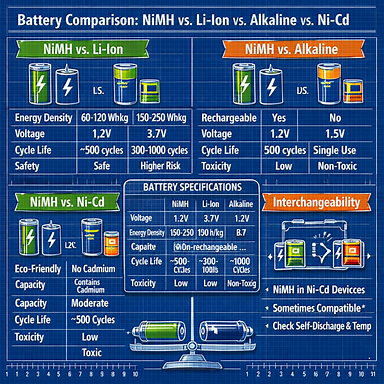
7.1 NiMH vs. Lithium-Ion
Parameter |
NiMH |
Li-ion |
Energy Density |
Medium |
High |
Safety |
Very high |
Moderate |
Cost |
Lower |
Higher |
Cycle Life |
~500 |
500–1500 |
Self-Discharge |
High |
Low |
Applications |
Hybrids, tools |
Phones, laptops |
7.2 NiMH vs. Alkaline
Feature |
NiMH |
Alkaline |
Rechargeable |
Yes |
No |
Voltage |
1.2 V |
1.5 V |
High-Drain Performance |
Excellent |
Poor |
Cost Over Time |
Low |
High |
7.3 NiMH vs. Ni-Cd
Feature |
NiMH |
Ni-Cd |
Toxicity |
No cadmium |
Contains cadmium |
Energy Density |
Higher |
Lower |
Memory Effect |
Minimal |
Significant |
Cycle Life |
Moderate |
Very high |
7.4 Interchangeability with Ni-Cd
NiMH cells can replace Ni-Cd in many applications, but differences in self-discharge, charging profiles, and temperature behavior must be considered.
NiMH batteries remain a scientifically and technologically relevant energy-storage system. Their combination of safety, environmental compatibility, and robust cycling behavior ensures continued use in hybrid vehicles, renewable-energy modules, and consumer electronics. Although lithium-ion technologies dominate many high-energy applications, NiMH chemistry maintains a critical role where durability, safety, and cost-effectiveness are prioritized.
NiMH batteries use nickel oxyhydroxide and metal-hydride alloys to store hydrogen reversibly, enabling safe, stable rechargeable operation. They offer moderate energy density, strong power output, and environmental advantages. Common in electronics, hybrid vehicles, and renewable systems, they balance durability, safety, and cost despite higher self-discharge and lower energy than lithium-ion cells.

 EN
EN