Product Overview
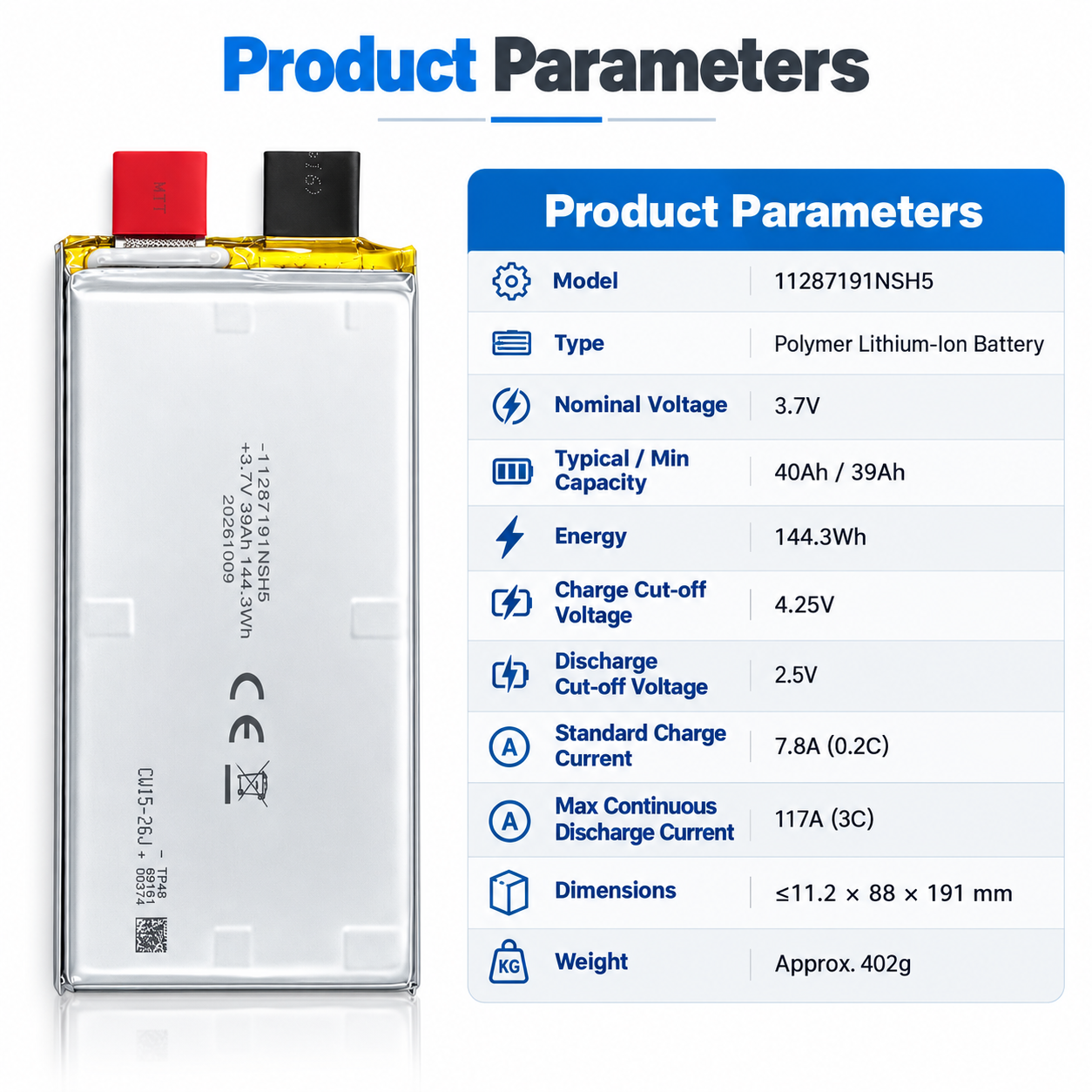
The 11287191NSH5 is designed for engineering teams and battery pack manufacturers seeking a high-capacity LiPo cell rather than a finished drone battery pack.
Its 39Ah minimum capacity and 40Ah typical capacity provide a useful foundation for high-energy battery configurations. At 3.7V nominal voltage, the cell offers 144.3Wh based on its minimum rated capacity.
With a maximum continuous discharge current of 117A and AC impedance below 2mΩ at 1kHz, this cell is a candidate for systems requiring substantial current output. Final performance must be evaluated under the actual operating temperature, discharge profile, and pack assembly conditions.
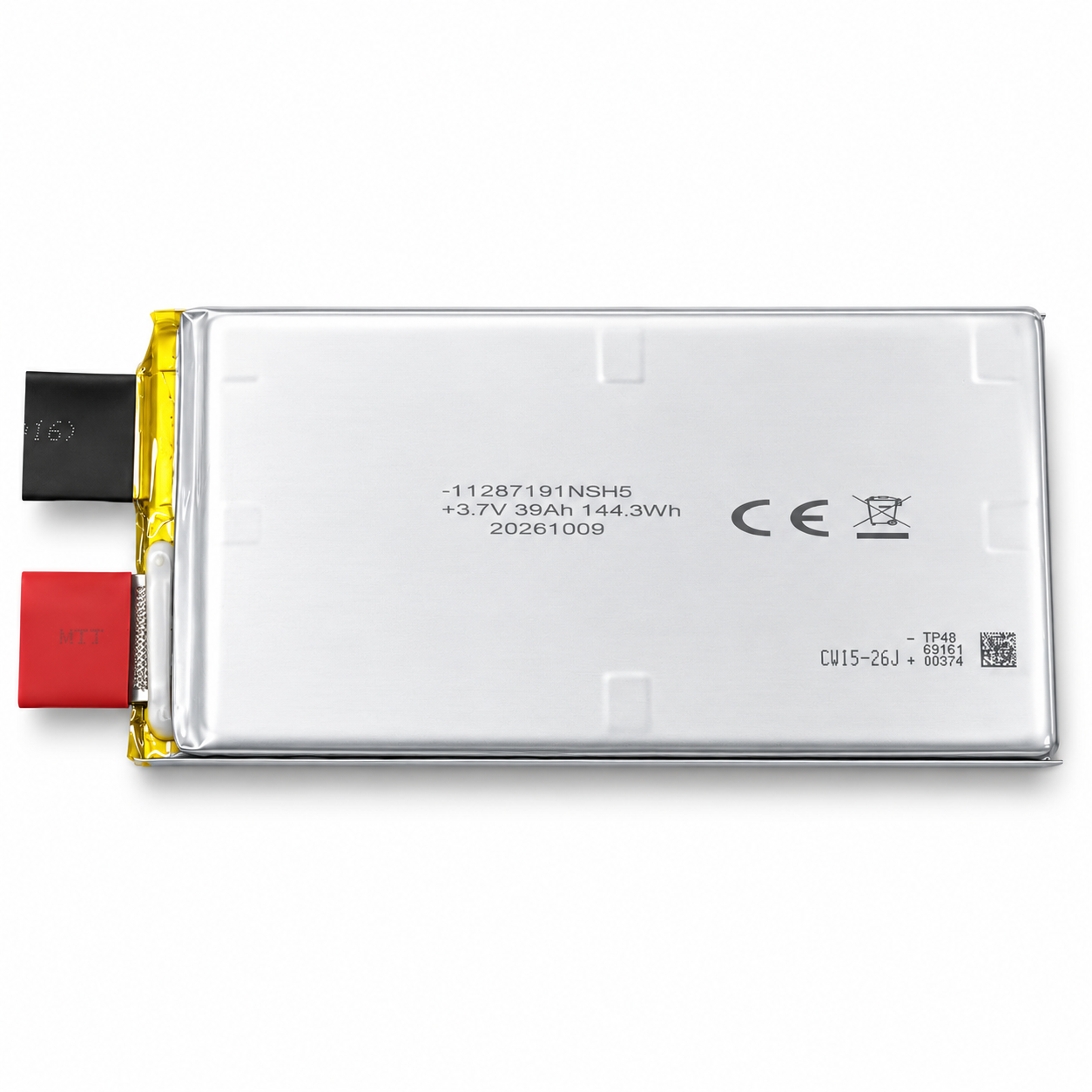
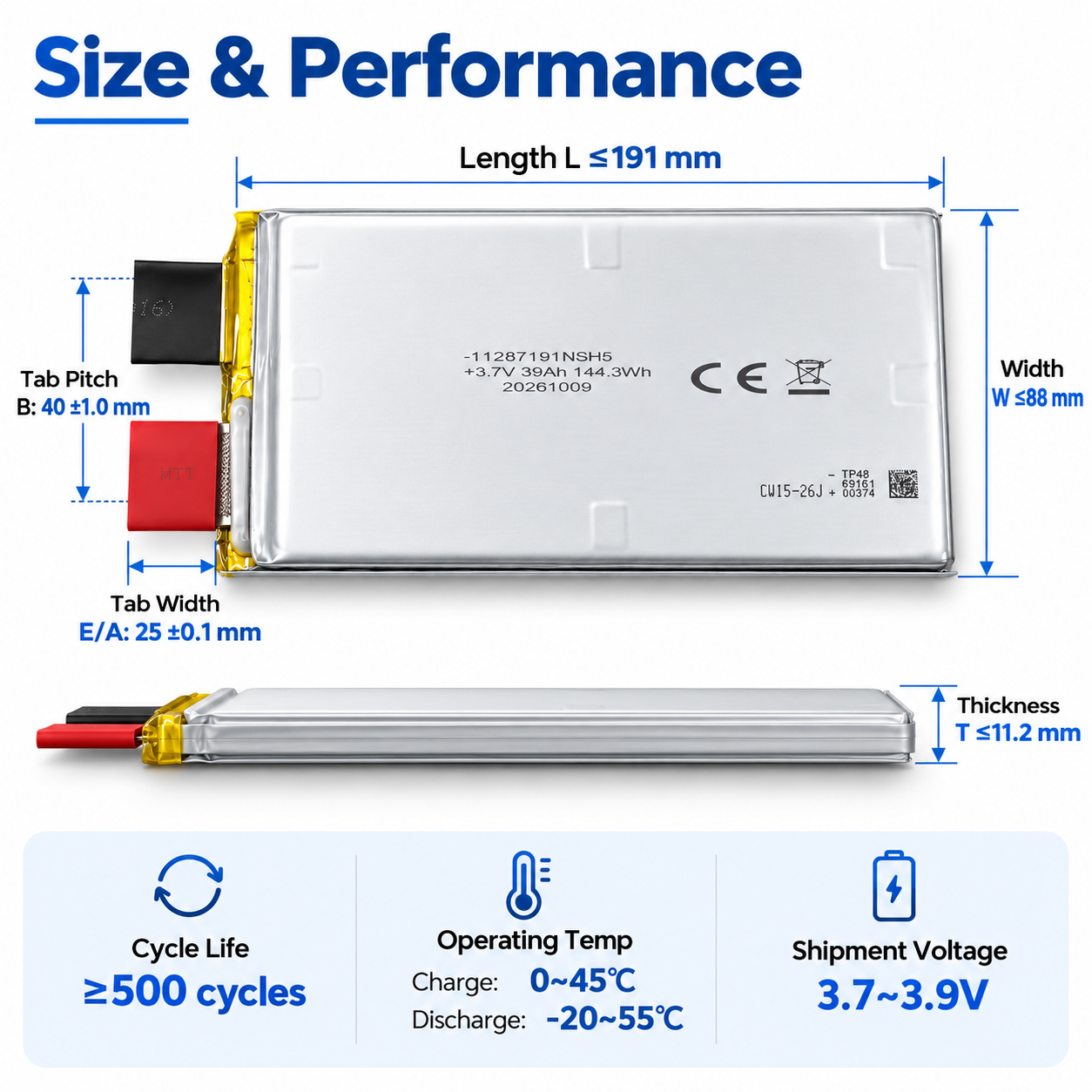
The silver aluminum-laminated pouch measures no more than 11.2mm thick, 88mm wide, and 191mm long. This flat construction can help engineers arrange cells within suitably designed battery enclosures.
Technical Specifications
| Parameter |
Specification |
| Cell Model |
11287191NSH5 |
| Battery Chemistry |
Polymer Lithium-Ion |
| Cell Type |
Rechargeable Pouch Cell |
| Typical Capacity |
40Ah |
| Minimum Capacity |
39Ah |
| Nominal Voltage |
3.7V |
| Nominal Energy |
144.3Wh (39Ah basis) |
| Charge Cut-Off Voltage |
4.25V |
| Discharge Cut-Off Voltage |
2.5V |
| Standard Charging Current |
7.8A (0.2C) |
| Maximum Continuous Discharge |
117A (3C) |
| AC Impedance (1kHz) |
<2mΩ |
| Cycle Life |
≥500 cycles under specified test conditions |
| Dimensions (T × W × L) |
≤11.2 × 88 × 191mm |
| Weight |
Approx. 402g |
| Charging Temperature |
0°C to 45°C |
| Discharging Temperature |
-20°C to 55°C |
Cycle life is based on testing at 25±3°C using the specified 0.2C charge/discharge procedure, with an 80% capacity retention criterion.
Why Choose This 39Ah LiPo Battery Cell?
1. High Energy in a Lightweight Pouch
The cell delivers 144.3Wh of nominal energy with an approximate weight of 402g, corresponding to about 359Wh/kg at the cell level.
For drone battery designers, energy and weight are both important considerations. This cell provides a high-capacity starting point for applications where battery weight, pack geometry, and operating endurance must be balanced.
2. 117A Continuous Discharge Capability
The specified 3C continuous discharge rate corresponds to 117A per cell.
This current capability supports the evaluation of high-load battery pack configurations for suitable UAV systems. Actual current requirements depend on the aircraft's motors, propellers, payload, flight profile, and power electronics.
3. Low AC Impedance
The cell has a specified AC impedance below 2mΩ at 1kHz.
Low cell impedance is beneficial when designing battery systems for substantial current demand, although actual voltage sag and heat generation must be verified through discharge testing and pack-level thermal analysis.
4. 500+ Cycle Life
The cell is rated for at least 500 cycles under the manufacturer's specified test conditions, retaining no less than 80% of its initial capacity at the stated test endpoint.
Actual service life varies with charge rate, discharge current, operating temperature, depth of discharge, and storage conditions.
5. Flat Pouch Structure for Battery Pack Integration
Unlike cylindrical cells, the 11287191NSH5 uses a flat pouch design.
Its rectangular footprint and tab configuration provide another option for engineers developing battery modules where installation space, electrical connections, insulation, mechanical support, and thermal management must be considered together.
Drone Battery Pack Configuration Options
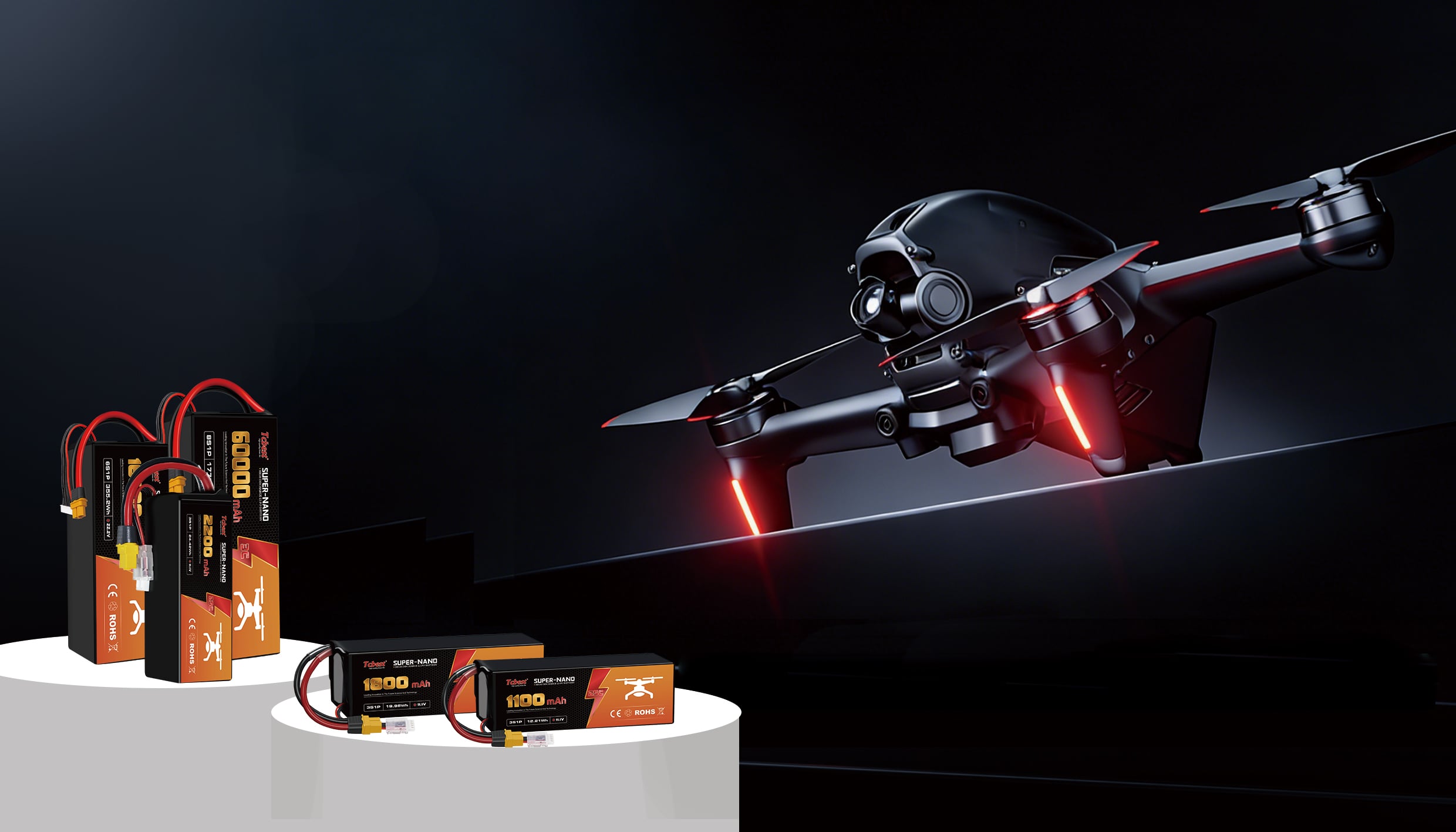
The 3.7V 39Ah LiPo cell can be evaluated for various series and parallel configurations depending on the required pack voltage, capacity, and current demand.
The following examples are theoretical values based on the individual cell's nominal specifications.
| Configuration |
Nominal Voltage |
Nominal Energy |
Cell-Only Weight |
| 6S1P |
22.2V |
865.8Wh |
Approx. 2.41kg |
| 6S2P |
22.2V |
1,731.6Wh |
Approx. 4.82kg |
| 12S1P |
44.4V |
1,731.6Wh |
Approx. 4.82kg |
| 14S1P |
51.8V |
2,020.2Wh |
Approx. 5.63kg |
These are calculation examples, not finished battery pack products. Total pack weight will increase after adding the BMS, busbars, wiring, insulation, connectors, and housing. Pack discharge capability and safety must be validated after assembly.
Mechanical Dimensions and Tab Design
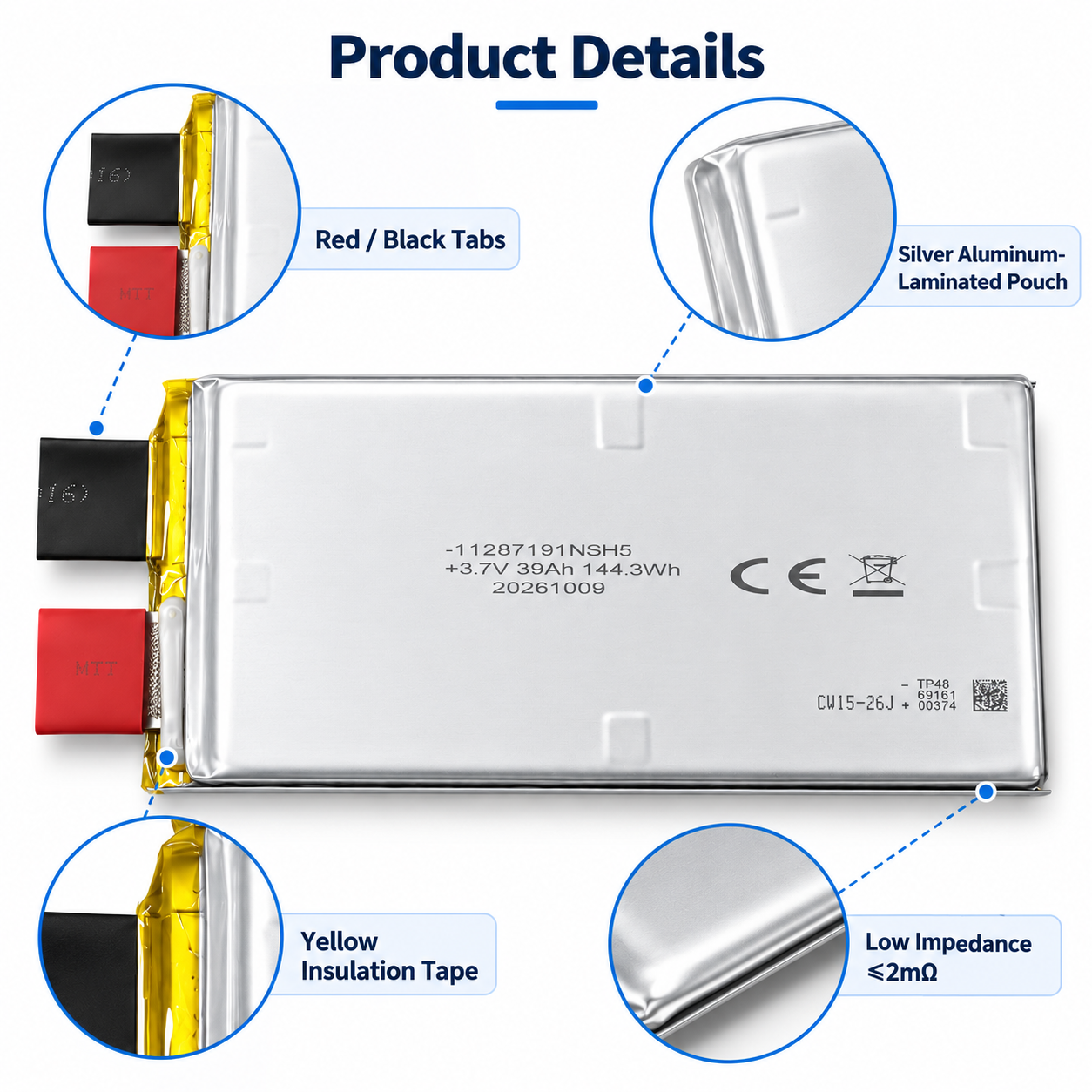
The 11287191NSH5 cell features the following dimensional specifications:
Thickness: ≤11.2mm
Width: ≤88mm
Length: ≤191mm
Positive tab width: 25±0.1mm
Negative tab width: 25±0.1mm
Tab center pitch: 40±1.0mm
The red and black insulated terminal areas are visible in the product photographs, together with the yellow insulating material along the pouch edge.
When designing a battery module, engineers should confirm tab alignment, insulation clearances, welding requirements, pouch swelling allowance, and mechanical support.
Do not short-circuit, puncture, bend, or directly solder onto the battery cell body.
Application Scenarios
Agricultural Drone Battery Packs
Agricultural UAV systems may require high battery capacity and significant current output to power propulsion systems and additional equipment.
This 39Ah LiPo cell can be evaluated as part of a custom battery configuration for suitable agricultural drone designs.
Mapping and Survey UAVs
Aerial mapping and inspection platforms often require careful balancing of battery weight, available energy, and installation space.
The cell's flat pouch construction and nominal energy characteristics can support pack-level design studies for these applications.
Heavy-Lift and Industrial Drones
Industrial multirotor and cargo UAV designs may operate under substantial electrical loads.
The cell's continuous discharge specification makes it a potential component for engineered battery systems, subject to pack-level electrical and thermal validation.
Custom Industrial Battery Modules
Beyond drone applications, the cell can be evaluated for suitably designed rechargeable battery modules requiring a high-capacity lithium polymer pouch format.
OEM/ODM Battery Pack Integration
Tcbest supports inquiries for lithium battery cells and battery pack projects based on customer engineering requirements.
For a custom battery pack quotation, please provide the following information:
Required nominal voltage and capacity
Series and parallel configuration
Continuous and peak current requirements
Battery compartment dimensions
Terminal or connector requirements
Operating temperature and application
Estimated order quantity
Battery pack configuration, protection design, tab requirements, and documentation availability should be confirmed before production.
Protective Packaging
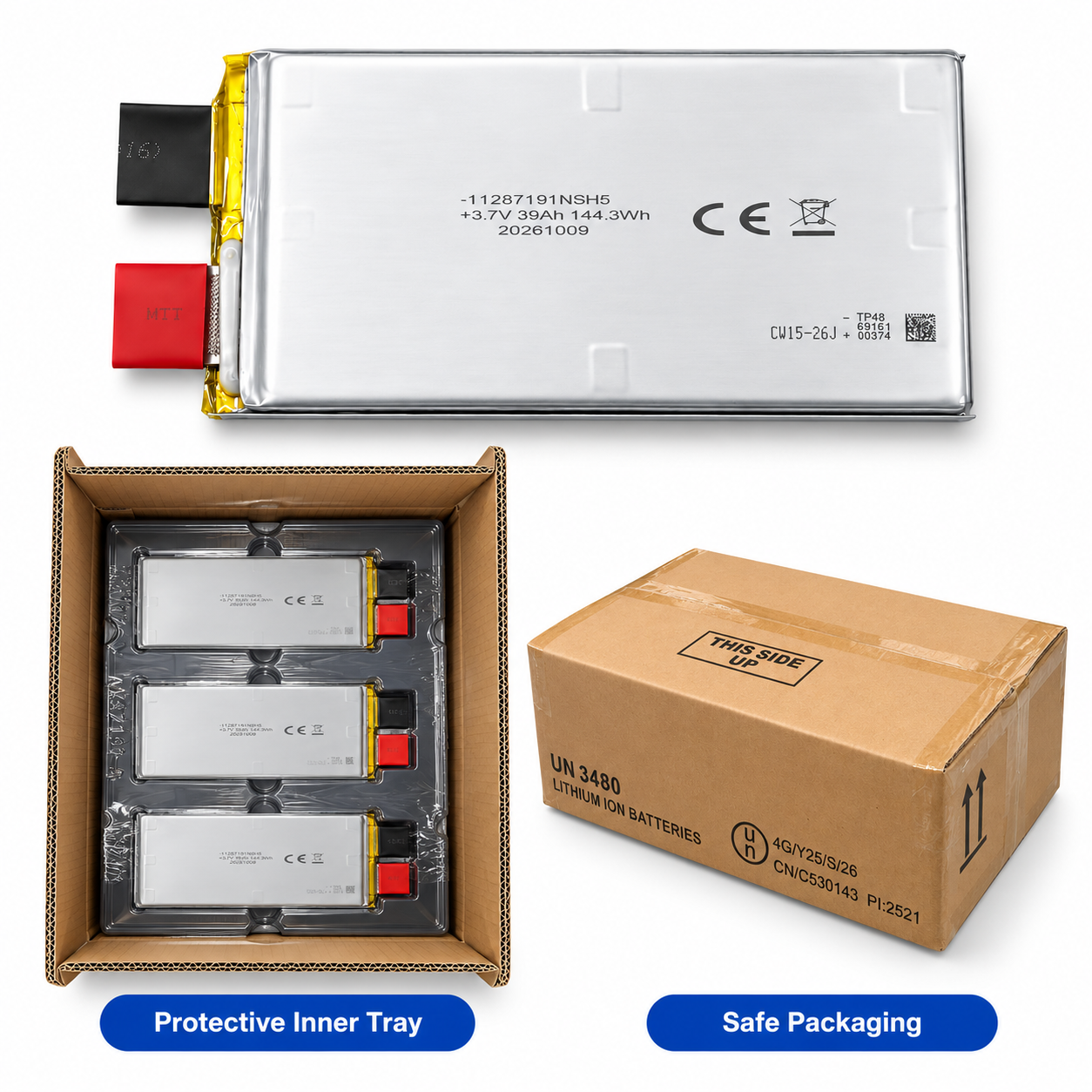
Battery cells are arranged in protective molded trays inside corrugated cartons, as shown in the product packaging photographs.
The packaging arrangement is intended to help keep cells separated and protected during handling and transportation.
Final packing quantity, terminal insulation, outer carton selection, and labeling depend on the confirmed shipment requirements.
Export Packaging and Shipping
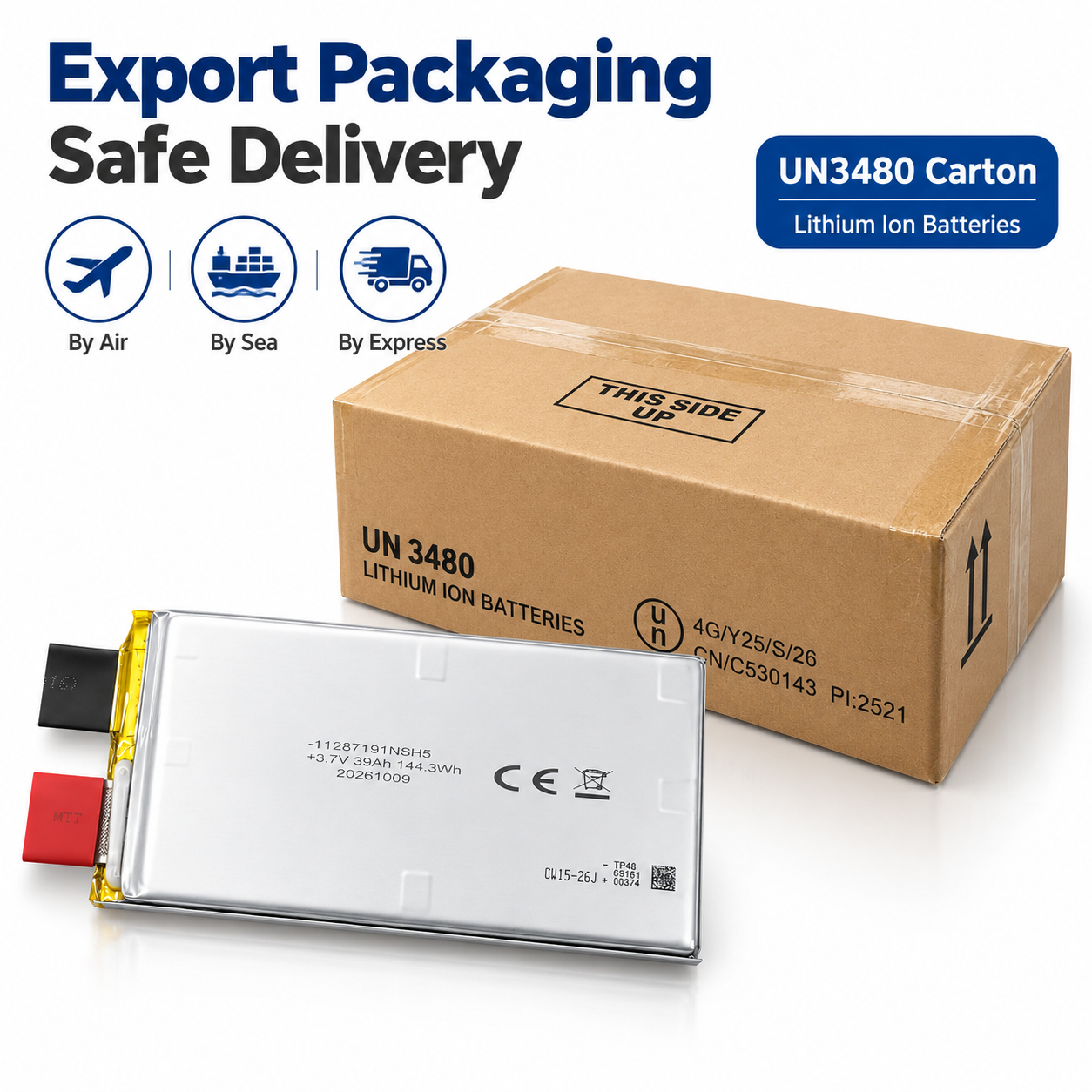
Standalone lithium-ion polymer cells are transported under the applicable UN3480 classification.
The supplied product photographs show a shipping carton with UN3480 markings and protective inner packaging.
International battery shipments require appropriate transport arrangements, documentation, and carrier acceptance. Air, sea, and express shipping options are subject to the applicable dangerous-goods requirements.
Please share your destination country, order quantity, and preferred shipping method so the shipment plan can be reviewed.

 EN