
 EN
EN
Abstract
Unmanned aerial vehicles (UAVs) increasingly operate in cold regions for scientific, industrial, and emergency tasks. However, lithium-ion batteries—the primary power source for most UAV platforms—experience substantial performance degradation when exposed to low temperatures. This paper provides a technical review of the mechanisms responsible for cold-weather battery limitations, including thermodynamic constraints, kinetic slowdowns, and safety risks associated with lithium deposition. The operational consequences for UAV endurance and reliability are examined, followed by an evaluation of mitigation strategies such as thermal management, operational adaptation, and emerging battery technologies. The review highlights the need for integrated thermal-aware design to ensure stable UAV performance in extreme environments.
I. INTRODUCTION
UAVs have become essential tools in applications that require operation across a wide range of climates. In cold environments, however, battery performance becomes a dominant limiting factor. Lithium-ion batteries, widely used due to their energy density and compact form, exhibit strong temperature dependence. When exposed to sub-zero conditions, their ability to deliver power declines sharply, reducing flight time and increasing the likelihood of in-flight instability.
Unlike stationary battery systems, UAV batteries are subjected to rapid cooling, high discharge rates, and continuous airflow during flight. These conditions intensify the effects of low temperature, making cold-weather operation a persistent challenge. Understanding the mechanisms behind this degradation is essential for improving UAV reliability in winter and high-altitude missions.
II. LOW-TEMPERATURE EFFECTS ON LITHIUM-ION BATTERIES
A. Thermodynamic Constraints
At low temperatures, the electrolyte becomes more viscous and ion transport slows. This increases internal resistance and reduces the battery’s ability to supply high current. As a result, UAVs may experience voltage drops during power-intensive maneuvers such as takeoff or rapid acceleration.
B. Kinetic Limitations
Electrochemical reactions at the electrode surfaces proceed more slowly in cold environments. The reduced reaction rate increases polarization and decreases discharge efficiency. Even when fully charged, the battery may deliver only a portion of its nominal capacity.
C. Lithium Plating and Safety Risks
When the anode cannot absorb lithium ions quickly enough, metallic lithium may deposit on its surface. This phenomenon is more likely at low temperatures, especially during charging or high-current discharge. Lithium deposition reduces capacity and increases the risk of internal short circuits.
D. Stored vs. Usable Energy
Cold-weather operation highlights the difference between total stored energy and energy that can be accessed under load. Although the battery may contain sufficient charge, diffusion limitations and voltage collapse prevent full utilization.
III. OPERATIONAL CONSEQUENCES FOR UAV SYSTEMS
A. Reduced Flight Endurance
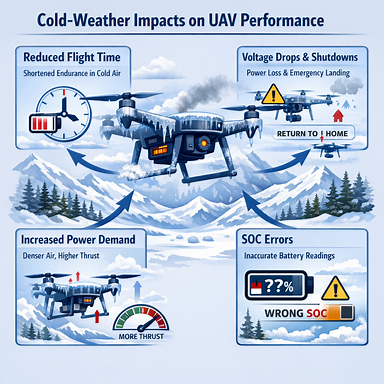
Cold-induced increases in resistance and reduced ion mobility significantly shorten UAV flight time. In many cases, endurance may drop to half of the nominal value, depending on the severity of the temperature and the UAV’s power demand.
B. Voltage Instability and Shutdown Events
Voltage sag is a major operational hazard. During high-power demand, cold batteries may experience abrupt voltage collapse, triggering automatic return-to-home procedures or emergency landings. In extreme cases, the flight controller may shut down entirely.
C. Increased Aerodynamic Power Requirements
Cold air is denser, increasing aerodynamic drag and requiring greater motor torque to maintain lift. This additional power demand accelerates battery cooling and further reduces performance.
D. SOC Estimation Errors
Battery management systems rely on voltage-based algorithms to estimate state of charge. Cold temperatures distort the voltage response, leading to inaccurate readings and sudden drops in reported battery percentage.
IV. SCENARIO-BASED ANALYSIS
A. Polar Research Missions
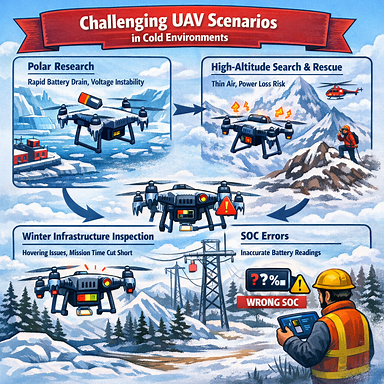
UAVs used in polar environments experience rapid battery cooling and severe voltage instability. Flight endurance is often significantly lower than expected, and emergency landings are common.
B. High-Altitude Search and Rescue
High-altitude missions combine low temperatures with reduced air density. Cold batteries deliver less power, while thin air forces motors to operate at higher speeds, increasing the likelihood of mid-air power loss.
C. Winter Infrastructure Inspection
During power line or pipeline inspection, UAVs must hover for extended periods. Cold batteries struggle to maintain stable voltage during hover, leading to erratic flight behavior and shortened mission windows.
V. MITIGATION STRATEGIES
A. Thermal Management
1) Preheating
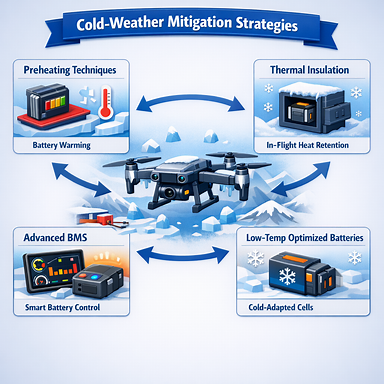
Raising battery temperature before flight is the most effective mitigation strategy. Preheating improves discharge performance and reduces voltage instability.
2) In-Flight Insulation
Thermal insulation slows heat loss caused by wind chill. Lightweight materials can help maintain battery temperature without adding excessive mass.
B. Operational Adaptation
Operational adjustments include reducing payload, avoiding aggressive maneuvers, shortening mission duration, and monitoring battery temperature in real time.
C. Low-Temperature-Optimized Chemistries
Specialized electrolytes and electrode materials can improve conductivity and reduce resistance at low temperatures, enhancing cold-weather performance.
D. Advanced Battery Management Systems
Next-generation battery management systems incorporate temperature-aware state-of-charge estimation, predictive thermal modeling, and adaptive discharge control to improve reliability.
VI. FUTURE RESEARCH DIRECTIONS
A. Solid-State Batteries
Solid-state electrolytes offer improved low-temperature conductivity and reduced lithium plating risk, making them promising candidates for cold-climate UAVs.
B. Self-Heating Battery Designs
Self-heating architectures integrate internal heating elements or thermal-retention materials to maintain optimal temperature autonomously.
C. Hybrid Energy Systems
Combining lithium-ion batteries with fuel cells or supercapacitors enhances resilience across temperature extremes and extends mission endurance.
D. Advanced Thermal Materials
Novel insulation materials and thermal-retention structures may significantly improve battery temperature stability during flight.
VII. CONCLUSION
Cold environments impose substantial constraints on UAV lithium-ion battery performance, affecting energy delivery, voltage stability, and operational safety. These limitations arise from fundamental thermodynamic and kinetic processes that are amplified by UAV flight dynamics. A comprehensive mitigation strategy—combining thermal management, operational adaptation, optimized chemistries, and advanced battery management—can significantly improve cold-weather performance. Future innovations in solid-state batteries, hybrid systems, and thermal materials hold promise for enabling reliable UAV operation in extreme climates.