
 EN
EN
Unmanned Aerial Vehicles (UAVs) have evolved far beyond their origins as hobbyist toys, becoming indispensable assets across industries worldwide. Today, drones are widely deployed in logistics, medical transport, precision agriculture, infrastructure inspection, professional cinematography, and high-speed racing. As these platforms grow increasingly sophisticated in their architecture, the demands placed on their propulsion systems continue to escalate.
Among the many components that make up a modern drone, the battery system is arguably the most critical. Drone battery performance directly determines flight duration, throttle response speed, payload capacity, flight safety, and overall fleet availability. Selecting the right power source is far more than simply fitting a battery pack into the airframe—it is a core engineering decision that can make or break mission success.
This comprehensive guide will delve into the structural mechanisms of modern drone batteries, evaluate the predominant battery options available today, outline clear selection criteria, and provide rigorous maintenance protocols to help you maximize operational efficiency.
Primary Types of Drone Batteries
The drone industry leverages several distinct chemistries to accommodate diverse flight characteristics. Each chemistry offers unique trade-offs in weight, energy capacity, discharge capability, lifespan, and safety.
1. Lithium Polymer (LiPo) Batteries
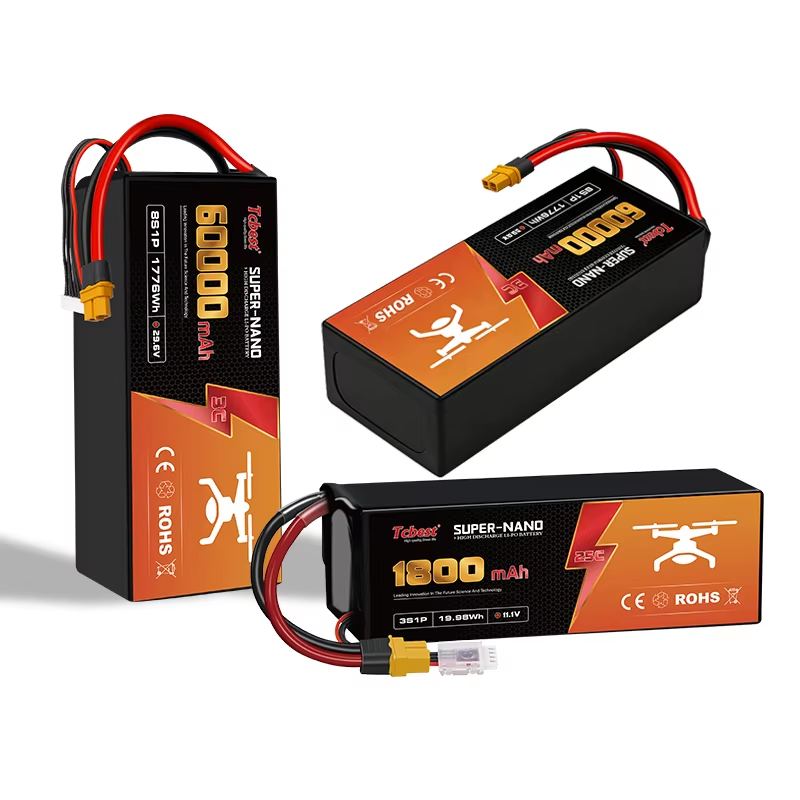
Lithium polymer batteries are the undisputed standard for consumer-grade hobbyist drones, FPV (First-Person View) racers, and high-performance multirotors. Unlike traditional cylindrical cells, LiPo batteries use a gel polymer electrolyte encased in a flexible aluminum foil pouch. This design eliminates the heavy metal casing, maximizing the ratio of active chemical material to total weight.
Advantages:
High energy density: LiPo chemistry compresses substantial electrical energy into an extremely lightweight and compact form factor. This provides the high thrust-to-weight ratio essential for aggressive aerial acrobatics.
Extremely high discharge rates: Measured by "C-rating," LiPo batteries can release their entire charge within minutes without catastrophic voltage sag. This characteristic delivers the instantaneous current bursts required for aggressive acceleration and stability in strong winds.
Form-factor flexibility: Because they use soft foil packaging rather than rigid metal cans, manufacturers can shape them into ultra-thin slices or custom geometries that fit snugly within aerodynamically optimized drone frames.
Disadvantages:
Chemically unstable: The combination of unstable lithium compounds and flammable organic solvents presents a risk of thermal runaway. Puncture, physical impact, overcharging, or severe manufacturing defects can lead to swelling, toxic gas release, or even violent chemical fires.
Shorter lifespan: Even with perfect maintenance, conventional LiPo cells degrade relatively quickly. Operators typically notice significant capacity and performance decline after 200 to 300 charge-discharge cycles.
Strict storage requirements: Leaving LiPo batteries fully charged or completely depleted for more than a few days triggers permanent chemical degradation, structural swelling, and capacity loss. They must be maintained at a very specific storage voltage when idle.
Best Use Cases:
FPV racing, freestyle acrobatic drones, heavy-lift cinema drones requiring instantaneous throttle response, and custom hobbyist builds.
2.Lithium-ion (Li-ion) Batteries
Lithium-ion batteries are the primary power source for long-endurance commercial platforms, surveying drones, and many standardized enterprise and consumer camera drones (such as DJI's Mavic series). Traditionally built in rigid cylindrical form factors (like the common 18650 or 21700 cells), Li-ion technology prioritizes steady, sustained energy output over raw burst power.
The market now features two prominent variants: liquid electrolyte and semi-solid. While liquid Li-ion cells are reliable workhorses, the industry has made a significant shift toward semi-solid Li-ion batteries for industrial applications. By replacing most of the liquid flammable solvent with a stable, highly conductive semi-solid polymer clay matrix, semi-solid cells represent a dramatic leap forward in energy containment technology.
Advantages:
Superior energy density: Standard Li-ion configurations, especially advanced semi-solid variants, offer significantly higher gravimetric energy density (Wh/kg) than standard LiPo batteries. This directly translates to substantially extended flight times per charge.
Extended cycle life: Li-ion cells degrade much more slowly over time. A well-managed Li-ion battery pack can withstand 500 to 1,000 full charge cycles before its capacity drops to 80% of its initial rating, making it far more cost-effective for commercial fleets.
Enhanced thermal safety: Because semi-solid Li-ion batteries lack the freely flowing liquid electrolyte found in conventional cells, they are highly resistant to internal shorts, structural punctures, and thermal runaway propagation.
Disadvantages:
Increased thrust-to-weight ratio: Cylindrical variants use heavy steel or aluminum casings, adding structural dead weight to the drone. Even pouch-based semi-solid variants, due to their inherent chemistry, cannot match the agility of traditional LiPo batteries in acceleration.
Lower current discharge capability: Li-ion batteries have higher internal resistance. They cannot deliver massive instantaneous current bursts (low C-rating). Forcing a Li-ion pack to discharge too rapidly causes significant voltage sag, triggering premature low-voltage warnings and forced landings.
Best Use Cases:
Commercial surveying, long-range mapping, automated agricultural spraying, industrial inspection drones, logistics/cargo drones, and premium consumer camera drones where flight duration is prioritized over aggressive maneuverability.
3.Nickel-Cadmium (NiCd) and Nickel-Metal Hydride (NiMH) Batteries
Nickel-based battery systems represent an older generation of rechargeable power technology. Made from heavy metal alloys, they were the standard for early radio-controlled (RC) aircraft and early multirotor prototypes before the commercialization of lithium-based cells. Today, they are almost entirely obsolete in modern drone workflows.
Advantages:
Extremely robust construction: These cells are mechanically rugged, highly resistant to physical impact, and can withstand severe overcharging or over-discharging without explosion.
Climate-tolerant: Nickel-based chemistries perform exceptionally well in extreme temperature conditions, maintaining nominal output in sub-zero Alpine winters or scorching desert heat.
Disadvantages:
Poor mass density: These battery packs are excessively heavy and bulky relative to the small amount of electrical energy they store. Using NiMH batteries would limit a modern drone to just a few minutes of sluggish flight.
Memory effect: NiCd and NiMH cells suffer from chemical "memory effect." If repeatedly recharged before being fully discharged, they lose the ability to utilize their full capacity, further reducing effective runtime.
Best Use Cases:
Restoration of vintage RC aircraft, stationary ground-control equipment, or highly specialized industrial applications where weight is irrelevant but physical damage is almost certain.
4.Hydrogen Fuel Cells (Emerging Technology)
Hydrogen fuel cells represent the cutting edge of enterprise-level drone propulsion. Unlike traditional batteries that store energy statically within a chemical matrix, fuel cells generate electricity dynamically through an electrochemical reaction between compressed hydrogen and atmospheric oxygen, emitting nothing but pure water vapor as waste.
Advantages:
Revolutionary endurance: Hydrogen systems shatter the "45-minute barrier" that plagues lithium-based multirotors. Drones powered by hydrogen fuel cells can typically achieve continuous flight times of 2 to 5 hours.
Rapid turnaround: Refilling a pressurized, high-strength carbon-fiber hydrogen tank takes less than five minutes, completely bypassing the multi-hour charging bottlenecks associated with large battery packs.
Disadvantages:
Prohibitive cost: The underlying infrastructure—including membrane electrode assemblies, expensive platinum catalysts, carbon-fiber composite storage tanks, and localized hydrogen generation or transport equipment—requires capital investment far beyond standard battery systems.
Extremely complex logistics: Sourcing, storing, and safely handling high-pressure hydrogen tanks requires strict regulatory compliance, specialized transport permits, and dedicated ground-support teams.
Best Use Cases:
Linear infrastructure inspection (power lines and cross-country pipelines) and large-scale maritime search-and-rescue operations.