
 EN
EN
An Analytical Exploration of UAV Power Transport Practices in Contemporary Air Travel
Abstract
As drones become embedded in fields ranging from environmental monitoring to digital cinematography, the practical matter of transporting UAV batteries on commercial flights has gained increasing relevance. Lithium-ion and lithium-polymer batteries, which power most consumer and professional drones, present unique thermal and electrical risks. Consequently, airlines and aviation authorities impose restrictions that vary in detail yet share common structural principles. This paper examines these principles through a technical and practical lens, aiming to clarify how many drone batteries travelers can reasonably expect to carry on a plane. Rather than reproducing regulatory language, the discussion focuses on underlying engineering considerations, cross-airline patterns, and traveler-oriented strategies.
1. Introduction
The rapid expansion of civilian drone use has created a new category of travel challenges. Drone operators—whether hobbyists, researchers, or commercial professionals—often need multiple batteries to sustain field operations. Air travel, however, introduces constraints that are not immediately intuitive. Lithium-based batteries are energy-dense electrochemical systems, and their behavior under stress has led aviation authorities to classify them as potentially hazardous.
This paper approaches the topic from a hybrid academic-technical perspective. It does not attempt to replicate official regulatory phrasing; instead, it analyzes the logic behind existing rules and synthesizes them into a coherent framework that travelers can apply across different airlines and regions.
2. The Technical Basis of Battery Restrictions
2.1 Energy Density and Thermal Behavior
Lithium-ion and lithium-polymer batteries store significant energy in compact form. Under normal conditions, this energy is released in a controlled manner. Under abnormal conditions—mechanical damage, internal short circuits, or exposure to extreme temperatures—the battery may enter thermal runaway, a self-accelerating reaction that can lead to fire.
2.2 Cabin vs. Cargo Dynamics
A key reason airlines prefer batteries in the cabin is not bureaucratic but practical. Cabin crew can respond to early signs of overheating, whereas cargo compartments are isolated environments with limited real-time monitoring. This difference in response capability shapes nearly all battery-transport rules.
2.3 Terminal Exposure and Short-Circuit Risk
Spare batteries, unlike installed ones, have exposed terminals. Contact with metal objects can create a short circuit, generating heat rapidly. This risk explains why airlines require terminal protection and individual packaging.
3. Watt-Hour Categories: A Functional Framework
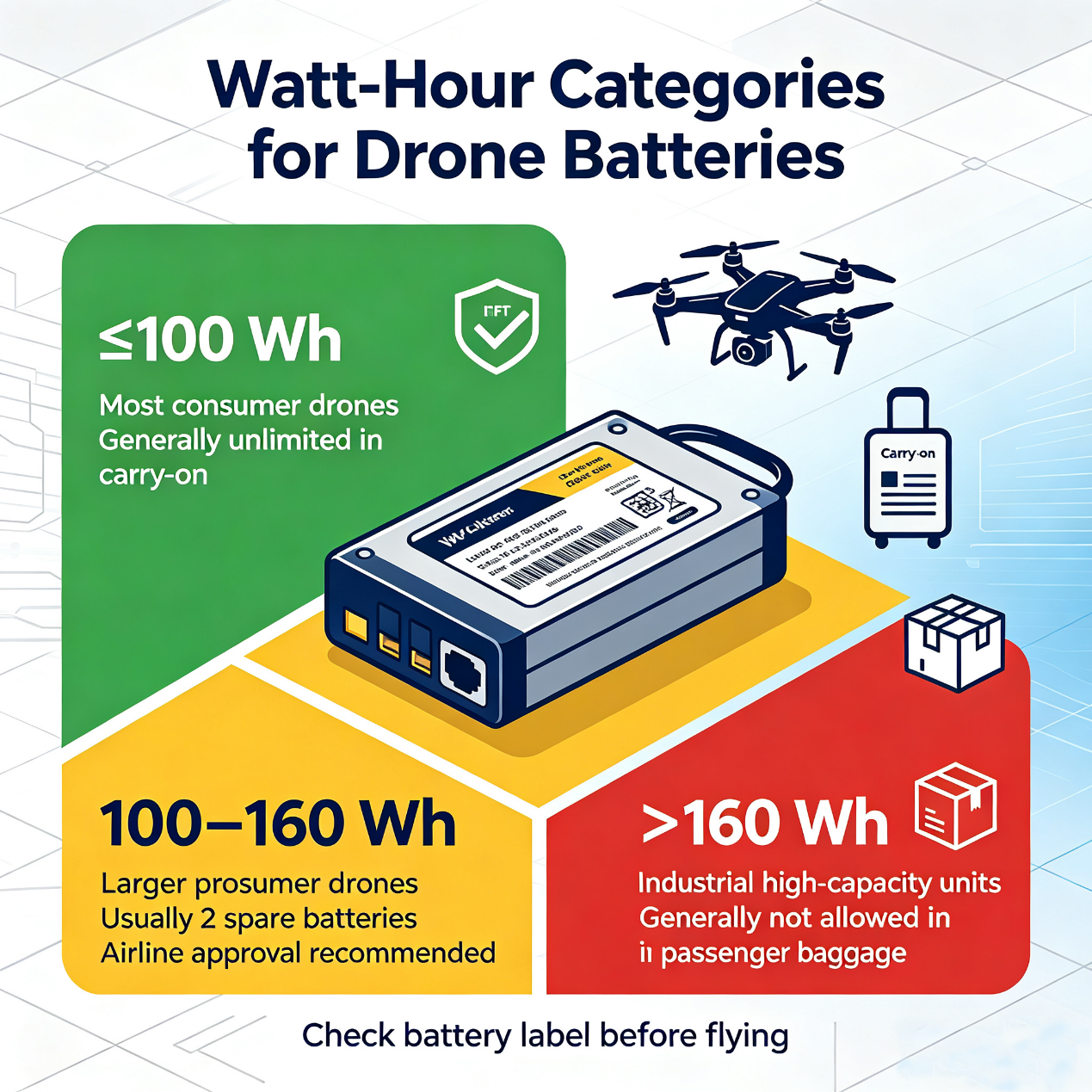
Although airlines differ in their specific wording, most adopt a watt-hour-based classification that reflects the energy and risk profile of the battery.
3.1 Batteries ≤100 Wh
These batteries power most consumer drones. They are considered low-risk within the lithium-battery category and are generally allowed in carry-on luggage without a strict numerical limit. The absence of a limit does not imply infinite freedom; rather, airlines assume travelers will carry quantities consistent with personal use.
3.2 Batteries 100–160 Wh
This range includes batteries for larger prosumer or light-industrial drones. Because of their higher energy capacity, airlines typically allow only two spare batteries per passenger, and many require prior approval. The approval process is not a formality—it ensures the airline can assess the specific battery type and packaging.
3.3 Batteries 160 Wh
Batteries above this threshold fall into a category that airlines generally prohibit in passenger baggage. Their transport requires specialized cargo procedures, including certified packaging and documentation.
4. Installed vs. Spare Batteries: A Practical Distinction
4.1 Installed Batteries
An installed battery benefits from the drone’s physical structure, which shields the terminals and reduces the likelihood of accidental activation or damage. For this reason, airlines often permit one installed battery in checked baggage, though cabin transport remains the safer option.
4.2 Spare Batteries
Spare batteries lack structural protection and therefore must remain in the cabin. The requirement for individual packaging—whether through fire-resistant bags, terminal caps, or original boxes—reflects the need to minimize short-circuit risk.
5. Cross-Airline Patterns Without Official Language
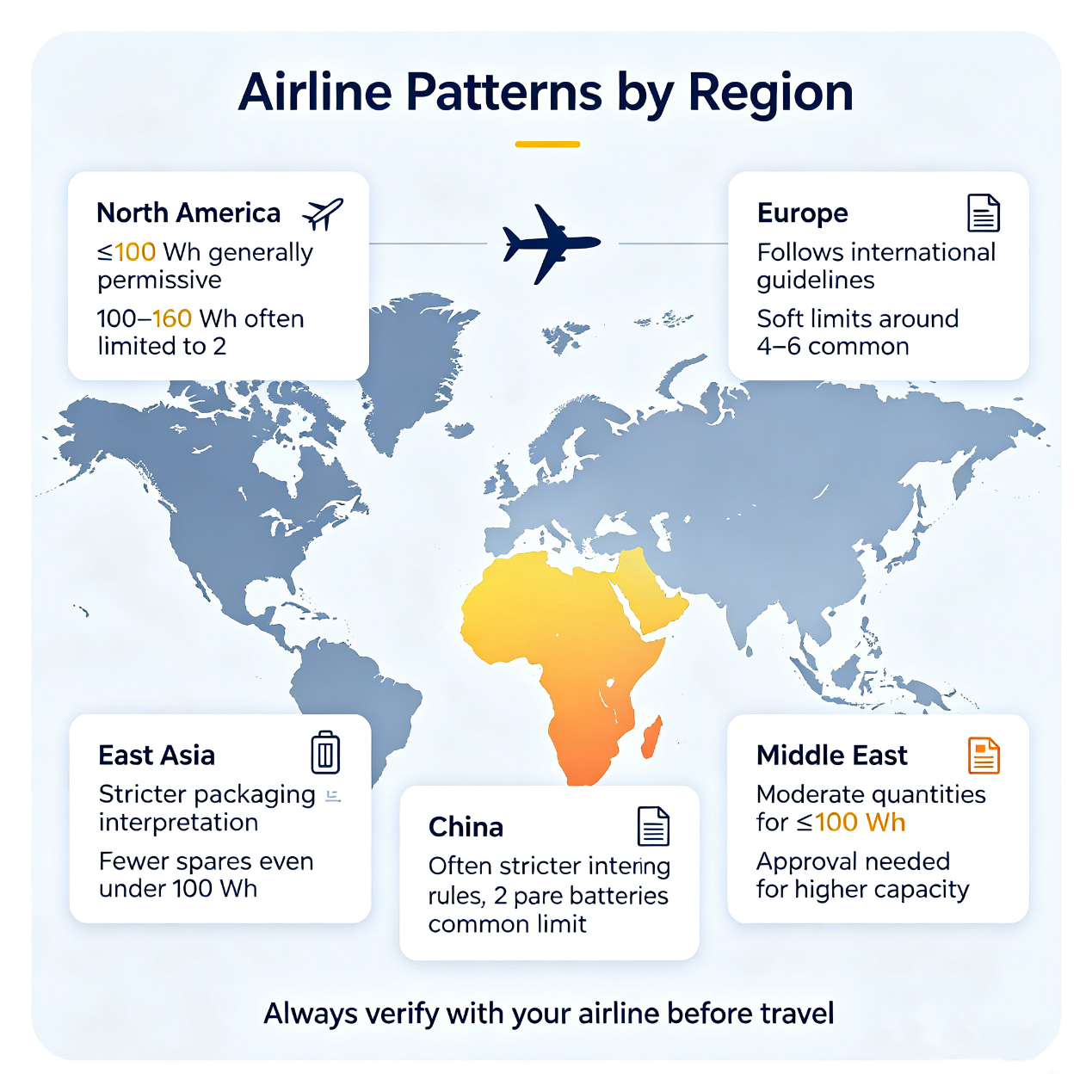
Although airlines phrase their policies differently, several consistent patterns emerge:
5.1 North American Carriers
U.S. airlines generally follow a permissive interpretation for batteries ≤100 Wh and a two-battery limit for the 100–160 Wh category.
5.2 European Carriers
European airlines align closely with international guidelines but may impose soft limits on the number of ≤100 Wh batteries, often ranging from four to six.
5.3 East Asian Carriers
Many East Asian airlines enforce stricter packaging rules and may limit passengers to fewer spare batteries, even within the ≤100 Wh category.
5.4 Chinese Carriers
Chinese airlines often adopt the strictest interpretation, frequently limiting passengers to two spare batteries regardless of watt-hour rating.
5.5 Middle Eastern Carriers
Carriers such as Emirates and Qatar Airways typically allow moderate quantities of ≤100 Wh batteries and require approval for higher-capacity units.
These patterns are not official classifications but empirical observations based on publicly available airline policies.
6. Practical Considerations for Travelers
6.1 Verifying Watt-Hour Ratings
Travelers should confirm watt-hour values printed on battery casings or calculate them manually. This step is essential because airline staff may request verification.
6.2 Communicating With the Airline
For batteries above 100 Wh, contacting the airline in advance is advisable. Approval processes vary, but early communication reduces the likelihood of delays at the airport.
6.3 Packaging Strategies
Effective packaging includes:
- Fire-resistant storage bags
- Terminal covers
- Individual compartments within a hard case
These measures reduce risk and demonstrate responsible handling.
6.4 Charge Level Management
Transporting batteries at partial charge—typically 30–50%—reduces internal stress and is widely recommended by UAV professionals.
6.5 Documentation
Carrying printed or digital copies of airline policies can help resolve misunderstandings during security screening.
7. Case-Based Illustrations
7.1 Recreational Traveler
A hobbyist carrying several 60 Wh batteries on a domestic flight in the United States typically encounters no numerical limit, provided all spares are in carry-on luggage.
7.2 Professional Videographer
A videographer traveling internationally with multiple 95 Wh batteries may face airline-specific limits. Some carriers allow all batteries; others restrict the number to four or fewer.
7.3 Industrial UAV Operator
Operators using batteries above 160 Wh must rely on cargo transport channels. Attempting to bring such batteries as passenger baggage is not permitted.
8. Synthesizing a Practical Answer
Although regulations vary, a functional summary can be constructed:
Batteries ≤100 Wh
- Generally unlimited
- Cabin only
- Terminal protection required
Batteries 100–160 Wh
- Usually limited to two
- Airline approval often required
- Cabin only
Batteries 160 Wh
- Not allowed in passenger baggage
This synthesis reflects global patterns rather than official regulatory language.
9. Ethical and Safety Considerations
Transporting drone batteries responsibly is not merely a matter of compliance. It reflects an understanding of the risks inherent in energy-dense systems and a commitment to protecting fellow passengers. Attempting to circumvent rules—such as hiding batteries in checked luggage—creates unnecessary hazards.
10. Conclusion
Determining how many drone batteries one can take on a plane requires understanding both technical principles and airline practices. While watt-hour thresholds form the backbone of global policy, airline interpretations introduce variability. A traveler who verifies battery specifications, communicates with the airline when necessary, and packages batteries responsibly can navigate these rules with confidence.
The broader implication is that UAV technology, while increasingly accessible, still demands careful handling. As battery technology evolves and drones become more integrated into professional workflows, aviation guidelines may adapt. For now, the practical framework remains clear: ≤100 Wh batteries are generally unrestricted, 100–160 Wh batteries require caution and approval, and anything above 160 Wh belongs in cargo channels.
Drone batteries are restricted by watt-hour ratings: ≤100 Wh are generally unlimited in carry-on; 100–160 Wh require airline approval and are limited to two; 160 Wh must be shipped as cargo. Proper packaging, partial charge, and cabin transport ensure safety and compliance during air travel.
Table of Contents
- Abstract
- 1. Introduction
- 2. The Technical Basis of Battery Restrictions
- 3. Watt-Hour Categories: A Functional Framework
- 4. Installed vs. Spare Batteries: A Practical Distinction
- 5. Cross-Airline Patterns Without Official Language
- 6. Practical Considerations for Travelers
- 7. Case-Based Illustrations
- 8. Synthesizing a Practical Answer
- 9. Ethical and Safety Considerations
- 10. Conclusion