
 EN
EN
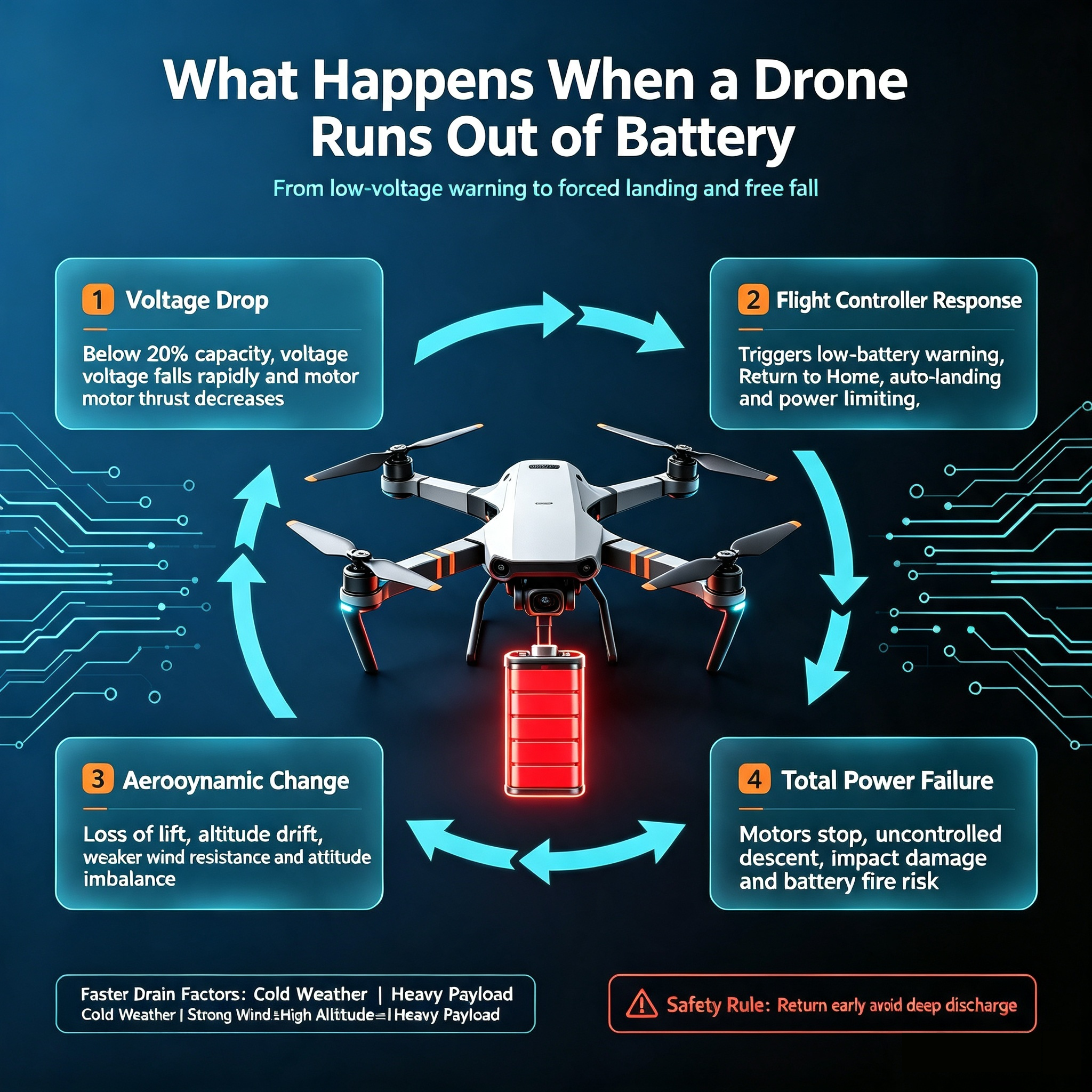
When a drone runs out of battery, the consequences extend far beyond a simple loss of power. The event triggers a complex chain of mechanical, electronic, aerodynamic, and software responses that determine whether the aircraft lands safely, crashes, or becomes unrecoverable. Modern drones incorporate sophisticated battery-monitoring systems, emergency protocols, and predictive algorithms to prevent catastrophic failures, yet battery depletion remains one of the most common causes of drone accidents worldwide. Understanding what happens when a drone’s battery reaches critical levels is essential for safe operation, regulatory compliance, and long-term equipment reliability. This article provides a comprehensive, academically structured analysis of the physical processes, system behaviors, flight dynamics, and operational outcomes associated with battery depletion in drones.
1. Battery Depletion as an Energy Crisis in Flight
Drone batteries supply electrical energy to every subsystem: propulsion, stabilization, navigation, communication, sensors, and onboard computing. As the battery drains, voltage drops progressively, reducing the available power for motors and electronics. Unlike ground-based devices, drones cannot simply “shut down” when energy is low; they must maintain lift to avoid falling. This makes battery depletion an energy crisis rather than a routine event.
Lithium-polymer (LiPo) batteries, the most common power source for drones, exhibit nonlinear discharge behavior. Voltage declines gradually at first, then rapidly once the battery reaches approximately 20–30% capacity. This steep decline can catch inexperienced pilots off guard. When voltage drops below the threshold required to maintain motor speed, thrust decreases, causing altitude loss. If the battery continues to drain, the drone may enter uncontrolled descent.
The battery’s internal resistance also increases as it depletes, especially under heavy load such as high-speed flight or strong wind compensation. Increased resistance causes voltage sag, a temporary drop that can trigger emergency failsafe systems even when the battery still has nominal charge remaining. This phenomenon explains why drones sometimes initiate emergency landing despite showing 15–20% battery capacity.
2. Flight Controller Response to Low Battery Levels
Modern drones incorporate flight controllers that continuously monitor battery voltage, current draw, temperature, and estimated remaining flight time. When the battery reaches predefined thresholds, the flight controller initiates a series of automated responses designed to preserve safety.
2.1 Low Battery Warning Stage
At approximately 25–30% battery, the drone issues a low battery warning. This stage is informational, allowing the pilot to begin returning to the home point. The drone still maintains full maneuverability, but the flight controller may limit aggressive movements to reduce power consumption.
2.2 Critical Battery Stage
When the battery reaches critical levels—typically 10–15%—the drone may automatically initiate Return-to-Home (RTH). The flight controller calculates whether sufficient energy remains to reach the home point. If not, it may override pilot input and begin descending at the nearest safe location.
2.3 Forced Landing Stage
If voltage drops below the minimum required for stable flight, the drone enters forced landing mode. In this stage, the aircraft descends regardless of pilot commands. The motors may reduce speed gradually or abruptly depending on battery condition. Forced landing is designed to prevent total power loss, which would result in free fall.
2.4 Power Cutoff Stage
When the battery reaches dangerously low voltage—often below 3.0V per cell—the flight controller shuts down nonessential systems. If voltage continues to collapse, the motors stop entirely. At this point, the drone falls uncontrolled.
These automated responses vary by manufacturer, but the underlying principle is universal: preserve lift as long as possible while minimizing crash risk.
3. Aerodynamic Consequences of Battery Depletion
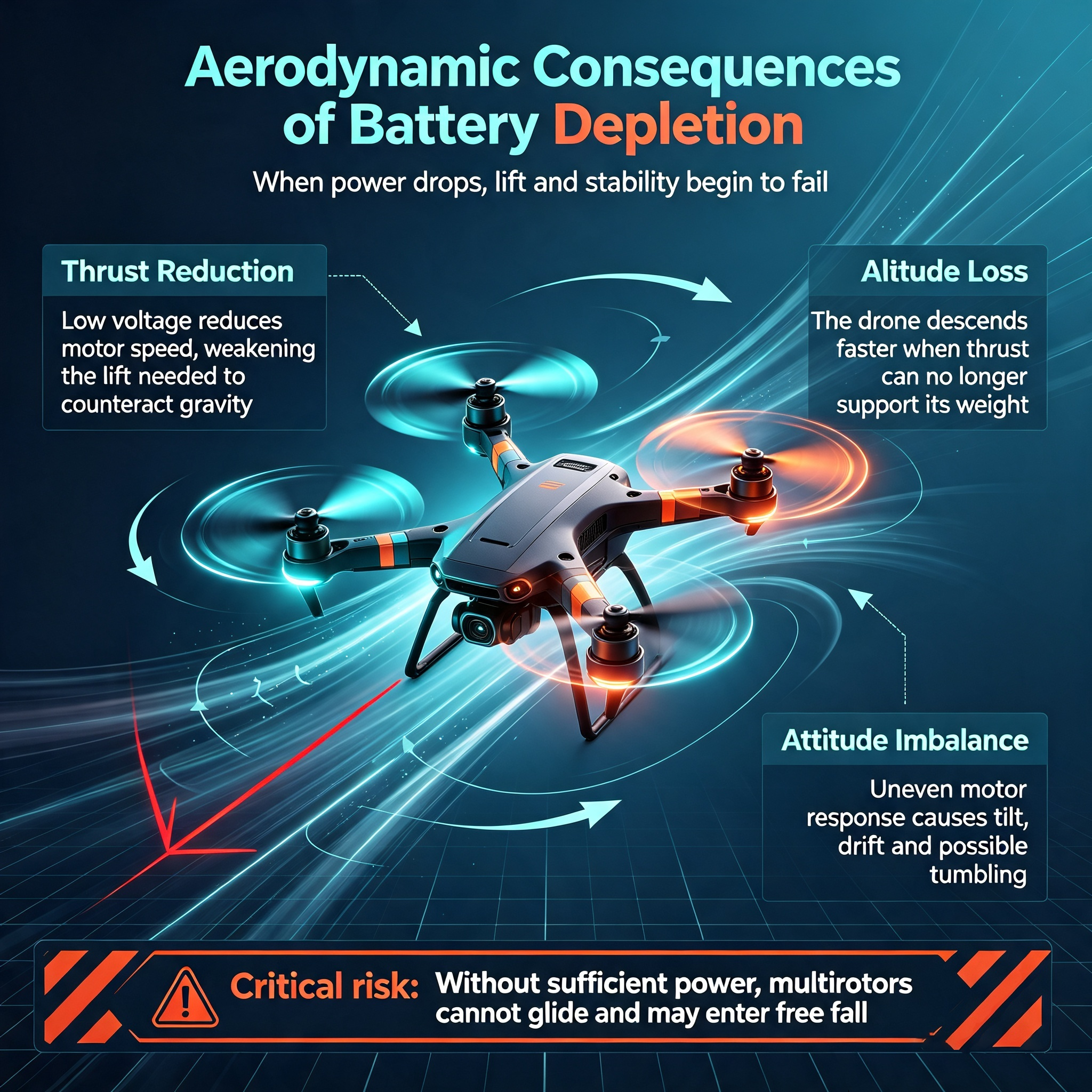
Battery depletion affects drone aerodynamics in several ways. As voltage drops, motor thrust decreases. Multirotor drones rely on precise thrust balancing to maintain stability. Even small reductions in motor speed can cause:
- Altitude loss
- Reduced horizontal acceleration
- Slower braking response
- Increased drift in wind
- Difficulty maintaining hover
When thrust becomes insufficient to counteract gravity, the drone begins descending. If the battery is severely depleted, the descent rate may exceed safe limits, leading to hard landings or crashes.
In extreme cases, one or more motors may lose power before others, causing the drone to tilt sharply. This imbalance can trigger tumbling, spinning, or flipping. Once a drone enters an uncontrolled attitude, recovery becomes nearly impossible without adequate power.
4. Communication and Navigation Failure During Battery Loss
Battery depletion affects more than propulsion. Communication systems, GPS modules, and onboard processors also require stable voltage. As the battery weakens, these systems may malfunction.
4.1 GPS Dropout
GPS modules require consistent voltage to maintain satellite lock. Low voltage can cause temporary loss of positioning data, forcing the drone into ATTI (attitude) mode. In ATTI mode, the drone cannot hold position and drifts with wind.
4.2 Controller Signal Loss
If the communication module loses power, the drone may lose connection with the remote controller. In such cases, failsafe protocols activate, typically triggering RTH or auto-landing.
4.3 Sensor Failure
Vision sensors, obstacle-avoidance cameras, and infrared modules may shut down under low voltage. Without these sensors, the drone cannot detect obstacles or maintain precise hovering.
4.4 Processor Throttling
The flight controller may reduce processing speed to conserve power. This can delay response times, reduce stabilization accuracy, and impair flight performance.
These failures compound the risks associated with battery depletion, making timely intervention essential.
5. What Happens During Complete Battery Failure
Complete battery failure is the most dangerous scenario. When the battery can no longer supply power, the motors stop instantly. Unlike fixed-wing aircraft, multirotor drones cannot glide. They rely entirely on powered lift. Without motor thrust, the drone enters free fall.
5.1 Free Fall Dynamics
During free fall, the drone accelerates downward at approximately 9.8 m/s². Air resistance slows the descent slightly, but impact forces remain severe. The drone may tumble unpredictably, increasing the likelihood of structural damage.
5.2 Impact Consequences
Impact damage varies depending on altitude, surface type, and drone design. Common damage includes:
- Broken arms
- Cracked frame
- Damaged motors
- Destroyed gimbal
- Battery rupture
- Propeller shattering
In some cases, the battery may burst or ignite upon impact due to internal short circuits.
5.3 Post-Crash Battery Hazards
A battery that fails mid-air may be swollen, overheated, or leaking. Handling such a battery requires caution. It should be isolated, placed in a fireproof container, and disposed of according to hazardous waste guidelines.
6. Smart Battery Systems and Predictive Algorithms
Modern drones use smart batteries equipped with microcontrollers that monitor:
- Voltage
- Current
- Temperature
- Cell balance
- Estimated remaining flight time
- Charge cycles
- Health status
These systems communicate with the flight controller to provide real-time data. Predictive algorithms estimate whether the drone can complete its mission and return safely. If calculations indicate insufficient power, the drone may automatically shorten the mission or initiate RTH.
Smart batteries also prevent over-discharge by shutting down before voltage reaches damaging levels. This protects battery health but can cause sudden power loss if the drone is far from home.
7. Environmental Factors That Accelerate Battery Depletion
Battery depletion does not occur in isolation. Environmental conditions significantly influence discharge rate and voltage stability.
7.1 Cold Weather
Low temperatures reduce battery chemical activity, causing voltage sag and reduced capacity. Drones may experience sudden power drops in cold environments.
7.2 High Wind
Wind increases motor load, accelerating battery drain. Voltage sag becomes more pronounced during aggressive wind compensation.
7.3 High Altitude
Thin air reduces propeller efficiency, requiring higher motor speeds to maintain lift. This increases power consumption.
7.4 Heavy Payloads
Carrying cameras, sensors, or delivery packages increases thrust requirements, shortening flight time.
Understanding these factors helps pilots anticipate battery behavior and avoid depletion.
8. Emergency Protocols When Battery Runs Out
When battery levels become critical, drones activate emergency protocols:
- Automatic Return-to-Home
- Automatic landing
- Forced descent
- Power prioritization
- Motor speed reduction
- Warning alarms
- Controller vibration alerts
These protocols aim to prevent uncontrolled crashes. However, they cannot compensate for severe battery depletion or environmental challenges.
9. Long-Term Effects of Battery Depletion on Drone Health
Repeated deep discharges damage battery cells, increasing internal resistance and reducing capacity. Over time, the drone may exhibit:
- Shorter flight times
- Increased voltage sag
- Higher risk of mid-air shutdown
- Reduced performance under load
Proper battery maintenance—such as avoiding full depletion, storing at 40–60% charge, and balancing cells—extends battery life.
10. Conclusion
When a drone runs out of battery, the consequences involve complex interactions between electrical systems, flight controllers, aerodynamics, communication modules, and environmental conditions. Battery depletion triggers warnings, emergency protocols, forced landings, and—if unmanaged—complete power loss leading to free fall. Understanding these processes is essential for safe drone operation, mission planning, and equipment longevity. As drones continue to evolve, smart battery systems and predictive algorithms will play an increasingly important role in preventing accidents caused by battery depletion.
Battery depletion reduces voltage, weakens thrust, disrupts navigation, and triggers automated safety protocols. Drones may initiate Return-to-Home, forced landing, or lose power entirely, causing free fall. Smart batteries predict remaining flight time, while environmental factors accelerate drain. Understanding these behaviors prevents crashes and improves operational safety.
Table of Contents
- 1. Battery Depletion as an Energy Crisis in Flight
- 2. Flight Controller Response to Low Battery Levels
- 3. Aerodynamic Consequences of Battery Depletion
- 4. Communication and Navigation Failure During Battery Loss
- 5. What Happens During Complete Battery Failure
- 6. Smart Battery Systems and Predictive Algorithms
- 7. Environmental Factors That Accelerate Battery Depletion
- 8. Emergency Protocols When Battery Runs Out
- 9. Long-Term Effects of Battery Depletion on Drone Health
- 10. Conclusion