
 EN
EN
The honest answer: it depends.
This isn't a cop-out. Two identical batteries, flown by two different pilots on two different builds, in two different weather conditions – the flight time can vary by more than double.
"1300mAh" tells you how much energy the battery can store, but it doesn't tell you how long that energy will last.
What really determines how long a battery lasts is never just about capacity alone.
I. First, a general reference range
If you're just looking for a ballpark figure, here are the typical flight time ranges for common drone types:
Drone Type |
Common Battery |
Typical Flight Time |
5" FPV Freestyle |
4s/6s 1300-1500mAh |
3-6 min |
5" FPV Cruising |
6s/1100-1500mAh |
6-10 min |
3" Cinewhoop |
4s/6s 850mAh |
4-8 min |
7" Long Range |
6S 2200-4000mAh |
10-25+ min |
Consumer Camera Drone |
Smart Battery |
20-40+min |
Note: These numbers assume healthy batteries, reasonable setups, and landing before the voltage alarm triggers.
II. Why does the "same battery" give such different flight times?
Because flight time isn't determined by "capacity" alone. It's the combined result of the following factors:
1. All-Up Weight (AUW)
Every extra gram costs you current. Action cameras, heavy mounts, extra zip ties, and unnecessary cable length – all of these are burning power every second you're in the air.
2. Propeller Efficiency
Aggressive high-pitch props feel snappy, but they draw more current. For cruising, a set of low-pitch, efficient props can easily buy you 2-3 extra minutes.
3. Motor and KV Matching
When motors operate outside their efficient range, energy is wasted as heat. If your motors feel hot after a chill flight, you're paying a "flight time tax" somewhere.
4. Battery Discharge Capability (C-rating / Internal Resistance)
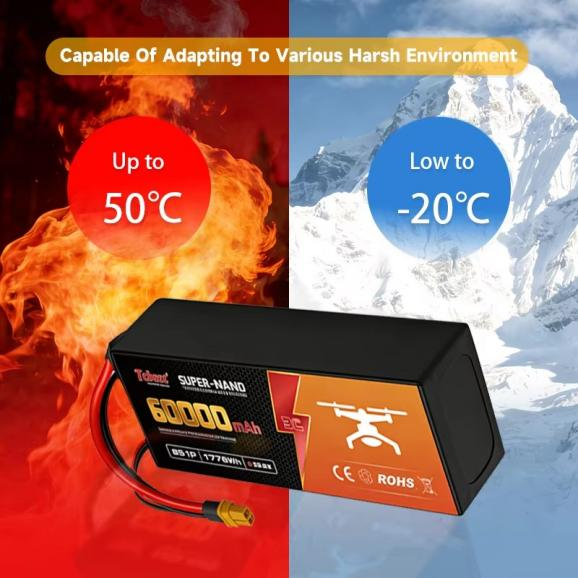
This is the most critical and most overlooked factor. A battery with insufficient discharge capability will experience severe voltage sag under throttle – you might have 30% capacity left, but the voltage has already dropped below the alarm threshold, forcing you to land.
"Energy left but can't use it" – that's the classic symptom.
5. Wind and Speed
Flying into a headwind requires significantly more throttle. On the same route, the difference between a windy day and a calm day can be 20-30% in flight time.
6. Flying Style
Frequent full-throttle bursts and aggressive corrections spike current draw and accelerate voltage sag. Aggressive flying vs. smooth flying – the same battery can give you 2-3 minutes of difference.
7. Tuning and Vibration
Bent props, loose screws, and poor tuning all waste power as vibration. Hot motors are the clearest signal that something is off.
III. Two different "lifespans" – don't mix them up
When people ask "how long does a battery last," they're often referring to two completely different things:
Term |
Meaning |
Typical Value |
Flight Time |
Minutes per full charge |
See table above |
Cycle Life |
Total charge/discharge cycles before performance fades |
~200-300 cycles |
The former depends on setup and flying style. The latter depends on how you treat your batteries.
A battery doesn't "die" overnight. It gradually becomes weaker – more voltage sag, more heat, earlier alarms – and that's how it tells you it's time to retire.
IV. How to get more flight time from your battery
You don't need to turn your quad into a slow glider. Here are practical improvements that buy you extra minutes without ruining the fun:
1. Reduce Weight
This is the highest-return move. Check all your "temporary" add-ons – oversized straps, excess cable length, heavy mounts. Every 30-50g you drop, you'll feel in the air.
2. Keep Two Prop Sets
One aggressive set for freestyle, one low-pitch efficient set for cruising. Try the same battery and the same route with both – the difference will surprise you.
3. Choose the Right Battery, Not Just a Bigger One
Bigger capacity often means more weight, which eats into the gains. The smarter move is to choose a battery with stable voltage and discharge capability that matches your load – this is often more effective than simply chasing higher mAh.
4. Fly Smarter in Wind
Fly the outbound leg into the wind first, and return with the tailwind. If your battery is weaker than expected, you'll find out early – not when you're stuck at the far end.
5. Fix Vibration Issues
Bent props, loose screws, and abnormal motor heat – these are all stealthy flight time killers. Fixing them often yields instant improvements.
V. Pre-purchase checklist
Before clicking "buy" on a new battery, ask yourself these four questions:
Question |
If "Yes" |
Do This First |
Does voltage drop heavily under throttle? |
Battery discharge is insufficient |
Choose a battery with better discharge capability, or reduce load |
Are motors hot after a chill flight? |
System efficiency is off |
Check props, tuning, motor/prop matching |
Did you recently add weight (camera, mount, etc.)? |
Weight is eating your flight time |
Reduce weight or adjust battery size |
Does weather significantly affect flight time? |
Wind/temperature is the main variable |
Pre-warm batteries in cold weather, plan wind legs |
VI. One Sentence Summary
How long a battery lasts depends on "how much energy it has" AND "how you use it."
Capacity sets the upper limit. Your flight habits and setup determine how close you get to that limit.
If you optimize weight, battery matching, props, and flying style – even with the same battery, you'll notice a real difference in flight time.