
 EN
EN
Abstract
Energy storage remains the principal bottleneck in the performance envelope of unmanned aerial systems (UAS). Although significant progress has been achieved in aerostructural optimization, autonomous navigation, and lightweight composite materials, the electrochemical limitations of contemporary battery technologies continue to restrict flight endurance and operational continuity. This article provides a scholarly analysis of drone battery performance, focusing on flight duration, charging dynamics, degradation pathways, and environmental dependencies. By integrating concepts from electrochemistry, aerospace engineering, and systems optimization, the discussion aims to establish a theoretical foundation for understanding the constraints and future trajectories of UAS energy systems.
1. Introduction
The rapid expansion of UAS applications—from precision agriculture and geospatial surveying to emergency response and environmental monitoring—has intensified the demand for reliable onboard energy systems. Unlike manned aircraft, which can leverage high–energy density fuels, electric drones are fundamentally constrained by the specific energy and power characteristics of their batteries. Consequently, the endurance of a drone is not merely a function of airframe design or propulsion efficiency but is intrinsically tied to the electrochemical behavior of its energy storage system.
Academic interest in UAS battery performance has grown substantially, driven by the need to quantify energy consumption models, predict degradation, and develop hybrid or next-generation storage solutions. This article synthesizes current knowledge to provide a rigorous examination of flight and charging durations within the broader context of UAS energy system design.
2. Battery Chemistries in UAS: Electrochemical Foundations
2.1 Lithium Polymer (LiPo) Systems
LiPo batteries dominate multirotor UAS due to their high specific power and ability to sustain elevated discharge rates. Their polymer electrolyte architecture reduces mass and allows flexible form factors, which is advantageous for compact airframes.
From an electrochemical perspective, LiPo cells exhibit:
● High C-rate tolerance, enabling rapid current extraction without severe voltage sag
● Low internal impedance, improving transient response during thrust adjustments
● High gravimetric power density, essential for lift-intensive multirotor platforms
However, LiPo systems are susceptible to electrolyte decomposition, dendrite formation, and thermal instability. These degradation pathways reduce cycle life and impose strict requirements on charging and storage protocols.
2.2 Lithium-Ion (Li-ion) Systems
Li-ion batteries, particularly those employing NMC or NCA chemistries, offer higher specific energy and improved cycle stability. Their electrochemical stability makes them suitable for fixed-wing UAS and long-endurance missions where sustained power, rather than peak power, is the primary requirement.
Key advantages include:
● Superior energy density, enabling extended mission durations
● Lower self-discharge, beneficial for intermittent deployment
● Enhanced structural robustness, reducing mechanical failure risk
Their lower peak discharge capability, however, limits applicability in high-thrust or highly dynamic flight regimes.
3. Flight Duration: A Multivariate Energy Consumption Model
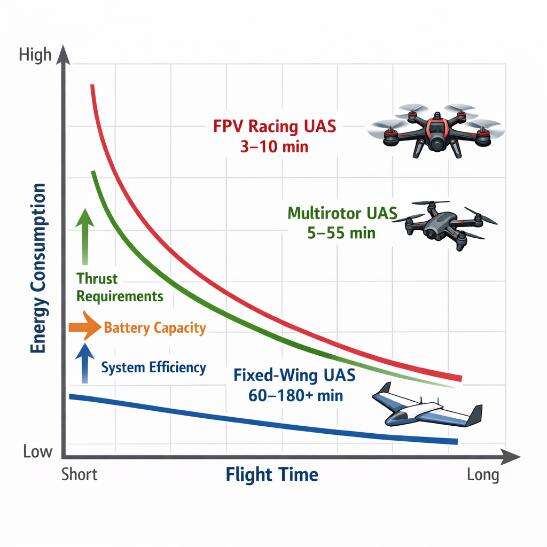
Flight endurance in UAS is governed by a complex interplay of aerodynamic, mechanical, and electrochemical variables. Academic models typically express endurance as a function of thrust requirements, battery capacity, and system efficiency.
3.1 Multirotor Platforms
Multirotor UAS require continuous thrust to maintain lift, resulting in high power consumption. Typical endurance ranges include:
● Micro-UAS: 5–15 minutes
● Consumer UAS: 20–40 minutes
● Professional UAS: 30–55 minutes
The endurance ceiling is fundamentally constrained by the quadratic relationship between thrust and power demand.
3.2 Fixed-Wing Platforms
Fixed-wing UAS achieve lift aerodynamically, reducing power consumption significantly. Endurance commonly ranges from 60 to 180+ minutes, depending on wing loading, propulsion efficiency, and battery capacity.
3.3 High-Performance FPV Systems
FPV racing drones exhibit extremely high discharge rates, often exceeding 50–100 C, resulting in flight durations of 3–10 minutes. These platforms prioritize instantaneous power over endurance, making them ideal case studies for high-stress battery behavior.
4. Determinants of Flight Endurance: A Technical Analysis
4.1 Aerodynamic and Mechanical Load
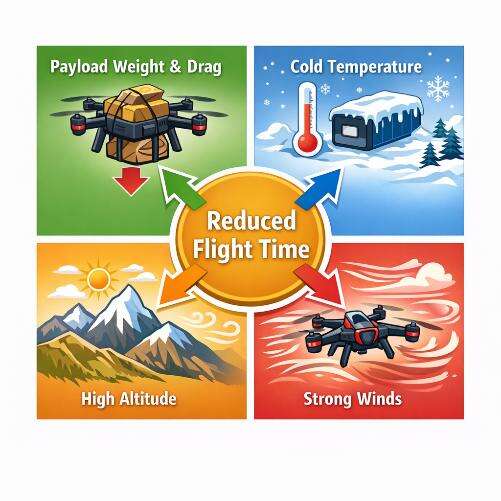
Payload mass increases required thrust, while payload geometry influences drag coefficients. Both factors directly elevate power consumption.
4.2 Environmental Dependencies
Environmental conditions exert measurable effects on battery performance:
● Low temperatures reduce ionic mobility and increase internal resistance
● High altitudes decrease propeller efficiency due to reduced air density
● Wind disturbances require compensatory thrust, increasing energy expenditure
These variables must be incorporated into predictive endurance models.
4.3 Electrochemical Aging
Battery aging manifests through:
● Capacity fade (loss of active lithium)
● Increased internal resistance (SEI layer thickening)
● Voltage instability under load
These factors reduce usable energy and accelerate thermal stress during high-power maneuvers.
5. Charging Duration: Electrochemical and Thermal Constraints
5.1 Standard Charging Regimes
Charging duration is governed by the constant-current/constant-voltage (CC/CV) protocol. Typical charging times include:
● Micro-UAS: 30–90 minutes
● Consumer UAS: 60–120 minutes
● Professional UAS: 90–180 minutes
5.2 Fast Charging Limitations
Fast charging increases lithium plating risk, elevates thermal load, and accelerates degradation. Academic studies consistently show that high-rate charging reduces cycle life due to SEI instability and electrode stress.
5.3 Parallel Charging in High-Performance Applications
Parallel charging is widely used in FPV communities but introduces risks related to voltage imbalance and thermal runaway. Proper balancing and monitoring are essential to maintain safety.
6. Strategies for Enhancing Endurance: A Systems Engineering Approach
6.1 Thermal Conditioning
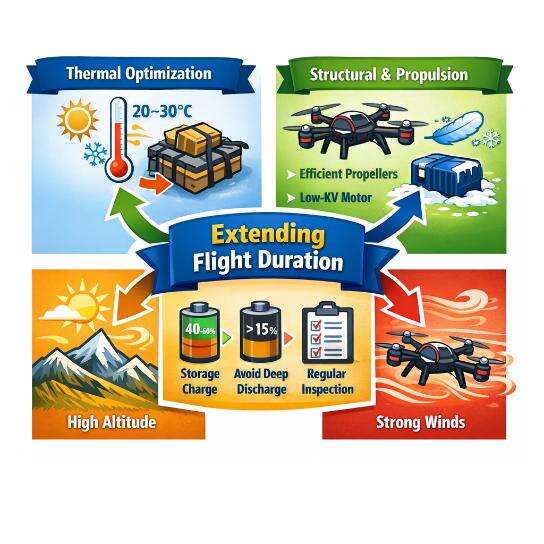
Maintaining batteries within the optimal temperature range (20–30°C) improves ionic conductivity and reduces voltage sag.
6.2 Structural and Propulsion Optimization
● High-efficiency propellers
● Low-KV motors for endurance platforms
● Aerodynamically optimized airframes
These design choices reduce power consumption per unit thrust.
6.3 Battery Management Practices
● Avoiding deep discharge (<15%)
● Storing at 40–60% state of charge
● Minimizing exposure to high temperatures
These practices mitigate degradation and preserve long-term performance.
7. Safety Considerations in UAS Battery Systems
Lithium-based batteries pose inherent risks due to high energy density and flammable electrolytes. Safety considerations include:
● Storage at appropriate voltage to minimize chemical stress
● Regular inspection for swelling or mechanical deformation
● Use of fire-resistant containment during charging and storage
These measures are essential for preventing thermal runaway events.
8. Future Directions in UAS Energy Research
8.1 Solid-State Batteries
Solid-state electrolytes promise:
● Higher energy density
● Improved thermal stability
● Reduced risk of dendrite formation
8.2 Hydrogen Fuel Cells
Fuel cell UAS demonstrate multi-hour endurance, offering a promising alternative for long-range missions.
8.3 Solar-Augmented Systems
Solar-integrated fixed-wing UAS can achieve near-continuous operation under favorable conditions.
8.4 Graphene and Advanced Nanomaterials
Graphene-enhanced electrodes may enable ultra-fast charging and improved thermal performance, though commercialization remains limited.
9. Conclusion
Battery performance remains the defining constraint in UAS endurance and operational efficiency. Through a scholarly examination of electrochemical behavior, environmental dependencies, and system-level optimization strategies, this article highlights the multifaceted nature of UAS energy limitations. Continued research into advanced materials, hybrid energy architectures, and intelligent power management algorithms will be essential for overcoming current endurance barriers and enabling the next generation of high-performance UAS platforms.